I lost my virginity to horror movies at a young age.
While I was brought up on cheery Disney movies as well, my childhood became a cocktail of family-friendly adventures followed by Jell-O shots of guts and gore and guts. The same five-year old stupefied by The Land Before Time would go on to watch the entirety of the Chucky series and the Exorcist before they turned six.
At the elementary school playground, I spoke to friends nurtured by their helicopter parents and felt like I understood something they didn’t. When my friends looked at the woods around the playground, they’d suspect that the area was forbidden because of poison ivy. Through the vast array of fictional mayhem I’d witnessed, I knew the truth: there was a chainsaw-wielding psychopath waiting to greet us behind a tree. The worst became possible. Anything could happen, and that was awesome.
Still, as a lover of the horror genre, I have to say that things aren’t what they used to be. Maybe it’s just the pining of nostalgia (and if that’s the case, I’m only twenty-two, so shit) but I believe that the genre has changed drastically in the last few years.
The chill-factor, the darkness on Halloween night, and the simple notion of a good scary movie; as we drift into the new millennium, I kind of feel like we’ve lost something intrinsic along the way.
Sure, we have a whole array of straight-to-Netflix features. The camera work is crisp. The monsters are generated by computer imagery. But in a world where you can make anything, where you can create a model of some kind of prehistoric, blood-thirsty monster in minutes, do stories lose the potential to be scary?
Recently, I spoke with Andy Elliott, Professor of Theatre Technology at Drew University. In addition, Andy is a die-hard fan of horror films and recently taught a class on the role of zombie flicks in American pop culture. He places the fault of the loss in scare factor not to the writers but to the reflection of the audience.
“In short, horror films are not as scary as they used to be,” Elliott says. “However, the reason isn't bad writing, so much as it is our over-exposure to the horrific. We let our thirteen-year-old watch The Exorcist recently. At the end of it, she said that it bored her. When it was released, this movie absolutely terrified the audience.”
He brings up a valid point. In a world where terrorist attacks occur every day, where mass deaths are distilled into one-hundred eighty characters in a tweet, perhaps we’re getting harder to scare.
In the seventies and eighties, we had a barrage of “slasher films” or “dead teenager” movies. Think along the lines of high schoolers on road trips through the Midwest getting dispatched one-by-one. Perhaps the Peeping Tom with the chainsaw isn’t scary now. He’s been overshadowed by more literal threats in our daily lives.
Still, Elliot doesn’t let the writers off the hook. He thinks they may be trying too hard to humanize their monsters.
“Current producers of horror feel the need to give us an explanation of why the horror is happening,” he explains. “In my opinion, this need to explain kills horror. Two great examples are the remakes of Nightmare on Elm Street and Halloween. The originals are considered paragons of the horror genre. The remakes both tried to explain why their villains became monsters. Michael Myers was an abused and bullied child and Freddy Krueger was a molester who was unjustly slain by vindictive parents. This humanized the monsters. Before, they were unstoppable evils….”
But isn’t it the task of a writer to humanize their characters? To make sure they’re fleshed-out and believable? Maybe it’s a two-sided coin. If we humanize them completely, we’re left with nothing to be scared of. Can we really turn Freddy Krueger into a tragic figure like Disney’s Beast turning back into a Prince? Imagine you’re being chased in a cornfield by a homicidal maniac with a pair of hedge clippers. Would it really change how you felt about them if you knew they had sand kicked into their faces as children?
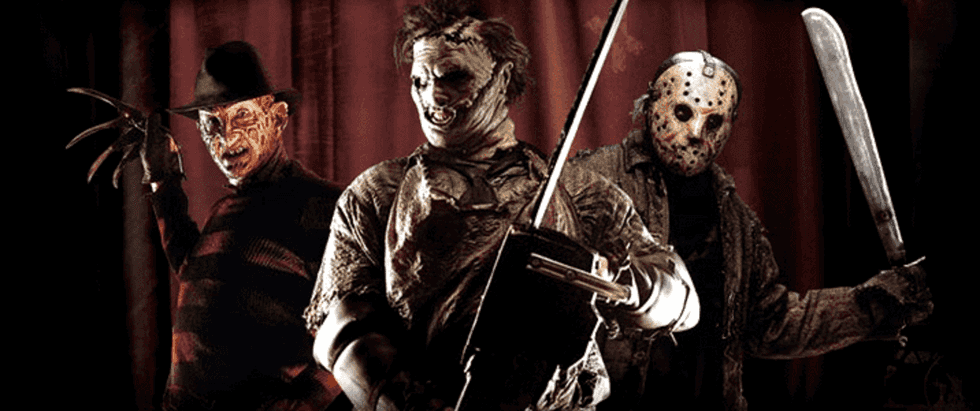
When Elliott thinks back to the “good-old-days” of horror films, he brings up the seventies and the early eighties. This included classics like The Exorcist, Friday The 13th, Halloween and Alien. He notes how these films are so ingrained into our culture, that we may have become desensitized.
“Jason, Michael, the Xenomorph, and Leatherface have all become cultural touchstones,” he says. “It's hard to be afraid of them because we see them everywhere."
So then what was the catalyst? If something in the horror genre changed, can we really blame terrorism and pressing social issues alone? Elliott thinks there may have been other causes.
“Technology has definitely affected the genre in a negative way, which is unfortunate,” he says. “The advances in technology have created a reliance of spectacle and "jump scares" rather than creating situations and stories that are truly frightening.
It goes back to the point about creating a monster. Nowadays, with a decent program, you can create the most frightening behemoth to walk the face of the Earth. Years ago, artists needed to tinker with puppetry and animatronics to make something believable and frightening. At this point, there’s eleven-year olds intelligent enough to create these monsters on their tablets and computers.
In horror movies, computer-generated imagery is like a fresh mound of clay, because you can make anything with it. But when we can assemble monsters on a conveyor belt and acknowledge them with the indifference of, “Oh, look, it’s something you could make on Photoshop,” then what are we supposed to be scared of?
And, of course, how much of this is really nostalgia? Are we just looking to the classics with rose-tinted glasses? Are younger audiences today seeing something entirely different?
From what I’ve seen, many kids actually regard some of these scary movies with humor, or at least more humor than my friends did back in the day. When I showed one of my friends The Exorcist as a child, he cried and had to be picked up by his parents. When my eight-year-old cousin saw it, he laughed as Reagan vomited up pea soup and found it hilarious.
Maybe it’s not that the genre’s fading. It’s just Hollywood’s inability to as of yet really latch onto the next big thing.
So, what are we really scared of? In this age of social media, inter connectivity and eyes glued to our phones, what rattles and unsettles us? We’re still waiting on the answer. Maybe we won’t know until it sneaks up on us, so unexpected and unaware.
In the meantime, Elliott has mixed thoughts on the future of the horror genre in the next twenty years.
“Honestly, I don't see it changing,” he says. “The film industry has to walk a fine line. If they make something truly terrifying, they risk alienating an audience. Time has become increasingly more concerned with box office sales at the expense of storytelling. What I would hope for is that the next generation of horror writers and directors return to the development of good stories and that sense of the ineffable.”