


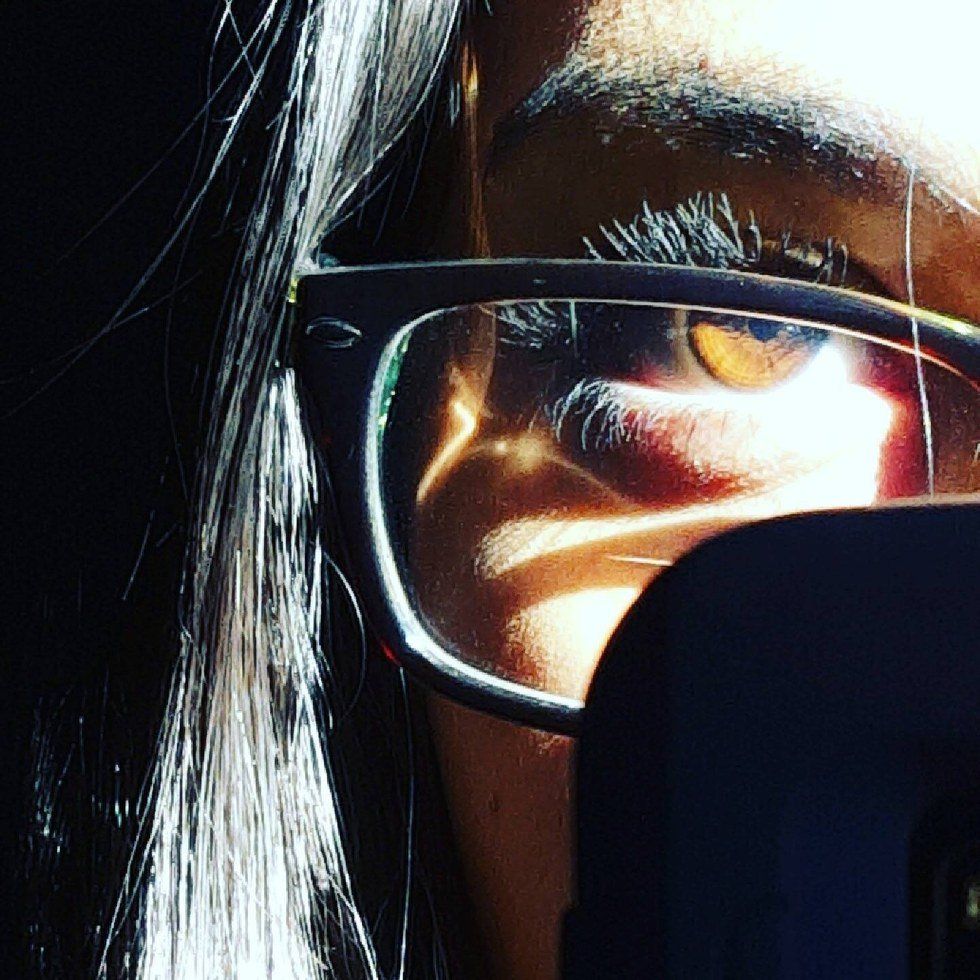
When I was ten years old, I remember receiving my first iPod which granted me web search enabling capabilities. I remember using the Google app rigorously every day. I always found something new to search. Some of the main topics I would search were things like "how do I lose weight fast?" "How do I make my boobs grow bigger, faster?" "How do I get the cool kids to like me, too?" I have always been concerned about societies perception of me and my body for as long as I can remember. Growing up, I can see how these innocent searches ultimately affected me as I got older. Now, as I listen to my seven-year-old sister talk to me about how she "wishes she could look as pretty as sissy" or "I wish I could dress like all of the other girls," I have begun to really understand how the media's perceptions of beauty have affected young girls in our modern day society.
“I don’t mind being burdened with being glamorous and sexual. Beauty and femininity are ageless and can't is contrived, and glamor, although the manufacturers won't like this, cannot be manufactured. Not real glamor; it’s based on femininity,” Marilyn Monroe. This quote gives us an outlook through the perspective and portrayal of beauty for femininity through all women in the United States in the mid-1900s. Marilyn, just like many women today, was ridiculed greatly for her projected body image which was manipulated and altered by the media. She fought vicariously for the appropriation of natural, feminine beauty. Marilyn’s issue with media portrayal leads me to today's problems through the beauty industry and the effects that media has on it. How does the world see beauty in young women and how does the media effect this daily perception?
To introduce the topic, an article entitled “The Images of Beauty Are Unrealistic and Hurt Women” focuses on examples of how unrealistic standards of beauty in our culture and media are greatly effecting the younger and older women of our generation. The article gives us vivid descriptions of events that have caused outrageous acts of protest for a woman’s right to live naturally beautiful rather than artificially projecting beauty by corporate and manufactured materials that normalize high beauty standards. This chapter stresses the importance of the projection of natural beauty in all women. The author of this chapter, Kirsten Anderberg, briefly states, “We are being brainwashed to hate our bodies so that we can buy unnecessary products to remedy them, and waste endless hours on artificial beauty.” This statement reflects that the media is wrongfully degrading our femininity to a sort of secret that we must hide. It also depicts that we, as women and young girls of this new generation, are allowing the media to portray our beauty in an unrealistic fashion and that we are allowing it to destroy our sense of dignity and self-love. The article states, “Women are reduced to size, told to be less, told to shed big chunks of themselves for acceptance.” This statement discusses another heavy topic where we are faced with facts about the media’s ultimate effects on women who do not “meet” the media’s structured stigma on biological beauty—women who have more weight on them. Society has heavily discussed the sensitive topic of women with extra weight and how the media has portrayed them to apparently not be beautiful, but rather a target for billion dollar weight loss commercials that use skinny women to make the other women feel bad about themselves, as the poster children for their derogatory companies.
In another article called “Altered Fashion Magazine Photographs Contribute to Unrealistic Body Images” the author, Vivian Diller, focuses on the effects that photoshop has on the younger feminine society and how the media's abuse of photoshop combined with the stigmas of gender beauty standards are effecting the way that we judge others and ourselves. The use of photoshop can create phenomenal images of beauty, but it's not authentic beauty. The waistlines are trimmed too thin, necks exaggeratedly stretched out, flaws airbrushed cleanly away and abs flawlessly pasted, sculpted unrealistically onto human bodies captured by digital devices. These images are created to be published in beauty magazines and advertisements all around the world. Jessica Bennet, a publisher for The Daily Beast, states, “It doesn't take a genius to see that [magazines are] creating a standard of beauty that’s far from what the average American reader can attain.” Photoshop is the ultimate basis behind all beauty stigmas. From digital manipulation and photoshop, animated movies, to unrealistic clothing designs, the media has changed the way that we see beauty today.
Upon researching this particular topic, I decided to capture the voices of a few local high school teens and even a recent college graduate who all have faced media discrimination on the topic of "beauty." My first choice was a girl named Sharon from a local high school who spoke on what "beauty" means to her:
"Beauty to me isn't judged by appearance. You can have it all on the outside, but if you're intellectually shallow, you're not worth knowing. Inner beauty is what lasts lifetimes. When you die, people aren't going to remember you for how great you looked in your high waisted shorts and red lipstick; inner beauty is something that you just can't forget about someone. It's impactful. People do change people. I feel like media plays a huge role in how beauty is perceived by this generation. I look at people like the Kardashians and I feel sorry for them. They're famous for their appearance and nothing more. How sad is that? To be worshiped for how you look. Outer beauty only lasts for so long. Once it's gone, there's no regaining it back."
When asked how she believes the media's perception of beauty has affected her while growing up, and how it also affects her today, Sharon stated:
"From an honest standpoint, I used to and still sometimes do feel suppressed by the media. At the start of the year, I used to start my morning off by scrolling through People Magazine and Cosmopolitan. I faithfully never skipped an issue. But there came a breaking point for me. I pinpointed why it made me feel so insecure. All of it just isn't real. It isn't what matters in life. It came to the point where I didn't care anymore. I didn't care about Gigi Hadid's net worth or how many boyfriends Taylor dated. It was slowly sucking the life out of me. I had to escape it. Seeing beautiful women in the media wasn't empowering at all because it was all focused on outer beauty along with materialistic fantasies. So, I wiped my phone clean. I didn't want a constant reminder of the world's perception of beauty because I already had my own."
As a closing statement, I asked Sharon to give today's younger generation of girls advice about how to handle the media's unacceptable perceptions of beauty, she states:
"To the next generation: Put your phone down. I had a great media-free childhood and I'm thankful for it. I'm glad I spent my days climbing trees and playing babies with my neighbors instead of posting selfies of a makeup-caked face. We all have a purpose in this life. We didn't happen by chance. We're here for a reason and I don't think it's to post it all. I think it's to go out and live your life free from body-shaming and the pressures of the media. I believe that the media will be the death of the generations to come. I don't think there's anything wrong with social media if you take precaution. Know your limits and protect yourself. If you notice how you feel more self-conscience, that's probably not a good sign. The only form of social media I use is Instagram and Snapchat. I chose that for myself because I know it's what I can handle. I like to document my life through pictures because I one day want to look back on it all and have a visual representation. Recently, I've chosen to not caption my photos as often. Why? I feel like we all have a way of perceiving things. I like being able to keep mine to myself sometimes. Only those who come up close can see the real me, and I like it better that way. Not everyone is meant to know you in this life, and that's okay. Not everyone is meant to see your beauty because the fact is, some are just incapable of seeing it."
Moving forward, one example of how the media has stigmatized beauty is The Miss America pageant, which has limited its accepted contestants to those of whom fit the “appropriate” beauty norms. These beauty norms consist of tall height, little to no body fat, long tan legs, big breasts, central European facial structure and picture prefect, flawless skin. These examples of our beauty norms have limited our contestants to a centrally white European majority. The Miss America and Miss USA pageants have been incredibly racist towards people of color and varying ethnicities. In all of the years that the parents have been an active part of American culture, there has been only a total of four contestants that have not been associated with European features. Of these there consists of three light skinned African American women and only one a Hispanic woman who was asked to attend speech training classes to erase her Hispanic accent. Upon the increasing popularity of Miss America pageants, there has been a huge increase in young adult and youth pageants. These pageants are targeted specifically towards children and young adults and ultimately allows them to become perceptible to early onset anxiety, depression, and begin to lose self-esteem at an alarming rate through their years. The author Deborah L. Rhode states, “A $200 billion global industry is heavily invested in fueling anxieties over appearance and a need for self-improvement. Technological advances have expanded our opportunities, and media images are an ever-present reminder of the gap between our aspirations and achievements.” In this quote, Rhode points out that the media is heavily invested in the personal insecurities of women all around the world. The beauty norms reflected from these pageants have changed cultures outside of our own such as the Philippines, a culture who at one point valued robust women, but have now seen an increase in depression and self-harm in young women after the introduction of television.
On the topic of mentality, a side effect of darker side of the media's projection of beauty standards has been linked to causing the interworking of eating disorders. NEDA says, “There is no single cause of body dissatisfaction or disordered eating. But, research is increasingly clear that media does indeed contribute and that exposure to and pressure exerted by media increase body dissatisfaction and disordered eating.” Because the media uses such extreme and unnecessary forces to make people feel negative about their bodies, it is usually the suspected culprit. Media has been an underlining note in causes behind eating disorders, one in eight being in women.
Television series and other forms of media such as music broadcasting, radio television and magazine articles effect the way that teenage girls begin to compare themselves and their biological beauty to the beauty of other teenage girls and women. These women that they compare themselves with are usually the ladies that are photo manipulated products of society pasted and plastered into thousands of materials sold around the world. Magazines have been a huge reason why teenage girls all around the world begin to doubt their self-worth and beauty. Magazines tend to insert harmful and derogatory opinion based articles over what a man really wants, what a girl should really look like and "Fifty Tips To Lose Fifteen Pounds Quickly." Young girls read these articles with innocent curiosity only to leave the page with the regret of finishing. These articles cause severe mental dysmorphia and climactic changes in self-esteem and self-love, but they continue to buy into this opinion based advice and scramble to buy more of their material. The ideas produced by media concerning beauty standards effect the developing generations more than the older generation. Being exposed to beauty standards at a young age makes it more likely that you will grow with lower self-esteem.
The media has set out to attack a large percentage of the population: the overweight. Magazine articles constantly state the benefits of a healthy and long life without asking for the opinions of others. The magazine article writers have contributed a great deal of anxiety and stress upon overweight women as they attempt to live their lives authentically. This form of media has caused several headlining stories on media broadcasting channels from all around the United States. These stories consist of women lashing out against the media for wrongfully portraying them as a skinnier, unrealistic version of themselves and publishing the pictures without their consent and then allowing that picture to be posed in an article that focuses primarily on weight gain and the benefits to dieting by taking pills. The medias view on heavy-set women is bothersome to most. The media portrays these women as monsters to society and picks and ridicules them endlessly and publicly at an attempt to convince them to conform to societal standards of beauty and to choke on pills to achieve the look of superiority over everyone else.
As we reach the end of this article, I chose another voice to speak on her beliefs on beauty stigmas in the media. Ashley, a recent college graduate, gives her opinion on her personal definition of "beauty." She states:
"I think beauty is having the ability to respect who you are and the way you look. It doesn't mean you don't have flaws or that you think you're perfect, but it does mean that you can hold your head up and present yourself to the world with confidence."
When asked how she believes the media's perception of beauty has affected her while growing up and how it also affects her today, Ashley states:
"I have always been tall and full-bodied and I hated that when I was young. The media made me feel like I should be a tiny, dainty girl if I ever wanted to be a "desired" woman. Twenty two years later, I know that's not true. It's hard to see shows like "My Giant Life" and seeing these six-foot-four women struggle with finding men that will date them or clothes that will fit them. It's even harder knowing that girls out there are watching thinking, "I'm super tall, too. That means I'll never attractive to anyone." It took me along time to be okay with being six feet tall and it's hard to validate your own beauty when the media makes something about you out to be some kind of spectacle."
As a closing statement, I asked Sharon to give today's younger generation of girls advice about how to handle the media's unacceptable perceptions of beauty, she states:
"Stop apologizing for the things about you that you see as imperfections. It's already hard enough to love yourself with the pressure of the world on your back, so don't make it even more difficult by speaking negatively of yourself. Once I stopped apologizing for my height, I found that people could see past it (or even love it) very easily. Give yourself a break—you're always more beautiful than you think."

That being said, how does the world see beauty in women and how does media effect this daily perception? The answer is this: the world sees beauty as a type of putty. One that molds to the shape of your hand and allows you to manipulate it and transform it into anything that you want. Media effects daily perception by continuously giving us new forms of advertisements through technology that we see in nearly every app, magazine and website that dehumanize women and projects our beauty as not ever being enough. Through my process of exploration into the depths of the beauty industry, I have discovered just how severe the affects of media can be on women around the world. Before exploring the topic I was unsure of what I might stumble across, I found various forms of information and opinions that allowed me to explore and increase my knowledge of cultural and biological beauty standards and how media effects them in the world. I hope that my readers have now opened their eyes of the harmful side effects caused by media, specifically in the beauty world, so that they can be aware on how to view these portrayals and analyze them appropriately, efficiently and intelligently.
To end my article, I leave you with one last opinion from Miyah, a young teen at a local high school who is an activist for women's rights, and fights the dress code rules daily. Here is her definition of beauty:
"My definition of beauty has absolutely nothing to do with appearance, but everything to do with who you are when no one is watching. Kindness is the true beauty."
When asked how she believes the media's perception of beauty has affected her while growing up, and how it also affects her today, Miyah states:
"The media always force fed me a very strict set of rules on how to be beautiful. Step one, be white. Step two, starve yourself. Step three, have pin straight blonde hair. I, a black woman, couldn't fit those standards no matter how I tried, so I struggled with confidence issues all of my life."
As a closing statement, I asked Miyah to give today's younger generation of girls advice about how to handle the media's unacceptable perceptions of beauty, she states:
"While I still find myself questioning my beauty I have come to accept how I look and have taken on the challenge of loving myself. It's an everyday battle, but it is one I will gladly fight."
Citiations:
Espejo, Roman. "The Images of Beauty Do Hurt Women." The Culture of Beauty. Detroit: Greenhaven, 2009. 76-83. Print.
Gerdes, Louise I. "Standards of Beauty Are Increasingly Influenced by the Media." The Culture of Beauty. N.p.: n.p., n.d. 41-51. Print.
"Media, Body Image, and Eating Disorders | National Eating Disorders Association." Media, Body Image, and Eating Disorders | National Eating Disorders Association. N.p., n.d. Web. 03 Nov. 2015.
Patzer, Gordon L. "The Dark Side of Physical Attractiveness." Looks: Why They Matter More than You Ever Imagined. New York: AMACOM, 2008. N. pag. Print.
Rhode, Deborah L. "The Pursuit of Beauty." The Beauty Bias: The Injustice of Appearance in Life and Law. New York, NY: Oxford UP, 2010. 45-68. Print.
Thompson, J. Kevin. "Sociocultural Theory: The Media and Society." Exacting Beauty: Theory, Assessment, and Treatment of Body Image Disturbance. Washington, DC: American Psychological Association, 1999. 85-87. Print.
Zurbriggen, Eileen L., and Tomi-Ann Roberts. "Teens, Pre-teens, and Body Image." The Sexualization of Girls and Girlhood: Causes, Consequences, and Resistance. New York: Oxford UP, 2013. 197-212. Print













