


Last month, I visited my gastrointestinal specialist about a medial condition that would later be defined as colitis. As I sat in the waiting room, I couldn't help but notice the overwhelming amount of signs dedicated to informing individuals about overcoming obesity. The various signs included defining the Body Mass Index (BMI), warning effects of childhood and adulthood obesity, and detailing the number of patients who had been recently diagnosed as obese at the clinic.
As a woman in her 20s, I have significant concerns with my physical appearance and suffer self-esteem issues. So, what is the first thing they always do at the doctor's office?
They weigh you.
The nurse kindly asked me to step onto the scale and I purposely re-directed my attention away from the number that appeared on the scale. After meeting with my gastrointestinal specialist, I flipped through the patient plan of care and noticed an additional diagnosis was attached to the packet. Underneath my diagnosis was an "instruction on dietary management education, guidance, and counseling" and "encouragement to exercise." Yes, the scales might indicate an unhealthy weight and my BMI is borderline obese, but I will not let my "plus-sized" body define my level of happiness.
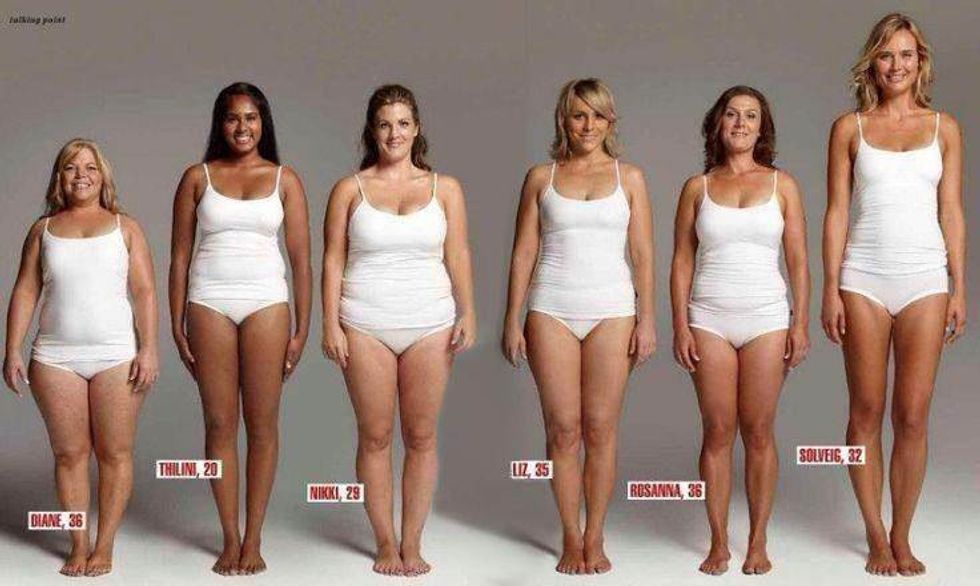
For several decades, the fashion industry has been pushing clothing sizes on us while making us feel that if being small is the only indicator of being healthy. Naturally, we have learned to correlate the small clothing sizes with healthy bodies, which is justified on fashion runaways, advertisements, and on-screen television shows and movies. Can you be skinny and healthy? Of course. Can you be curvy and healthy? Most definitely.
Let's be honest, most women are incapable of having a slim body with a small waistline, but the social pressures continue to make a impact throughout our daily lives. The media is the main contributor to body dissatisfaction, which is currently at an all time high. If the majority of women in the media continue to favor and resemble the minority of women in real life, then the percentage of women who are defined as "overweight" will continue to increase. Meanwhile, the war of plus-sized women continues to make headlines and the mass media has routinely turned a blind-eye to the real situation; the underrepresentation of real women in a unrealistic world.
The most common misconception is that women's clothing sizes from 8 to 16 are stereotyped as "plus sized." The clothing size you wear doesn't actually make a difference as to where you fall on the weight spectrum. We need to stop determining our self-worth and level of happiness through a clothing tag or a number on a scale.
After several years of struggling with depression, I have learned to rebuild my self-confidence with re-establishing strong friendship bonds and accepting that I'm beautiful regardless of where I fall on the chart. I have accepted that the societal standard of the "perfect body shape" doesn't apply to my particular body shape or size. Yes, I might be classified as slightly overweight, but I'm on the Whole 30 diet and I exercise roughly five times a week. Despite what society classifies as "unhealthy" or "plus-sized," I will continue to live life to the fullest. I will continue to walk a spiritual path with God and allow his everlasting grace to fuel my happiness. I will continue to embrace my clothing size and weight. I will continue to live a healthy lifestyle and embrace my physical appearance as a perfect creation by God. And, I will begin to see my reflection in the mirror as beautiful.
Remember, size is just a number and beauty isn't defined by pounds on a scale.













