
Earlier this week, I was visiting my primary care physician about my allergies and asthma. I had been having a blessed morning on all accounts aside from breathing issues. I woke up early to work on a research paper, read some poetry outside in the garden with my cats, and even squeezed in an hour-long bike ride before heading to my early afternoon appointment.
As I sat in the waiting room, I couldn’t help but notice the overwhelming amount of signs dedicated to overcoming obesity. Plastered on the wall were signs defining BMI, warning about the effects of obesity, detailing the amount of patients who had been diagnosed as obese at the clinic, and revealing the amount of local patients who had overcome obesity as a result of dietary and exercise plans.
As a woman in her 20s, of course I have significant concern over my physical appearance. Most girls my age have self-esteem issues related to appearance, and I’m admittedly no different. And what’s the first thing that they always do at the doctor’s office? They weigh you.
After seeing all of those signs, the last thing I wanted to know was my weight. I don’t believe in scales. I ditched mine a long time ago. I do believe in working out and listening to the feedback your body gives you. That being said, I treated this doctor’s visit like the others: as I stepped on the scale, I purposefully turned my head away from the number.
“A nice, round 150!” the nurse chirped, scribbling away on her clipboard.
And so I thought about weight the whole time I was in that room. Because on every wall in there were posters just like in the waiting room. Posters with BMI in big, bold letters and “The Warning Signs of Diabetes” scrawled across in defining, detrimental script. And my doctor came in eventually, of course, and we talked about my symptoms. He’s a nice doctor and always has been a helpful physician. We decided on a new inhaler and an additional pill which would help combat my symptoms.
As I sat in my car waiting for the air to cool, I flipped through my patient plan of care to go over the names of the medications prescribed. It was there that I saw an additional diagnosis which wasn’t discussed with me during my appointment. The code written down was adult (Z68.27), otherwise known as a BMI between 27.0 and 27.9 – the classification for an overweight diagnosis.
Underneath my diagnosis was my “plan order” on which I was given “instruction on dietary management education, guidance, and counseling” and “encouragement to exercise.” Now I’m assuming that because I visited the office in my workout clothes, maybe my doctor assumed that I had just recently started working out and eating right. But I’ve been around the same weight for almost half a year, and I haven’t changed my amount of exercise or the way that I eat in any drastic manner.
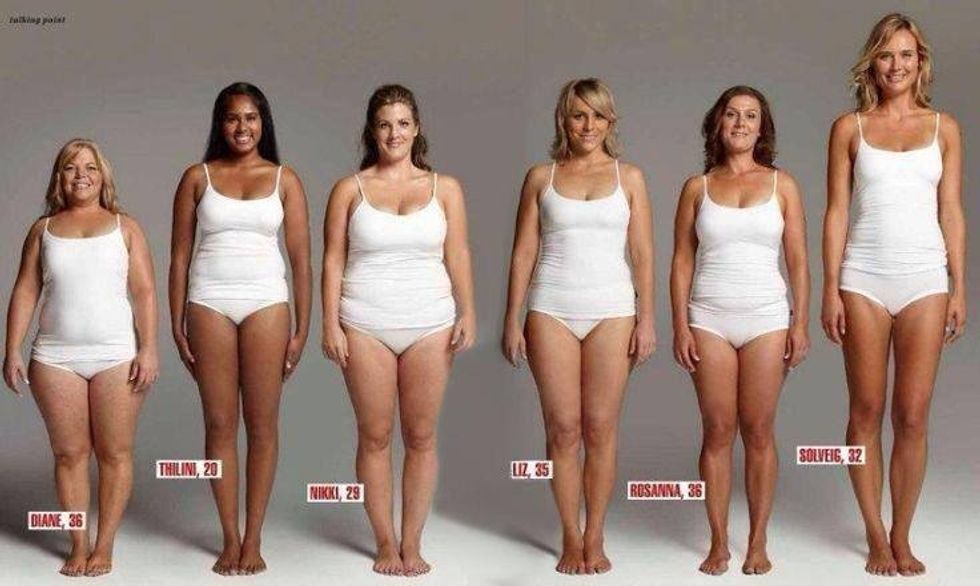
Nor do I plan to. I exercise more than the recommended amount and I even use a food tracker on my phone to keep count of my calories. But to me, that isn’t the point. The point is that an individual’s BMI is not an adequate overview of general health, yet it is seen as the end all to a diagnosis. The BMI is viewed by both the U.S. and European countries as the pinnacle factor of whether someone is underweight, "normal", overweight, or obese – as if human beings are simple cut-and-dry shapes which fit into pegs like a children’s game.
According to National Public Radio, Lambert Adolphe Jacques Quetelet, who invented the modernly termed “Body Mass Index", never dreamed of its utilization in reference to individuals. Quetelet was a mathematician, sociologist, astronomer, and statistician (not a physician) who created the formula essentially as an ideal of “the average man” in relation to a normal curve of the current European population he inhabited. The simple equation, which is now around 186 years old, only takes into account an individual’s height and weight – not whether that weight is attributable to muscle or fat.
In short, the Quetelet Index, now coined the Body Mass Index, was never meant for individual usage in assessment of obesity. NPR also notes that Quetelet “produced the formula to give a quick and easy way to measure the degree of obesity of the general population to assist the government in allocating resources. In other words, it is a 200-year-old hack.”
So why are we still using it as a helpful measure to diagnose someone’s obesity on an individual level? According to the Center for Disease Control and Prevention, more than one-third of U.S. adults are obese. With such a large number, either we are over-diagnosing because of flawed measures or we are using a flawed measure (such as the BMI) which can incorrectly diagnosis someone as overweight, or obese. Of course there are distinct differences between being overweight and obese, and of course there are individuals who have come across these issues which need intervention and future prevention. I’m not arguing that weight cannot help predict some facets of health, but it cannot be the only indicator which we use to label someone as part of an “epidemic.”
As a society which is also on the rise with eating disorders, should not bone density and muscle mass become concerns for doctors? The focus should not rely solely on presence and quantity of fat, but on muscle mass and bone density as well. If our concern really is the unhealthy individual and supplying that individual with an intervention and preventative measures, we are far too technologically and scientifically advanced to use a 186-year-old formula as the sole indicator of physical well-being.