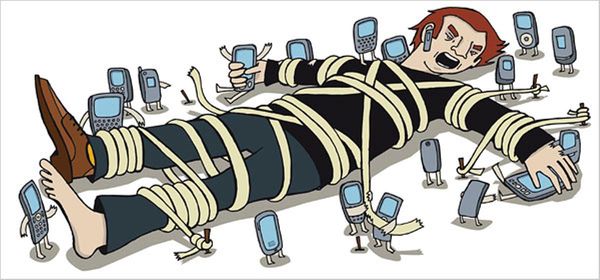


Countless scenes come to mind. Red and yellow withered leaves crunch beneath the steady pace of moving feet, wedding bells swing left and right, or silence fills the air as friends enjoy each other’s company. Yet in each situation, the people involved would be on their cell phones. While cell phones may have started out as an innocent way to improve human interaction, addiction has become an unintended consequence, and it's time to think about why you should put down your phone.
Let's start with the basics: how did we get addicted to these things in the first place? Well, smartphones were created with the intention of being marketable products for a target audience. How exactly could new gadgets snag their target audiences? Basic economic principles would tell us that as humans, we want more.
Given the opportunity, who wouldn’t take 1000 gigabytes of storage space over 60; 25 days of vacation over 15; or five A grades over two? Intrinsic motivation drives us to complete tasks, but extrinsic motivation drives us to seek rewards.
Knowing this fact has led thousands of entrepreneurs, scientists, and businessmen to innovate and create things that leave us wanting, well, more, and more has led to countless improvements on what was once a simple object: the phone. Now we aren’t just calling people, we’re texting them. We don’t just have contacts, we have search engines, email inboxes, and cameras—cameras that capture priceless memories now seamlessly stored in an accessible place: the Camera Roll.
Moreover, apps like Instagram and Facebook have become readily available on mobile phones, so myriad people are able to compare themselves to others at any point during the day. Take Instagram. Any user of the app has the ability to market him/herself. He/she first modifies the selected picture, then has the opportunity to share this photo on another social media outlet like Facebook or Twitter before it’s sent out into the digital world.
According to researchers, such “sharing” has caused an unhealthy amount of pressure on teenagers and adolescents alike. Perfectly straight, white teeth framed by bright red lipstick and paired with brand new bikinis fill 12-year-old girls’ square canvasses. Is this depiction what 12-year-olds should look like? With constant documentation and vanity in effect, kids use social networks on their phones as a measuring tool, with “likes” and “favorites” indicating their level of popularity. As a result, teenagers find themselves imitating whatever will get them the most recognition from their peers, stressing over the potential trauma of not being good enough.
Regrettably, the feeling of inadequacy does not end here. It has been noted that texting—which physicians claim has led to negative effects like anxiety, repetitive stress injury, and sleep deprivation—contributes to another phenomenon: fear of missing out (a.k.a. “FOMO”).
These effects can be linked to the unnecessary pressure to respond. For example, if a cell phone is set on vibrate for the night, teenagers find themselves constantly “deluged” by the “pressure to answer immediately.” Teenagers have too much of an “interest in knowing what’s going on in the lives of their peers, coupled with a terrific anxiety about being out of the loop,” according to Katie Hafner.
Unfortunately, putting down the phone is becoming more and more difficult. According to analysts, people spend an average of 158 minutes each day on their smartphones, says John Koetsier.
What are the effects of so much time spent on cell phones? Dr. Michael Abramson, an epidemiologist, studied 300 children aged eleven to fourteen, and found that “kids who used mobile phones performed faster on a battery of cognitive tests but…also made significantly more errors.”
With the need to respond in an expedient manner, kids start vacillating between two or more tasks: the task to answer the group message or respond to the “tweet,” and the task to finish whatever is happening in the real world—whether that be doing the dishes, or finishing homework.
However, the multitasking that cellular phone activities like texting force us to do, is also making us less efficient. In fact, “studies show that when our brains switch back and forth from one task to another, our neural circuits take a small break in between,” making us less productive, all-the-while making us think that we are being more productive (Gary Small).
Essentially, distractions and interruptions plague our ability to manage time in the best way possible, because despite the preconceived notion that multitasking means doing more, the brain actually works better when it sustains one task at a time.
As consumers, we have been led to believe that the shiniest, leanest, and fastest phone will bring us the most happiness. We have failed to realize that the very object that has brought us convenience and efficiency—allowing us to speak with whomever we want whenever we want—has really brought us unhappiness. There is a necessity to respond, to always communicate. Pictures are now opportunities to get famous on Instagram. Dating has become nothing more than multiple days in communication on Snapchat.
It feels like there is no away from the viral escapade of the mobile phone, and as it continues to evolve at a rapid rate, it becomes more and more difficult to put down, leaving both children and adults habituated and entirely unaware of what their addiction has done.
Picturing my future children scares me, as I see verbally and socially challenged monsters waiting for the next thing to come, while failing to contribute ideas of their own. I see kids who are so immersed in their incandescent gadgets that they miss the world around them. I see kids living in black and white who think they are living in a vivid stream of color.