
There are certain unspoken rules every person follows. If someone is a certain distance behind you and is clearly going in the same direction, you hold the door for them. If you make eye contact with someone in the hallway, but don’t have time to talk, you smile as you walk past.
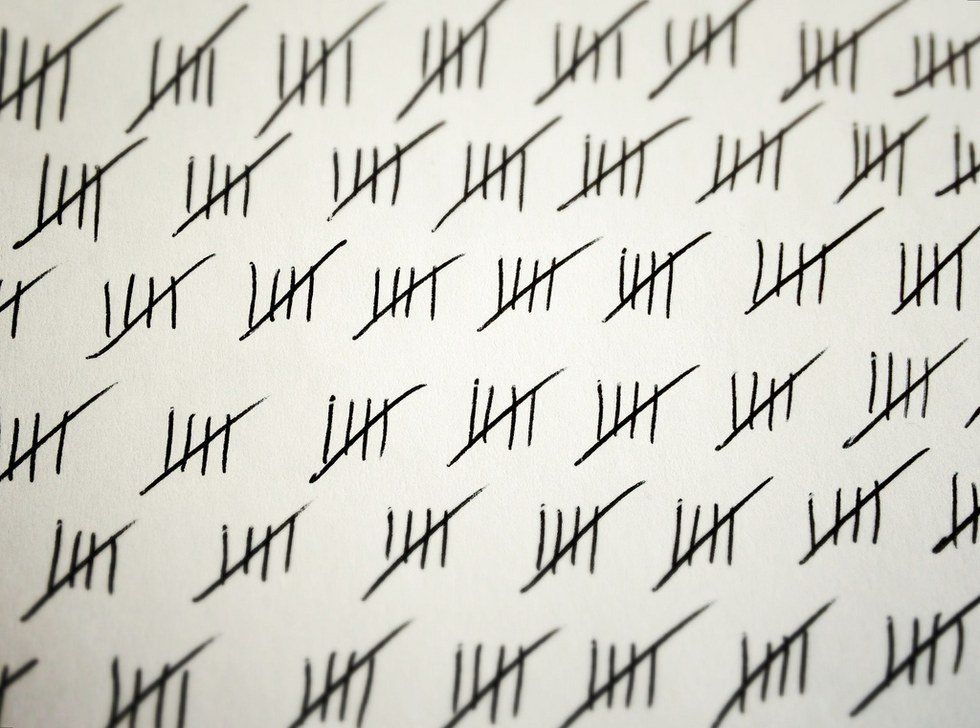
For some of us, there are more rules. Rules that don’t make a lot of sense, but that must be followed regardless in order to avoid the consequences. What consequences? I ask myself sometimes, as I step on the intersections of a tiled floor or count the number of times I tap my toothbrush on the sink when I’ve finished brushing my teeth. What consequences are there if I don’t follow the rules? I wonder, as I grit my teeth and peel skin from around my fingernails or count every 20 steps I take. I never have an answer for myself beyond, there will be consequences and they will be terrible. There is a reason OCD is an anxiety disorder.
Obsessive-compulsive disorder is quieter than a lot of other mental health disorders. Most people who have OCD know that our rituals aren’t logical, but that doesn’t mean they can just be dropped at any time. I know that I’m luckier than others – while I need to step on each intersection of perpendicular lines on the floor, if I need to cross a long stretch of tile I can talk myself into counting steps instead. It does feel like I’m only putting off the inevitable, though. Like one day, I’ll have to find each intersection in a large tiled room and step on each one.
I have a very distinct memory of one of my high school teachers seeing me set up my pencils in a triangle and commenting. I straightened my triangle and mumbled that no, it didn’t mean anything, I just needed it that way. No, I had no answer as to why beyond, “I have obsessive-compulsive disorder…”
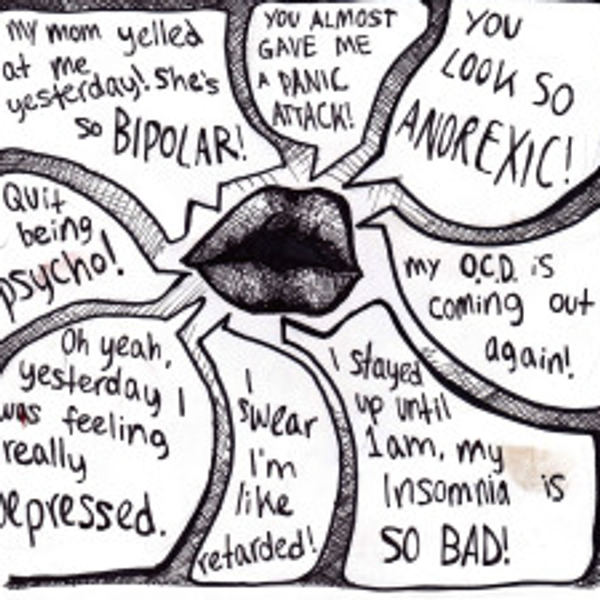
“Oh,” my teacher laughed, “I know what you mean! I like having a tidy workspace too. I’m so OCD too; I’m such a neat freak.”
Obsessive-compulsive disorder is not synonymous with tidiness. My mother will be the first to tell you that my room is her personal idea of hell – things on the floor, laundry that has yet to be put away on the foot of my bed, my closet door wide open, shoes lined up under the window. When I do get it clean, it never seems to stay that way very long.
There are two parts to OCD and they are both in the name. Obsessions are intrusive, anxiety-inducing thoughts. In OCD, they occur more regularly and are significantly stronger than normal intrusive thoughts, and they are always negative. I can’t be in the same room as a knife left on the counter without vividly seeing myself reach out and take it to drive into my own foot. There is a shelf, exactly eye-level, over the little fireplace in the front room; every time I pass it, the thought that I should, for whatever reason, bash my own head on it presses to the front of my mind insistently until I’m out of the room.
The second part of OCD is the compulsions. These are the most visible symptoms. Compulsions are ritualistic behaviors, acted out as a way to ward off the intrusive obsessions. I’ve touched on a few of mine: stepping on perpendicular intersections in the floor, repeating actions in bouts of 12 or 20, counting, peeling skin… the list goes on. Others who have OCD will have different obsessions, different compulsions; it affects everyone differently.
Some with obsessive-compulsive disorder certainly do keep things very clean. Hand-washing is one of the most well-known compulsions, after all. Others might be compelled to turn the lights on and off several times before leaving a room, or need each chair they have to face a certain way or find that they feel extremely anxious if they don’t touch the door frame as they enter a room.
Whatever the symptoms, it’s easily agreed that obsessive-compulsive disorder is not some cute, organized, tidy thing you can turn on and off. It’s an anxiety disorder, and no part of anxiety is organized.
“I’m a total neat freak; I’m so OCD.”
No – you’re not.