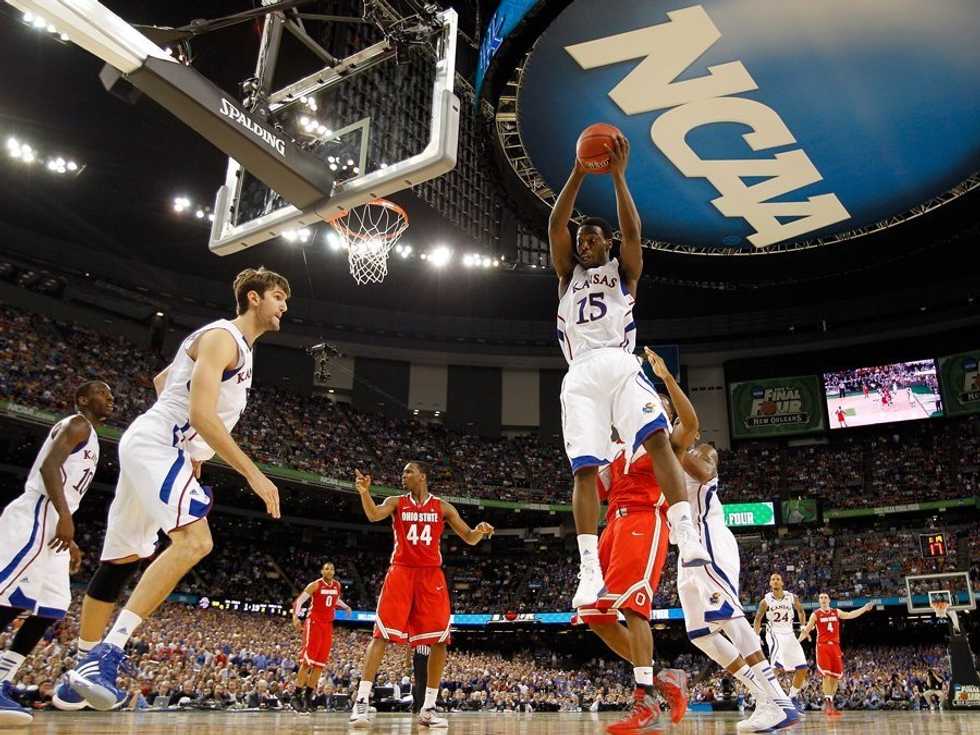
The folks of the United States are like the Romans with their fetish for blood sports when it comes to our own love of watching sports. And no other sporting event is more akin to the Roman games with all its grandeur than March Madness. Where men’s college basketball teams compete in their conferences, and then the National tournament, depending on their conference name.
A fitting name, considering there’s so much college basketball that the tournament can’t even be contained to just March, it needs the first week of April to finish.
March Madness is a college basketball fan’s dream come true. They’re happily smothered by this insanity, where they periodically flip between the four channels on TV that play the games practically all day. Or they can watch all the games at the same time if they have one of those fancy TVs that can somehow do that.
Watching the games isn’t enough for the American fan, though. There needs to be some sort of participation. This need manifested into craze of fans trying to predict the outcome for themselves, whether as a form of gambling or just an innocent competition between friends. Filling out a bracket became so popular, that for the past eight years, even President Obama has found time in his schedule to fill out a bracket on a live segment of ESPN’s popular show SportsCenter.
I decided to fill out a bracket this year. The only problem is, I had no clue what teams are actually good. I didn’t want just pick the higher seed to win, because the beauty of March Madness is all of the underdog stories. There’s a possibility a small, unknown team would knock off a powerhouse program.
When I used to participate in this phenomena, I watched a lot of the regular season games, and SportsCenter was practically the only show I watched. My guesses were quite educated back then.
I didn’t watch one game this year, and I refuse to watch SportsCenter now because I don’t like to be tortured by the unbearably unfunny quips spewed by all the different hosts.
I wasn’t sure what to do, so like anyone lost in today’s time, I turned to the Internet. After printing out a bracket, I turned to the all-powerful force that controls our lives to see what kind of information I can scrounge up on the competing teams.
Then I realized the magnitude of what I set out to do. Six teams, three games, and half an hour later, I started to have second thoughts about my decision. I mean, how could I justify a wasted night of researching 64 college basketball teams when I had more important things to do? Just because filling out a bracket makes the spectator sport a little more participatory doesn’t mean I have to waste precious time! That probably says something about human’s primal love for gambling, but I’d rather not think about that.
So I found myself in a bit of a dilemma, because I really wanted to fill out a bracket without doing any research, but I also didn’t want to make blind guesses. So I turned to the thing that has all the answers when the Internet can’t help: television. Like always, I wasn’t let down.
During an episode of "The Cleveland Show," a few characters were coincidentally betting on college basketball and basing their bets on whose mascots would win in a fight. I knew right away I found my Magic 8 ball, the sure-fire way to make my decisions.
But I think I would have done better just making blind guesses. To name a few of my mistakes, I had the University of Colorado beating UCONN, because a buffalo could easily stomp a husky. I bet that the Friars of Providence would get beat by the Trojans of Southern California, but somehow those pious folks beat those warriors (they probably used some sort of horse). The one that upsets me the most is the Wisconsin Badgers beating the Pittsburg Panthers. In what universe can a badger beat a panther in a fight?
Needless to say, my bracket is obsolete now, but the funny thing is, I’m not the only failure. I know people who follow basketball with a magnifying glass who got everything wrong. They listened to inside information and had knowledge of past games to make educated guesses, but they still got it wrong. Even experts on TV rarely get it right.
Too often, we overlook human spirit and grit, and we believe we can predict a person’s behavior by past events. That’s the beauty of March Madness: no amount of data or hypothetical mascot fights can predict the winner of this perfect insanity.