
A toxic combination of unwillingness to adapt, and indifference to unpredictable presidential nominees, has left what remains of the Republican party scrambling to win over the minds of the young, and the historically disadvantaged. This, at the cost of traditional conservative ideals, which are now associated with the obscure, and often, false rhetoric of the party’s inevitable candidate – Donald J. Trump.
In an opinion-editorial piece titled “The Republican Party is Dead” published in the Los Angeles Times in May of this year. Max Boot, a Russian-born contributor, and senior fellow at the Council on Foreign Relations, recalls his family’s decision to flee the Soviet Union, in 1976. He, his mother and grandmother, came to Los Angeles to begin a life free of Soviet-Communist oppression. Boot attests the 1980s is when he became a Republican, as many former socialist-state refugees had. As Boot puts it, “Refugees from communism, whether from Russia or Cuba, generally oppose socialism and embrace conservative political views.” Boot immigrated to the United States during a period in which conservatism was on the rise following decades of democratic administrations. Punctuated by the Carter presidency and its many unfortunate – however often undeserved – allegations of mismanagement including the Iranian hostage crisis and handling of the 1979 energy crisis. It was time for a shift. Enter Ronald Reagan, the election of 1980, the moral majority had become mainstream and the Oval Office would be occupied by a Republican president for the next decade. This was the political catalyst for Max Boot, and millions of other refugees; the classic brand of Republicanism Americans up until the 2016 election, have come to expect. Low taxes - in theory, large defense budget, fewer tax dollars spent on social programs like Medicare. The bootstrap, self-reliant attitude Americans know and love, had reached a golden age.
Fast forward to this election cycle, the Reagan Republicans have reached an identity crisis. A crisis so dire in fact, that many in the Party of Lincoln may be forced to make a decision that would have been preposterous two decades prior: vote for a Democrat. The hardline right has been caught in a trap of their own design. Now, they have no choice but to cast their vote for a Republican they staunchly disapprove of, or Hillary Clinton. A former First Lady to Barrack Obama’s democratic predecessor – Bill Clinton. She also happens to be a former Secretary of State who served during President Obama’s first term.
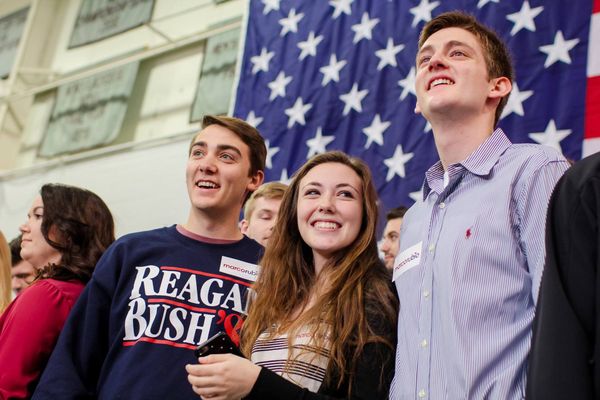
The problem of party decay runs much deeper than the Republican old guard not being content with their options. This issue may have repercussions not only for this election, but may threaten the very core of Republican thought – of the Party of Teddy and Eisenhower. The key factor: young people. Young people, while not a necessarily a majority at the moment, have one significant advantage over older generations. The advantage is time. Time changes all things, and so too will time change the American political and ideological landscape. Just as previous political establishments – Whigs, Free-Soil, and Populists for example – had succumb to the passage of time and the advent of new perspectives and demands – social reform, economic policies to name a few. Conservatism, and eventually even Republicanism, may go the way of the Federalist – that is to say, extinct.
It is due to the Republican Party’s unwillingness to adapt to the increasingly liberal political climate and attract the millennial vote effectively which has moved themselves one step closer to obsolescence. Not only this, but the establishment’s appeasement of Donald Trump during the primary season, reinforced by the angry, primarily white, working class’s enthusiasm towards the candidate that has, one might say, ruined the Party’s image for young voters. Democrats in every political form have taken advantage of the “uncool” Republican establishment. The Democrats had a great enough advantage this election cycle to rally unprecedented support for a candidate like Senator Bernie Sanders of Vermont. A self-identified “democratic socialist” who may have arguably commanded a greater amount of youth enthusiasm than Clinton.
The political climate is liberal according to young people. In a series of polls by the Pew Research Center, conducted in September of last year, twenty-eight percent of Millennial voters identified as “mostly liberal.” Up from twenty-three percent among Generation X, twenty percent among Boomers, and sixteen percent among those of the Silent Generation. Equally profound is that among millennial Republicans, fifty percent found that business corporations “make too much profit.” If you were to ask these millennials’ Silent Generation grandparents, only thirty-one percent would agree with their grandchildren. Fifty-seven percent of millennial Republicans believe that immigrants strengthen the country, sixty-four percent feel that homosexuality should be accepted by society. Across the board, the millennial lens is lists heavily to the left.
This inability to respond, or even recognize signals of ideological shift regarding age group is truly the tragedy of the Grand Old Party. It has allowed itself to not only nominate a candidate who many Republicans disapprove of. But a candidate whose vitriolic language and largely inexperienced demeanor has degraded the viability of the GOP platform among the youth even further than previous Republican nominees. The party of Max Boot, the young Russian immigrant, hopeful and eager to work hard for a better life in 1976 has been replaced by a grotesque, and borderline comedic party platform in 2016.
The Republican platform needs to change and change quickly if the Right wishes to bestow their conservative ideals upon the next generation of policy makers, of Senators, of Presidents. Granted, a number of these ideals have been, at this point, regarded as dated or obsolete. Same-sex marriage comes to mind (naturally, opponents remain). Nevertheless, the Republican platform which has remained mostly constant for nearly 155 years, may be undone as a result of carelessness, and pride. There are Republican ideals that are vital to the American identity. An identity not of race, or sex, or nationality. But of common good, of kindness, of strength, of patriotism, of the shared sense of community not bonded by faith or status necessarily, but by grit and determination. These are traits that Republicans historically have rallied around. It would truly be a national tragedy if American conservatism in place since the Civil War were to be swept away because of an unruly candidate by the name of Trump, and his handlers allowing him to ruin the future of their party.