
“What event in your life helped shape who you are today?” This question could be asked in an interview for a job, in a getting to know you game or here, in an internet article. In my case, I’d choose to answer with an almost 12-year time period in my nearly 18-year-old life.
From the ages of six to about 17, I was an equestrian. Though I don’t remember each visit to the barn from my elementary school days, I could tell you that the stables were blue, the first pony I took a lesson on was named Pepper and I was afraid to brush him.
Why does that matter? Because I can also tell you where I left off and I didn’t get to that point without learning a few life lessons. So how did it end? It ended with a young woman who knows the meaning of responsibility, trust, patience and teamwork, and the power of having an internal drive and motivation to improve.
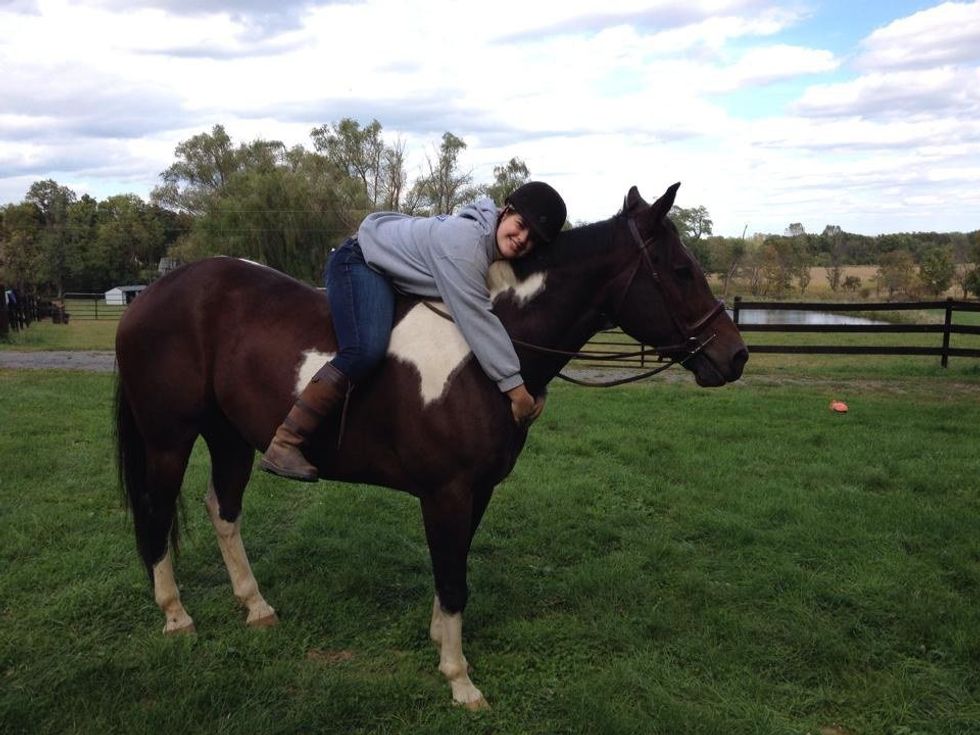
Trust, patience and teamwork. Horses cannot speak human languages so how are you supposed to work together? In the early stages of riding you learn that if a horse puts his/her ears back, they’re mad. You learn not to walk directly behind them because they can’t see you and they might spook and hurt you. As you advance your skills, you have to learn some communication on your own. Trials and errors of “am I leaning too far forward?” or “do I need to add more pressure in my leg?” and “could the slightest shift in my weight really affect our ride that much?” lead to both horse and rider knowing what each other means without speaking a word. (By the way, in my case, the answer to all three questions was usually yes.) Bandit, the horse I had the pleasure of owning for about two years, knew all of my secrets, let me cry in to his neck when I went through a break up, listened to me practice songs from whatever musical I was in for hours on end and even shared some of my food with me. When you have no words to speak with, patience, trust and the mental game of working with another being develops quickly.
Internal drive. Everybody likes to claim that they’re motivated, but equestrians have no choice but to be. Nobody is going to lift you back in to the saddle after you fall to the ground. Encouragement to get back on comes from others, sure, but in the end, you’re the one who climbs that mounting block again. I learned how vital motivation was around early middle school. I’d fallen off and due to winter weather and no indoor arena, didn’t ride for a while. I switched barns, but was scared to get on. Thanks to the long, patient help of two amazing teenagers who taught my lesson, I slowly but surely gained the confidence to get back in the saddle. Once there, though, I had to want to ride. I went from knowing I could ride, but not pushing myself, to jumping, showing and eventually owning my own horse. At the time, I felt like I couldn’t accomplish anything. I couldn’t even sit on a horse—something I’d been doing for years already. Nothing fazed me afterwards—falling and hurting an arm, fracturing my tailbone, getting concussions, they all happened, but I got through them and still rode. Without my own motivation, my time spent regularly with horses would have been cut in half. My drive to power through one of the toughest times for me still runs in full gear today. Without the motivation I found in myself, I never would have taken AP classes; auditioned for my school district’s Arts and Communications Academy; or prepared, gone out and auditioned for multiple acting and musical theatre programs at colleges.
Responsibility. I always knew that it was important to take care of the horse you ride whether you’re on a school horse, a horse you lease, your friend’s horse, or your own. But once I was lucky enough to own Bandit, a beautiful gelding—about ten years in to my rendezvous with the equestrian world—I realized just how much responsibility there is. With school horses, I could tell my trainer, “He has a cut, but I washed it out” and somebody else took care of it from there. When I had nobody to pass him on to, I had to learn how to clean (and keep clean) different injuries, how to make sure they’re healing well and how to take even further steps when common creams and medicines weren’t enough. I quickly learned that even when I was sick and didn’t feel like going to the barn, I had to, because nobody else was going to ride my horse for me. Another life was dependent on mine.
What made me who I am today? Four different barns, multiple trainers, numerous friendships and countless horses. Any equestrian will tell you that without riding, they’d be a completely different person. No matter the reason an equestrian decides to stop riding regularly, each one knows that in their heart, they'll never stop being one. I’m glad that I had the chance to work with such beautiful animals, because without them, I wouldn’t be me.
So, what event in your life helped shape who you are today?