
Be warned: spoilers to follow.
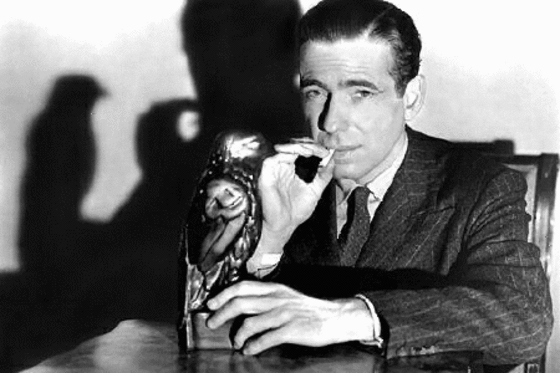
Despite what you may have heard about the Crusades being a costly, embarrassing fiasco for all involved, apparently one band of crusaders did so well for themselves that they were able to fashion a golden statue of a falcon worth a mind boggling amount of money (a million dollars is mentioned as the low end of its price range). Naturally, an object with such a high price tag inspires several murders and double-crossings. When his partner is murdered, Sam Spade becomes tangled up in three criminals’ search for the bird. Despite being deeply attracted to Brigid, a female member of the gang, he still convicts her for the murder of his partner. Thus proving that principal and duty trump emotion and personal loyalty. Thus, good triumphs evil, or does it? I postulate that Sam Spade is driven by the same materialistic and exploitative world view as the falcon hunters.
Spade is constantly shown seeking money. When Brigid reveals that she lied about why she hired him, Spade responds that he believed her money, not her story. He later dupes the criminals into giving him several hundred dollars as he pretends to switch over to their side. Despite his claims that the falcon is merely a “dingus”, he stares, transfixed as Gutman, the leader of the gang, describes the value of the falcon.
His relationships with women are based on similarly materialistic grounds. He had an affair with his partner’s wife, Iva, although he admits he wishes “he never laid eyes on her”, and constantly dismisses her with patronizing remarks like “run along home now.” The way he physically distances himself when she mentions how much she needs him makes it clear that he wants to cut her out of his life now that the passion of the forbidden affair has lead to emotional dependence. Similarly, his relationship with Brigid is also based in physicality, despite the fact she constantly and obviously lies to him about her past and intentions, Spade is inexplicably attracted to her. It’s implied that he is attracted to her because she is dangerous and refuses his attempts to control her, as did Iva. Spade also cuts her off once she becomes too emotionally dependent on him, just as he did Iva. In this case, he does so when she asks him to shield her from justice. However, this isn’t due to choosing duty over love, but because if he let her go free, she would “have something over him that she could use.” Illustrating a clearly predatory dimension to their relationship. Spade’s most positive relationship is with his secretary, Effie. Their relationship is very much one of employee and employer. He asks her to do tasks, and she does them, showing that even Spade’s most positive relationship is based in his selfish world view.
Spade’s relationship with the truth is his most troubling. He frequently tells both Iva and Brigid that he knows they’re lying but “if that’s their story, that’s fine”. He regularly lies to his policeman friend, who has been assigned to the case, regarding his feelings about his partner and about his relationship with Brigid. He does this so that the police don’t suspect him of his partner’s murder anymore than they already do. He frequently uses sarcasm and wit to mask a cold ruthlessness, traits that he shares with Gutman. Spade is less concerned with the truth than with his own well-being.
Despite the popular perception of Spade as a hero of truth and justice, his constant references to money, the bases of his romantic relationships, and the way he manipulates the truth for his own benefit all suggest he’s more like his adversaries than we had previously considered.