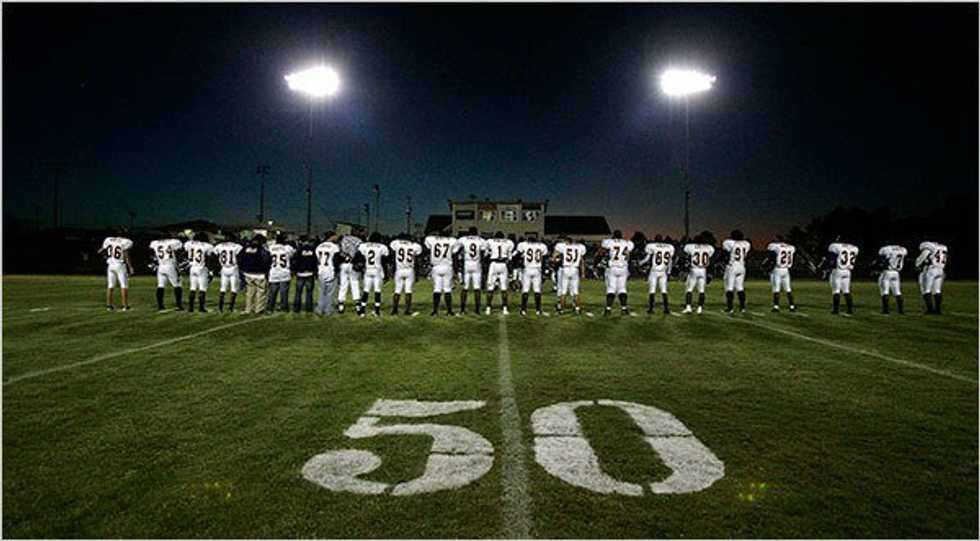
Picture this. You're sitting in the bleachers at a high school football game. It's Friday night. Everyone you know is there, practically the whole town. It's a brisk night with a slight breeze, under the lights: perfect football weather. You're having a great time, watching the game and socializing with friends until you hear it. It's that sound. The sound of two players hitting each other. We've all heard it. Whether it's on TV, or in the stands. It sends chills up your spine. The whole time, hoping and praying that no one is injured.
Five.
That’s the number of athletes, specifically high school football players, that have died this season due to injuries. The high school football season kicked off roughly around the last weekend in August. That’s five deaths since early September across the country, five too many deaths.
Football is a hallowed sport here in the United States, a sport unique to the U.S. When people think football around the world, they’re thinking goals. But not in the U.S. Here, we’re thinking touchdowns. Here, football is a hard-hitting, take-you-down, in-your-face kind of game. But the game that we all love so much is becoming one that is more dangerous than is fun.
Just a few weeks ago, Kenney Bui, a receiver for a school near Seattle, died of a traumatic brain injury. He was just 17 years old. He was seen making a hard tackle, then hopping right back up. But he was later taken by ambulance to the hospital after a hard hit to the head, where he died from blunt force injuries to the head.
Many of these deaths have been due to head trauma, and the lack of care regarding those injuries. After major hits and blows to the head, many players bounce right back up- not even showing any signs of injury. So how do we combat this problem plaguing high school football? Unfortunately, the answer comes down to numbers. High school players suffer three times as many serious injuries as college players do. And what’s even more shocking:
According to CNN, 70 percent of high school players with concussions played despite their injuries! And 40 percent said that their coaches didn’t know about the concussion!
But, we aren’t just seeing a rise in head injuries in high school athletes. There has been a significant rise in NFL players with Chronic Traumatic Encephalopathy (CTE). CTE is a neurogenerative disease linked to dementia, memory loss, and depression. Right now, examining the brain after death is the only way to discover CTE. According to ESPN, CTE is caused by a buildup of abnormal protein that strangles brain cells. This damage to the brain has been linked to blows to the head; something we see all the time in football. ESPN has reported that dozens of former NFL players have been diagnosed posthumously, 87 to be exact. Several of these players have committed suicide; the most recent being Adrian Robinson Jr. Robinson was a linebacker who played with several teams from 2012-2013. He was just 25 years old. And while there isn’t hard evidence linking suicide with CTE, there have been several signs that point to a connection. Other symptoms of CTE in NFL players include suicide, depression, aggression, and dementia. Sadly, this is becoming more prominent around the game of football. And it's happening right here in the state of Iowa.
On Sept. 8 of this year, former Hawkeye and Giant safety Tyler Sash was found dead in his home. The Des Moines Register reported his autopsy revealed an accidental overdose of pain medications including methadone, and hydrocodone. And while his death was from overdose, additional tests are being done to see if Sash showed signs of CTE in his brain as well.
Football is a cherished sport here in the United States. It’s a game that starts very early in many young boys’ lives. In the meantime, the game doesn’t seem to be slowing down anytime soon, and it’s time to start looking at the numbers. Too often we are seeing traumatic head injuries, and serious hits to bodies. And too often lately, we are seeing the serious and tragic consequences. While I’m an avid football fan and supporter, I still cringe every time there is a hard hit, or blow to the head, hoping the player gets back up on his own power.
So let’s not sweep these issues under the rug. Let’s face them head-on. It’s time we bring more light to this problem, and make the game we all love a safer one.