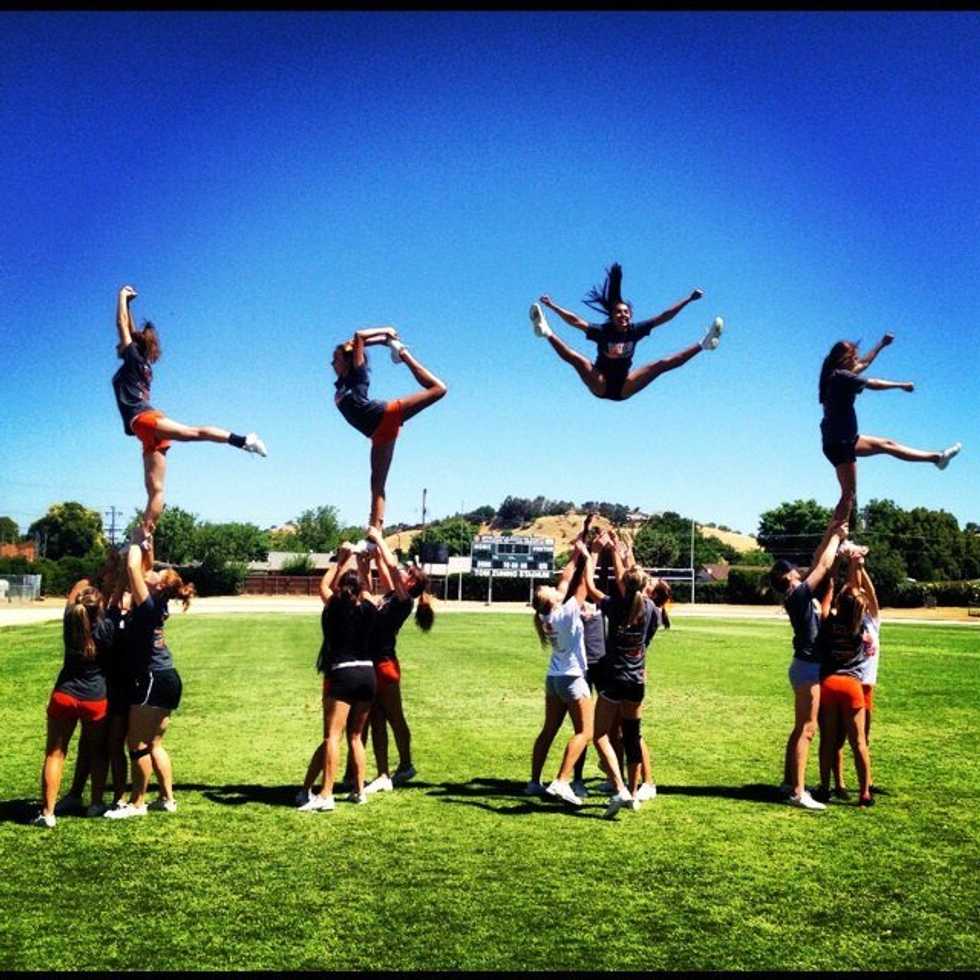
Short skirts, loud voices and tons of energy, that’s how most high school students would classify a typical cheerleader. In some schools, cheerleaders are seen as “wanna-be” athletes. All they do is cheer on their home team, right? Some cheerleaders are talented enough to throw out some back-flips here and there; some can even jump into the splits. How hard can that be? The answer is a lot harder than you think. Although cheerleading is formally deemed as not a sport, it is actually one of the most dangerous and demanding athletics out there. With dedication, teamwork, strength, agility, trust and competitiveness, cheerleading is definitely a demanding sport.
Webster’s Dictionary defines a sport as “physical activity that is governed by a set of rules or customs and often engaged in competitively.” Webster’s Dictionary does not mention the trust, or the teamwork necessary for any sport. Cheerleading is not considered a sport because the definition is to cheer on the home team. True, that is their main job; but cheerleaders provide much more than just school spirit. There is often a sense of teamwork and family that other sports cannot express. A cheerleader is not just a member of a team, but also a member of a family that depends on one another. Cheerleaders put their physical safety in the hands of their teammates every day just to get better at what they do. They also have to practice often. There is a trust that is not easily broken, as with a dedication and commitment to their team. This is no different from the recognized sports teams.
Cheerleading can also be one of the most dangerous activities in the world. Most spinal surgeons, who work on younger patients, often handle cheerleaders. Stunting, tumbling and jumping three hundred-plus days a year can affect a person’s body. Most of the female's injuries come from cheerleaders. High School Cheerleading accounted for 65.1 percent of all catastrophic sports injuries among high school females over the past 25 years. These athletes can fracture spines, break legs/arms, develop scoliosis, break collar bones, develop concussions and much more. Some cheerleaders around the globe have been grounded to the floor only because of past or future injuries. A cheerleader must have a good technical foundation; otherwise he or she will be prone to serious injury in the future. This, too, is like any recognized sport.
Cheerleading is also competitive. They have contests. Along with competitions come rules, and with cheerleading, there are a lot of them. According to the National Cheerleading Association, there are six categories for which teams are judged. These categories include: technique, stability of stunts/strength, choreography/flow of routine, degree of difficulty, perfection of routine and overall impression. When it comes to judging, the panel is pretty harsh. If the stunt moves, or the flyer stutters just a slight movement, it is a half of a point deduction. If signs or flags are left on the competition floor after the allotted time for the cheer is done, that’s another half of a point deduction. If the music ends before the cheerleaders do, a deduction is counted. If motions are sloppy and not tight, points are deducted. If a cheerleader is not loud enough, the panel deducts points. Judging is more intense than what anyone ever thinks. In football, soccer, baseball, softball etc., some players call the game due to the referees or umpires calling bad plays, but in cheerleading the judging is all fair and square. If a cheerleader steps out of line, at any point and time, the first place trophy could be lost. First place could be lost in a split second. One second can change the outcome of any cheerleaders dream. Thus, competition is also part of cheerleading.
The official ruling on cheerleading declares that it is not a sport. Most high school students believe cheerleaders are not athletes because all they do is cheer, but every cheerleader across the world would disagree with that opinion. Although cheerleading is formally deemed as not a sport, it is one of the most dangerous and demanding athletics offered. With its dedication, teamwork, strength, agility, trust and competitiveness, cheerleading should be recognized as a sport.