

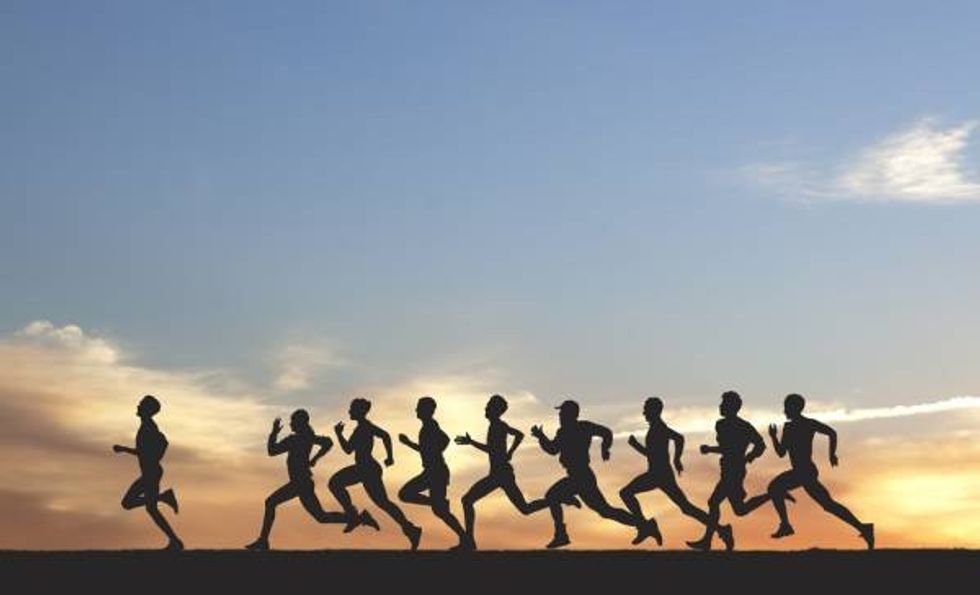
It's marathon season. Across the country and around the globe, people are running ridiculously far ridiculously fast (the winner of the recent London Marathon clocked the second-fastest time in the world at 2:03:04). As many of us watch from our comfortable positions on our couches, many wonder, How do they do it? In the eyes of some evolutionary biologists, a better question may be Why wouldn't they do it?
According to the endurance running hypothesis (ER), natural selection favored our ancestors with traits that promoted long distance running. Over time, our long frames, wide skulls, and powerful tendons set us apart from our walking and tree-climbing ancestor, Australopithecus. While some critics remain, others have started experiments producing evidence for the practical advantages of some supposed endurance running traits, like shorter toes (which help humans save on energy when pushing off from the ground). Nobody is sure why we developed to be so good at running--some argue persistence hunting, others following far-off signs like circling vultures to find animal carcasses to scavenge--but much of the evidence suggests that we humans were born to run. Here is a head-to-toe breakdown of our evolutionary advantages:
1. The Skull
Our heads were made for cooling and balancing. Our temples and foreheads create plenty of surface area for sweat to evaporate from, and veins filled with cooled blood lay close to arteries, keeping them cool as well. Our relatively flat faces keep the head's center of gravity up and back, while a ligament attaches our skulls and necks to the thoracic vertabrae for shock absorption and counterbalancing.
2. The Arms
Unlike Australopithecus, the human shoulders are not attached to the head and neck, allowing them to twist and adjust for balance while our heads face forward. Our forearms are shorter than our ancestors' as well, which helps counterbalance movement from legs and conserve energy.
3. The Torso
Like the arms, the torso moves idependently as well, "which allows you to use your upper body to counteract the twisting forces from your swinging legs," according to biologist Dennis Bramble. A narrow chest, waist, and pelvis makes more surface area for cooling, and our vertebrae and disks are larger relative to body mass for more shock absorption.
4. The Pelvis/Butt
Adaptions for shock absorption abound when it comes to this part of the body. A stronger, larger connection between the pelvis in spine than in Australopithecus keeps the body stable and provides shock absorption, as does the larger surface area of the knees and ankle joints and the hips themselves. The key to staying upright is the large buttocks. These huge muscles connect the femur to the trunk, and counteracts the need to lean forward from the hip while running.
5. The Legs
Our long, lean legs are much better suited for running than the shorter, heavier legs of our ancestors and ape cousins. The length allows for longer strides, the ligaments and tendons spring and release energy with each step, and the lean muscle conserves weight and takes less energy to move.
6. The Feet
As the study mentioned above proved, shorter toes mean better pushing off when running, while larger heel bones provide, you guessed it, shock absorption. The other bones in the foot create a strong arch that helps make each step more energy efficient.
So if you're ever debating training for a 5k, remember: thousands of years of evolutionary development gave us bodies perfectly suited to run countless miles--and it also gave us minds capable of inventing couches.