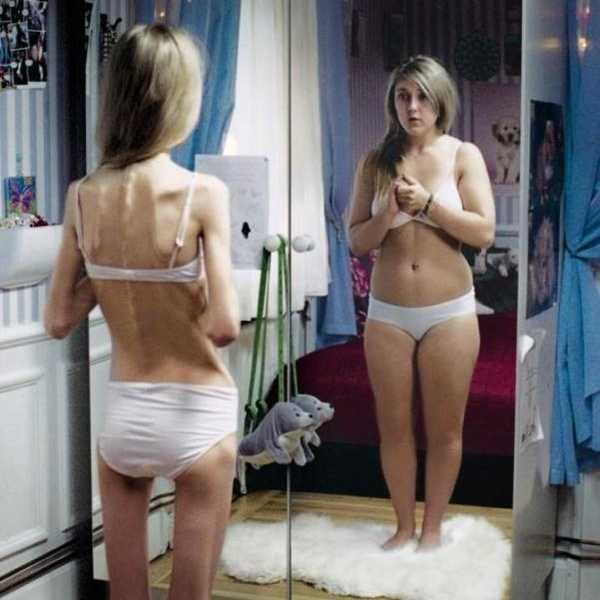
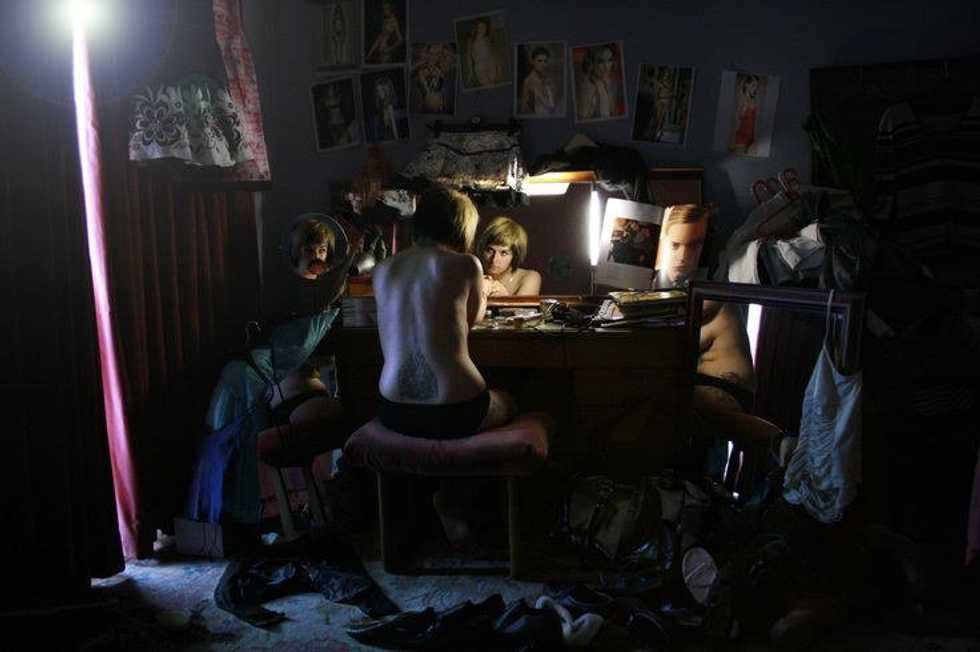
You imagine your skin hanging from your stomach, folding over your pants. You think it’s loose and bounces while you walk. It feels like your arms are heavy and flabby weighing you down through every stride you take. You feel like people are looking at the fat that lingers on your outer-thigh—that bubble a few inches below your hips. You’re fixated over what you see in the mirror and question constantly, is this really what I look like? You feel at your body, pull at your face, and pick at the unnoticeable scabs and pimples hidden in your skin.
While looking in the mirror, your insecurities blind the reflection right before your eyes. You can be a skinny girl whose skin is fitted to the bones you’re born with, but you see a hippo drowning in swamps of fat. Sometimes something clicks in your brain and you question: Is this all in my head? (Which most of the time it is all in our heads), but you bounce back to your critical self and can’t find a way out of the labyrinth of your mind.
You think everyone sees the flaws you imagine to be present. That your so-called “loose skin” and ‘jiggly thighs” consumes everyones perception of your appearance, but, in reality they don’t. Sometimes the way you view yourself can take over your brain to the point where you have manipulated yourself into actually believing that you are who you think you are, rather than who actually are. Often times, those very minute flaws that you think are prevalent or noticeably obvious are not even noticeable or not even there.
You’re in fear of what you think to be true— that you are someone you are not. Why do you feel this way? Why do you feel so uncomfortable in your skin? It’s as if your insecurities eat away at your brain and force you to believe that you need to lose weight, diet, train insane, get plastic surgery, be taller, be shorter, have bigger this, smaller that, and ultimately look like the models and actors you see on screen, and in magazines.
I am no doctor, but I am someone who comes from experience. If you feel like a person blinded, overwhelmed or lost in the sea of body image issues, than you may have a case of Body Dysmorphia. Body Dysmorphia, scientifically known as: Body Dysmorphic Disorder (BDD) is a psychological disorder in which we become obsessed with imaginary defects that we believe to be true based on our appearances.
I was influenced by what I saw on television. Being a 5’0 girl, whose curvy and has short legs, I envied models and actors who had long legs and a petite frame (something I couldn’t necessarily obtain due to genetics). I saw my legs as being the size of elephant trunks when I looked in the mirror, and would poke at my stomach pulling at my excess fat, constantly. I work out all the time in hopes of either toning my legs, or losing that pudge in my belly. I allowed my negative critiques on my physique to destroy every positive thought I had of myself. I recognized this was an issue when my family and friends would tell me they see "no fat" or say, "what are you talking about?" when I asked if I looked a little chunky. Often times I cried when I looked in the mirror, but mediated on the idea that it is all in my head.
I have no shame in admitting that I have a case of BDD; it is extremely common, especially in teenage and college student girls. It is something that has consumed me, and has overwhelmed me at times, but it also something I am working on and something that I know can be fixed and changed. In order to love myself and my body and what I see reflected in the mirror, I have to see past all these alleged ‘flaws’ and recognize all the beauty within me and on the surface.
Many other people, too, are influenced by what they see on television, in movies, or in magazines, but the truth of the matter is that those models and actors are either photo shopped, have unhealthy habits or have loads of money that they can spend on trainers, a healthy diet, someone to count their macros etc. all helping them look the way they appear at surface level.
Recognizing that you have BDD can be hard and painful, but like I said, it’s common and can easily be fixed with awareness and love for yourself. Coming from someone who has suffered and sometimes still suffers, I practice self-love and mediation through things that I find to be peaceful and relaxing. I also don’t feel ashamed of my BDD and I don’t listen the comments some people often say like, “you’re just talking about the way you look for attention,” or “you’re crazy” when I can't defy my insecurities and I allow them to manipulate me. BDD is not a joke, and it is a disorder, which should not be taken lightly.
With the media being so prevalent in our lives, it is hard to ignore what we see on screen, on our phones or in print, but we have to remind ourselves that we are who are and embrace the beauty we are born with. If we are unhappy with how we look or feel, instead of complaining and being upset, find a solution! Body Dysmorphia is something many people live with. They either don’t recognize they have it, or feel too ashamed to admit it.
If you do have BDD, good for you for recognizing it! The next step is loving yourself, embracing your beauty and finding a solution to the problem. Don’t live in fear of your insecurities and definitely do no feel ashamed. You’re not alone.