
The college campus is more intricate than simply a location where students live and receive an education. Every college campus has its own culture, Georgia Tech included. From a sociological perspective, culture is defined as “The common heritage shared by the people of a society, consisting of customs, values, language, ideas, and artifacts.” Humans create meaning together. And being human, we either conform and abide by the norms and values and/or create sub-cultures. An example would be the Free Speech Movement. But, before we even begin to analyze the subcultures, we need to understand the mainstream culture at Georgia Tech. What exactly is the norm here? Well, by observing campus activity, conducting interviews with students, and experiencing Tech myself, I was able to grasp what this culture entails.
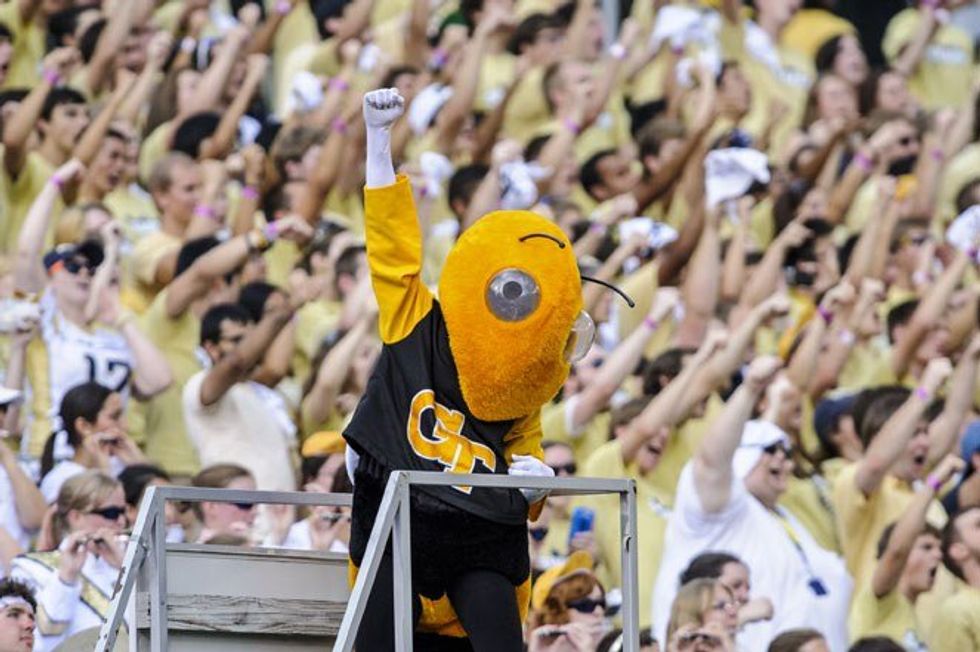
Now, school spirit is typically associated with sports teams, but the interviews that I’ve conducted have shown otherwise. It should be noted that the enthusiasm among first year students is higher than the enthusiasm among older students. I have spoken to older students who don’t particularly doubt Tech, but rather, take their feelings out on Tech when a bad test grade comes back. So yes, the school spirit among first years is typically higher than in other years.
Now, although Tech has a several great D1 sports teams, it is not considered the main reason why students love the school so much. At Tech, students pride themselves primarily on the academic rigor and prestige they earned the privilege of encountering each day, and so intelligence is valued highly. The approximate percentage breakdown by general study category is as follows here at Tech: 2 percent architecture, 4 percent Liberal Arts, 5 percent registrar, 9 percent Business, 7 percent sciences, 10 percent computing, and 63 percent engineering. Thus, being an engineer is part of the mainstream culture, too. When walking through the campus, it is so easy to assume that everyone is an engineering major before remembering that there are other majors offered here. It is an easy mistake to make; after all, peers in our classes are typically of the same major category as us. This is exactly what defines the Georgia Tech community.
Being naturally driven and ambitious, Georgia Tech students will immerse themselves in whatever it may be that they are passionate about, especially when it comes to supporting their major. I met a computer and electrical engineering major who joined the IEEE and the hardware team because it aligned with his academic agenda. He felt as if it was a “beneficial organization to learn about electronics and direct applications and implementations in the real world.”
The phrase “It’s not about what you know but who you know” doesn’t fully apply at Georgia Tech, because these organizations that students join are about contributing to their education, as well as making connections with those having the same interest, or major, most often. At Tech, there is a unanimous ambition for success using Tech’s many organizations as tools. These organizations, so deeply rooted in our passions, create our subcultures. However, while being so passionate supports our academic and self-growth, it hinders our ability to branch out. For example, I used to be member of Georgia Tech Motorsports Team, which is comprised of 95 percent Mechanical Engineering majors. To no one’s surprise, I’m an ME myself. This was my primary form of social activity at the time. This explains how it is so easy to forget there is more to Tech than just engineering. Our involvement, ironically, distances us from the rest of the Tech community. Conscious of this, I joined the rugby team to create a bit of separation between work and play.
It is so easy at Georgia Tech for your passion to become your social life. This allows us to understand how certain places on campus define social life. The fraternity and sorority subcultures, which take up the vast majority of East campus, define East campus as the louder, less academic party zone. West Campus, on the other hand, is defined as the quieter, studious zone being in a desolate location. The CULC, being geographically centered and academically resourceful, is viewed as neutral. Everyone knows what the CULC is and everyone has set foot in it. The CULC is the holy grail of student integration and is implicitly considered the rare union between east and west campus, between all students. The CULC attracts every one of all interests, of all backgrounds, of all passions. For this very reason, the CULC demonstrates that our campus as a whole is diverse, yet it reminds us that diverse is not the same as integrated. Attempts have been made at uniting the freshman class, through the introduction of the Freshman Experience programs in freshman residence halls, but alas, not many people go beyond the small elevator talk. Could it be that Georgia Tech is too populated to support successful integration?
Ah. So because this campus is so densely populated, it is, in fact, nearly impossible for students to simply mix in to the solution that is Georgia Tech. It is like trying to dissolve several sugar cubes in a drop of water. Students have no choice but to stick to what they already attached to. But, what if there was less sugar? Then would the sugar dissolve? Of course. Of course it would. With the same level of diversity among a smaller population, students wouldn’t be able to form these subculture as easily. This is why the CULC is so culturally significant, because it can allow students to mix together, keeping diversity constant while decreasing population size. Online demographic percentages tell us nothing about the integration levels at Tech. You have to be in it to understand it.
The Georgia Tech culture is so heavily defined by the subcultures, that the subcultures make their own rules. The sugar cubes, as I mentioned before, are so very intact. Sure, we attempt to unite ourselves through traditions such as the Ramblin’ Wreck song, but, in truth, we lack the complex understanding that there really is no definitive culture at Tech. The different subcultures define Georgia Tech.
I leave you with this: every college has its own culture. And every culture has its own subcultures. The prefix “sub” should not deceive, especially in this case, where the mainstream culture is defined by the presence of a myriad of subcultures.