The theory has been promoted for at least half a decade. The theory has been looking for piggy-backers. And, until recently, the theory has waxed true; that is, before the introduction of Karl-Anthony Towns. Of which I speak, the theory revolves around the death of the NBA big man. Having gained leverage in 2013, after the All-Star game abolished the Center position from its ballot, many thought the "man in the middle" was only one-dimensional, and insignificant.
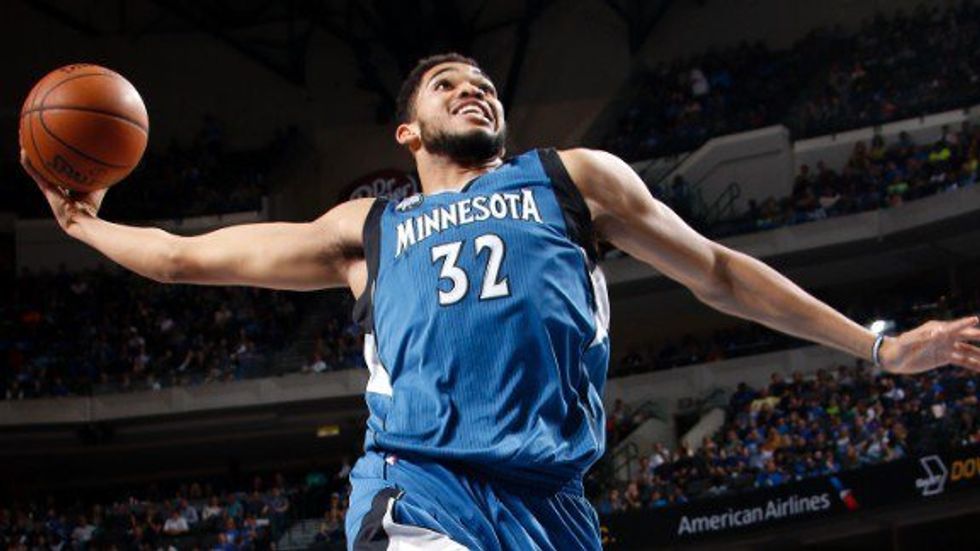
Sure, the Golden State Warriors have effortlessly transcended association norms by playing "small ball," taking positionless basketball into a realm of efficiency, intelligence, and fluidity. However, it should be understood that there is (and will always be) a place for a near 7-footer who can stretch the floor, dish from the top of the key, and abuse defenders with a well-structured repertoire of post moves. You can deem this an evolution, where the hailed centers of old, have been transformed into a forward-type player slotted in the 5 hole. Oh, and a slithery shot-blocker will always be welcomed in today's NBA. Enter: Karl-Anthony Towns.
After seeing him light up the NCAA for one season with the University of Kentucky, I saw him play his first game at the BMO Harris Bradley Center, as he posted 15 points in the first quarter. Granted, this was against an underwhelming Bucks team, but hooks and face-ups coincided with crafty dribbling and fantastic court spacing from number 15.
All was evident that night: I was watching the embryonic strides of someone who will only continue to possess a prized game predicated on spaciousness, mobility, dexterity, and sagacity.
Throughout his rookie season, Towns' average speed has been floating around 4 mph, which lends credence to the hybrid big man, as it ranks ahead of John Wall and Chris Paul. Towns is unique in that he can run the floor, stymie offenses within 5 feet of the basket, and can play the 4 (while guarding all frontcourt positions) if needed; this is very reminiscent of Towns' current teammate Kevin Garnett.
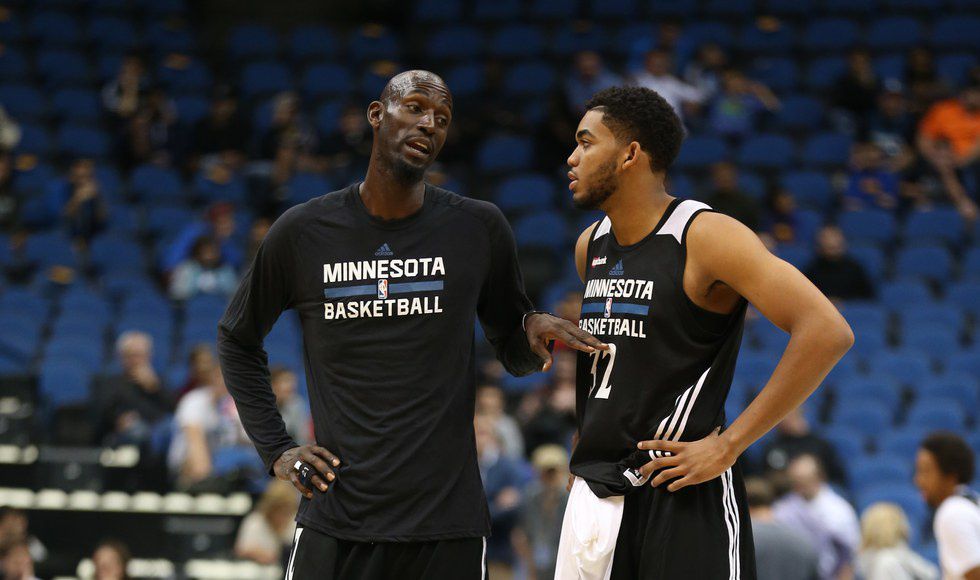
The 15-time All-Star, Garnett, will continue to influence Towns' game, as well as the rest of this young Wolves team.
Also, like his protégé, Garnett entered the league with a freakish body, an interesting mentality, and a great shooting stroke.
There is hardly a Rookie Of The Year argument, for a player who ranks 14th in the league in Player Efficiency Rating (further explanation on the statistic is here). There is not much to his game that needs improvement, as he is a respectable free-throw shooter and a decent ball handler.
He shoots at a brilliant volume, keying in on shots that are given to him. Among players who log more than 20 minutes per game, he ranks in the top 30 in effective field goal percentage (a stat which puts more 1.5 times the emphasis on 3 pt. shots than 2 pt. shots).
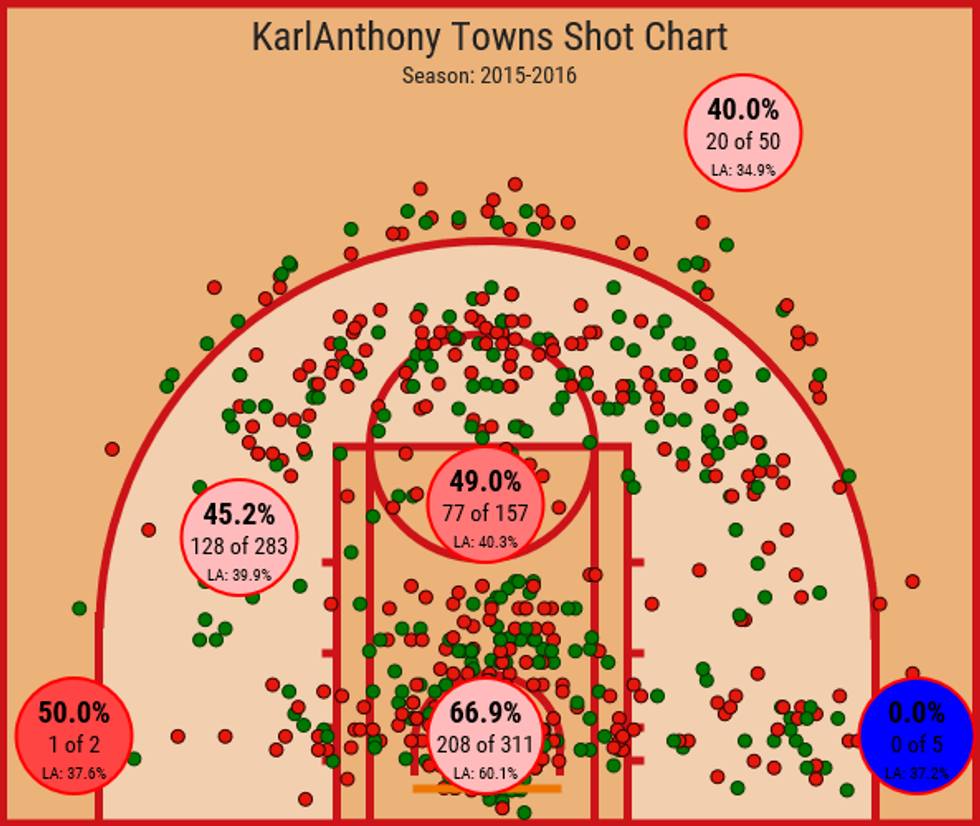
His ilk makes people consider who the best center in the NBA is. Meanwhile, with the nucleus they have established, the Timberwolves should slowly ascend the ranks of the Western Conference within the next few years. With Andrew Wiggins carefully cementing his game, while the Kentucky product should be able to have lessened attention on him, making Minnesota a living hell for opposing teams.
Off the court, there may be a lot of mysticism with Towns; but on the court, there is a cosmological certainty that the hybrid center will forever be synonymous with KAT. With a hyphenated name, it is only fitting that Karl-Anthony Towns is the leader of the hybrid vanguard that is sweeping the game of basketball.