
Certain faces define eras. When this phase of American history is examined in the future, Barack Obama and George Bush’s faces will smile up from glossy textbook pages. Musicians will not likely make the cut. But musicians and artists are the ones that live on, through genuine or fabricated personas. They inhabit a world outside reality - a world of burning-hot pop culture kept alive largely by the enthusiasm of youth.
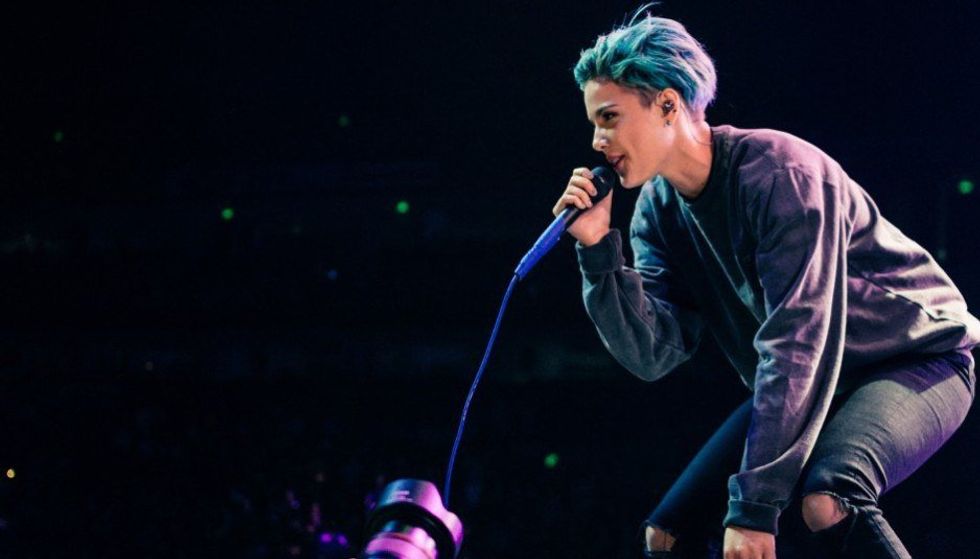
Today’s youth has a unique platform to express our visions. Millennials’ voices are becoming more and more important and influential as social media allows for broader platforms for communication. This is where Halsey - a singer who completely built her image on social media and personal relationship with fans, and who will be performing a sold-out show at Madison Square Garden this August - comes in. Bursting onto the scene in a flare of color and effortlessly polished sound that one would never guess was recorded in her friend’s bedroom, Halsey is a newcomer who is already changing the face of the music industry. In quintessentially millennial style, she built her image on social media, and now is a dedicated, outspoken force poised to become a central player in pop music.
Now 21 years old, Ashley Frangipane was born and bred in New York. Her stage name, Halsey, is the title of a Brooklyn street she often spent time on when she was a teenager. Her cataclysmic rise to fame was not supercharged by the support of a massive record deal or relentless promoters; instead, she grew her fan base on social media, through Tumblr, Instagram, and a deeply personal connection to fans. This connection has continued to carry through her ascension to the top. Her first album, Badlands, had 2015’s third best opening for a solo album.
Halsey’s music is electric, grounded by streamlined, neon beats. Badlands is filled with euphoric moments, songs about driving on infinite-seeming highways, conjuring images of trashed hotel rooms and dark Brooklyn bars that one cannot help but see as hopelessly gorgeous when she conjures them up. It's a teeth-grinding, sleek combination of edginess and pop, and the product is an enchanting wild ride of a record that has launched her towards international fame. She is a hurricane; she is in love; she is full of rage; she burns in the spaces between these things.
Despite its romantic imagery, the album has an undeniably dark heart, built on grittiness and an almost hysterical energy that bubbles just beneath the surface. “God damn right you should be scared of me,” she hisses in Control. Later, on Gasoline - a track she added at the last minute - she snaps, “Are you insane like me, been in pain like me? Bought a hundred dollar bottle of champagne like me, just to pour that motherf**cker down the drain like me?”
It’s these moments of unmitigated pain and honesty that define Halsey’s image. Halsey is bipolar, and Gasoline seems to be about a manic episode. The fact that she has chosen to sing and speak so openly about a mental illness that is so often stigmatized is a vitally important move towards more conversations and more improvements in how mental health is viewed and handled by society as a whole.
Still, there have been repercussions for her openness. All the attention is “a really positive thing if you feel you want to represent that, you want to show people you can be functioning, you can be admired and you can be idolized and still have a mental health illness,” Halsey said in an interview with Dazed Magazine. “It’s a positive thing, but at the same time it becomes kind of frustrating because I’m a musician.” Her honesty about her mental illness differentiates her from many other stars who sing of 'insanity' as if it is a beautiful tool for inspiration and mystique, when the reality is that mental illness is a disease. “They’re like, ‘I want to be with someone who is like crazy,’” she has said of people who associate mental illness more with thoughtful melancholia and less with the exhausting trial that it actually is. “Well, guess what? It’s not all painting at four o'clock in the morning and road trips and fucking great things. Sometimes it’s throwing things and, like, getting hurt and having to pick someone up from the police station at two o'clock in the morning. My biggest fear has always been being that woman.”
Whether or not she has accepted it, her image and outspokenness have grown “bigger than her body,” to borrow a quote from Control. Thus has always been the nature of the type of fame that spreads like wildfire. It often consumes artistic intent and truth.
It’s lucky, then, that Halsey’s image is so centered on honesty. She has the potential to be a a positive role model for thousands of youth who have struggled with poverty, mental illness, sexuality and more. The importance of role models for younger kids dealing with issues like hers cannot be overstated. She has been called “tri-bi’ in reference to the fact that she is bisexual, biracial, and bipolar, a term which she has since expressed her dislike for due to how it reduces the significance of each term.
Despite the unfortunate nature of the labels that result, Halsey continues to be overtly supportive of outsiders. At her October 22 concert at Webster Hall, she shouted out over the crowd, “This is for anyone who has trouble coming to terms with their sexuality - it sure took me a hell of a long time.” Later, in a much quieter voice, she said, “This is an album that I recorded in my friend’s bedroom.” That day, she announced her August 22 performance at Madison Square Garden; two days later, the show sold out.
Halsey has burst onto the scene of a generation that has grown up with social media, so more than the majority of other artists out there, she is able to identify with the experiences and match the pulse of today’s youth. Social media platforms have serious downsides, but they have created a generation that’s safe to say is far more aware of social issues than ever before, and Halsey is the living embodiment of the positive sides of social media culture.
The fact that this generation relates so deeply to Halsey is extremely telling about modern times. This is a time when LGBTQ+ communities are gaining strength, and social consciousness about vocabulary and marginalization and feminism are more talked about than ever before. In the same vein, mental illness diagnoses are becoming increasingly common. And Halsey is not in denial of any problems; she addresses them head-on. Where Kurt Cobain voiced the rage of the 1990s, Halsey is a voice of dissatisfaction, of a generation tired of being ignored and branded as lazy. She is a beautiful writer, reflecting a passion for the electronic and futuristic mixed with heady nostalgia - a combination that reflects many social media trends of today. Where the 1990s and earlier generations were defined by anger, the 2010s seem to be heavy with dissatisfaction and unsettledness, largely sparked by growing up in an uncertain world surrounded by perfect images broadcast through fake social media profiles. Halsey’s realness, or her superbly well-designed image of realness, manages to embody and break through this at the same time.
Whatever brew of ingredients Halsey used to gain the love of her fans has worked for her, and luckily for us, she has been using her imperfections for positive good. “We need a feminism that is not negligent of women of color, trans women, queer women. We need a feminism that protects ALL women. Globally,” the star said via Twitter.
Halsey’s image almost transcends her art; she has voiced worry in the past about the selfies she has posted on social media being more popular than her music. In 2015, she shaved her head, partly in order to escape those who inevitably defined her by her looks. She’s also been honest about the person behind those perfect photographs. Like many of today’s youth, she has experienced bullying on social media, and she often reads her own reviews, negative and positive. She told Evening Standard Magazine that “having people attack you in a personal way is the price you pay for being able to connect with people. If I’m opening my arms for you to come running into them, you can also shoot me in the chest.”
She’s a suburban Jersey kid and an international superstar, a confused youth and a talented lyricist with a propensity for hard-hitting metaphors. This duality defines her. Recently, she told USA Today that “I think kids who grow up in the suburbs make for the best artists, because you almost develop two personalities. You've got this one that's really calm and reserved, a small-town kind of person. And then whenever you're somewhere greater, whenever you do run off and escape to the city, you get to be that person you wish that you were, that bigger personality.”
Behind that personality and image is the music, and the songs are beautiful, enchanting and multi-layered, thick with fire and ice, patterned by electric beats and metallic sound effects. Her music is making strides - she recently collaborated with Justin Bieber on the song The Feeling, a combination that worked surprisingly well. And beneath all the glamour and the fame, there’s a foundation of appealing electricity to her songwriting. Halsey’s music evokes a world in which young people can experience pain, homelessness, illness, and more - where they can be the outsider- and can still make music and become successful, without the help of big record companies or extreme changes. For this reason, her public persona stretches far beyond her music. She is setting a precedent for a world in which public figures will hopefully be more honest about mental health and other struggles that so many people face and that are still stigmatized. In a way she is the Bernie Sanders of pop music - anti-corporate, controversial, somewhat inexperienced but undeniably magnetic, and with ideas that could change the world - though perhaps not yet our current world.
Halsey herself dislikes the voice of a generation label, a term often applied to her song New Americana due to its candid portrayal of modern American culture. But it is this deep willingness to express herself - coupled with the futuristic escapism of her music and the inevitable glamour that seems to surround her image - that makes her the perfect voice for a generation built on flawless social media images juxtaposed against online candor and a pervasive sense of uncertainty. She may not like her labels, but like the city that inspired her name, she is built upon them. It’s lucky that the music she makes is strong enough to provide a solid foundation, but it’s anyone’s guess how high the skyscrapers that rise from it will reach.