Self Injury. In the past, it was something that hid in the shadows. It was something that only “crazy” people did. But in recent years, self injury has gained prominence as a problem in our society. Despite its growing stature in our culture, very few people actually know what self injury is and why people engage in such behaviors. Many think that self injury, or SI, is strictly cutting. What’s worse, it is often assumed that people injure themselves strictly for attention. It’s a touchy subject that remains taboo in our culture, and, as a result, is rather misunderstood.
Over the years, self injury has gone by many names. Deliberate self-harm, or DHS; parasuicide; self mutilation; self-inflicted violence; cutting; and self-abuse have all been used to describe what will be referred to in this essay as self-injury. (Alderman) The medical term is Non-Suicidal Self-Injury, or NSSI.
What is self injury? SI is “a deliberate and intended action designed to cause harm to your own self. This usually takes the form of a physical self injury although can include emotional/psychological consequences.” (Clark) Contrary to popular belief, people who SI don’t necessarily have a mental illness. Sometimes people who SI are just stressed, angry or frustrated. They may have low self esteem issues, be dealing with bullying or domestic violence, struggling with their sexuality or any number of other issues. Self Injury is a form of a coping mechanism. (Perlman)
While not all those who struggle with self injury have a mental illness, mental conditions can be linked with SI. Self Injury is not itself a mental illness, but there are several mental health conditions associated with it, including: Borderline Personality Disorder (BPD), Depression, Eating Disorders, Anxiety and Post-Traumatic Stress Disorder (PTSD). (NAMI)
Suicidal ideation can also be linked to Self Injury. People who engage in Self Injury are far more likely to attempt suicide.”The temporary escape that self-injury provides could be a precursor to the more permanent escape of suicide.” (Arnold) However, while suicide is linked with SI, someone who self injures is not inherently suicidal. In fact, there is scientific evidence that backs up why Self Injury appears to work so well as a coping mechanism for those who engage in it.
In our brains, there are neurotransmitters that carry electric signals within our nervous system. Among these transmitters are endorphins, which can be found primarily in the pituitary gland, as well as distributed throughout the brain and nervous system. Endorphins, specifically, are released when we experience stress, pain, or extensive exercise. They change our perception of pain by interacting with our opiate receptors. They behave much like pain killers. Endorphins can also induce “feelings of euphoria, modulation of appetite, release of sex hormones, and enhancement of the immune response.” (Stoppler)
Self Injury causes a fast release of Endorphins that masks our physical and mental pain and can, in fact, create a sort of high that can be extremely addictive. Endorphins can therefore become a kind of self-medication. (McAllister) While it can prove effective, it comes with a plethora of nasty possible side effects, from severe blood loss, chronic pain, infection, avoidance of social situations, permanent scarring, tissue damage, delusional thoughts, broken bones, or even death. (The Refuge)
Despite the chemical and emotional reasons people self injure, it is difficult to really understand why anyone self injures without talking directly to them. In a 2015 poll of 17 anonymous NH residents, 13 had previously self injured. Most of those who had engaged in SI were between the ages of 18 and 29. When asked for insight on their SI, there were a variety of responses.
Respondent Nine was a young adult between 18 and 29 who admitted to engaging in cutting and bruising. She confided that her self harm began as a self-punishing behavior that stemmed from physical and emotional abuse at the hands of her mother. She got clean with the help of her boyfriend, but still struggles regularly with her urges. When asked if she had something she’d like to let the world know about SI, she responded “Someone who self-harms isn't doing it to hurt you or to spite you. The one thing that means to world to someone who suffers is patience and understanding and love. Getting angry with someone you're trying to help will only make them feel pathetic and weak, and chances are someone else is already making them feel that way.”
Also between the ages of 18 and 29, Respondent Five had a history of cutting. She explained that her SI began after learning that her vocal chords were permanently injured and that her singing career was probably over. She describes being soothed by the sight of blood running down her thigh and feeling relaxed by the process of cutting. She was asked how she had quit Self Injuring and she replied “I realized that a huge cause of my depression and subsequent self harm was people around me. I also realized that there was more I could do with my life, and that the injury to my vocal chords may have been a blessing in disguise. It left me free to choose what I wanted to do, rather than just go with what I was naturally talented at (but wasn't necessarily what I wanted). I realized there was more to live for than just singing.”
Respondent Seventeen was 18 years old. She admitted to deliberate Cutting, Bruising, and Scratching. She has been diagnosed with Anxiety-Triggered Depression and Posttraumatic Stress Disorder. She started self harming because it was a pain she was in control of. At the time of the survey, she had been clean for just over three weeks and going strong. She wanted people to know that “[Self Injury] isn't about attention. If you love someone who self harms, don't blame yourself. And if you are struggling, there is help. I promise you.”
These ladies are not alone. One in Twelve young people self injure, according to a 2008 study. Most of these people are girls. And ten percent of those people continue to engage in SI into young adulthood. (Kelland) Another study suggests that eight percent of third graders had engaged in SI at some point in their lives. (Raison) And yet another statistic reveals that 30-40% of people over the age of 17 have self injured. (The Refuge)
There are resources available by the dozens to help those struggling with self harm. Counseling and therapy can be enormously helpful in finding better coping mechanisms. In some cases, medication may be beneficial. Additionally, To Write Love on Her Arms is a non-profit organization dedicated to giving people hope for the future. The Butterfly Project may also be helpful in starting the quitting process. If you text GO to 741-741 you will be connected with a non-emergency crisis counsellor who can help you develop a plan for yourself or a loved one. And the 24-hour crisis hotline is available at 1-800-273-TALK at all hours of the day.
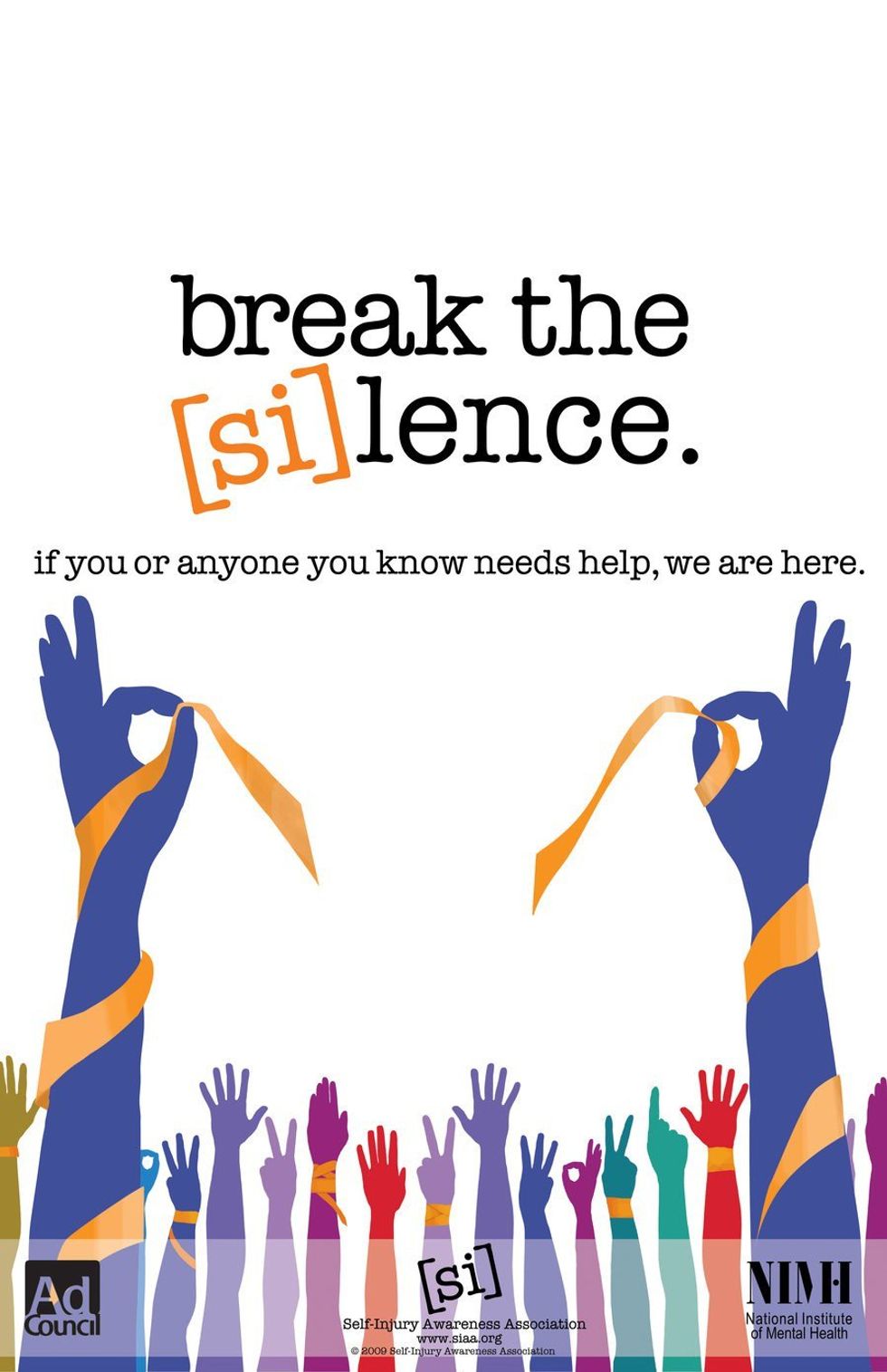
Don’t stay silent. There is hope and you are not alone. If you or someone you know is battling Self Injury, reach out. Self Harm is prevalent in today’s society. It can be dangerous, but there is help available. So why aren’t we talking about it?
Alderman, Tracy, Ph.D. "Self-Injury: Does It Matter What It's Called?" Psychology Today. N.p., 28 Nov. 2009. Web. 05 Nov. 2015.
Arnold, Carrie. "How Neuroscience Explains the Urge to Self-Harm – Carrie Arnold – Aeon." Aeon Magazine. N.p., 13 Oct. 2014. Web. 12 Oct. 2015.
"The Butterfly Project" Tumblr.com. N.p., n.d. Web. 09 Nov. 2015.
Clark, Jonathan. "Self Harm: Roots, Reasons and Response." Mindandsoul.com. Mind & Soul, 09 Dec. 2011. Web. 08 Oct. 2015.
"Crisis Text Line." Crisis Text Line. N.p., n.d. Web. 09 Nov. 2015.
Kelland, Kate. "One in 12 Teenagers Self Harm, Study Finds." Reuters. Thomson Reuters, 17 Nov. 2011. Web. 12 Oct. 2015.
McAllister, Dawson. "What Happens to Your Body When You Cut?" Dawson's Blog. TheHopeLine.com, 27 Feb. 2014. Web. 12 Oct. 2015.
"National Suicide Prevention Lifeline." Lifeline. N.p., n.d. Web. 09 Nov. 2015.
Perlman, Julia. "Why Do People Self-Harm?" TheSiteorg. N.p., 29 Sept. 2012. Web. 12 Oct. 2015.
Raison, Charles, Dr. "Doctor: Why Are We Surprised That Kids Hurt Themselves?" CNN.com.
Cable News Network, 15 June 2012. Web. 08 Oct. 2015.
"Self-Injury: Statistics, Causes, Signs & Symptoms." The Refuge. N.p., n.d. Web. 12 Oct. 2015.
"Self-harm." NAMI: National Alliance on Mental Illness. N.p., n.d. Web. 09 Nov. 2015.
Stoppler, Melissa Conrad, MD. "Endorphins: Natural Pain and Stress Fighters." MedicineNet.com. N.p., 1 Dec. 2014. Web. 12 Oct. 2015.
Thomson, Sharleigh. "The Why of Self Injury - Trigger Warning" Survey. Surveymonkey.com. 29 October, 2015 Web.