
Whispers, murmurs, and giggles escape the mouths of a hundred students at once, uniting half of my introductory journalism class to a common cause. What caused this reaction? It wasn't a joke or an embarrassing mistake by one of the professors; it was a confident blonde girl in the crowd who started her sentence with "As a Trump supporter, I..."
It's as if no one in my class attended kindergarten, the grade where I learned to respect all human beings, no matter how they look or act, or what their opinions are. I saw their reactions to her statement as indicative of the culture we now live in, where people have to be afraid of negative judgment every time they state what they believe. And that's not right.
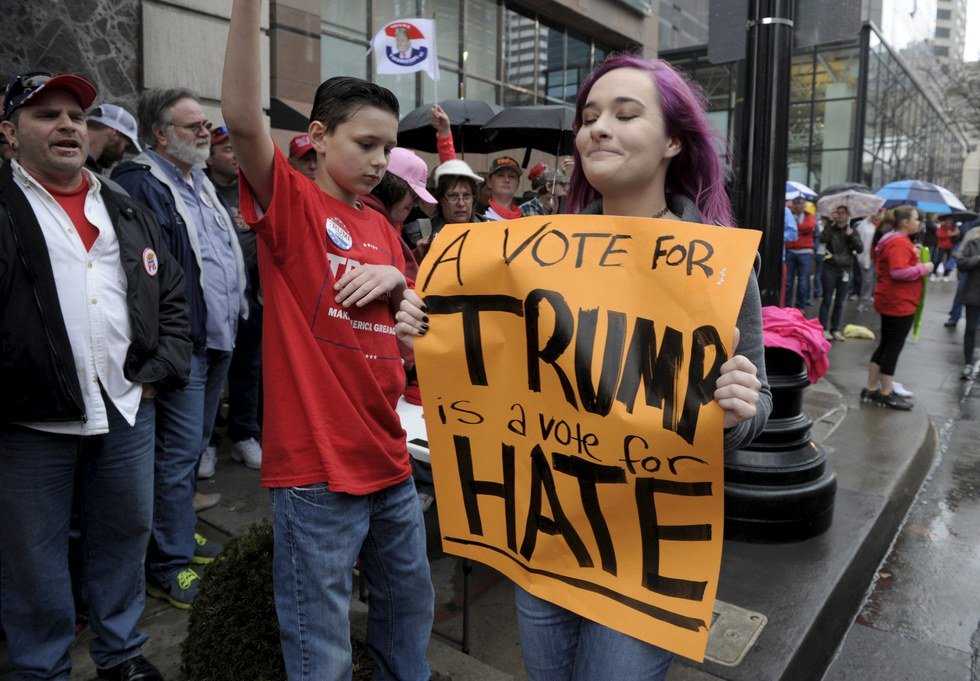
Anyone who openly hates an entire mass of people for what they believe is a bigot, and if you hate Trump voters for supporting a bigot, you're a hypocrite.
Even Nicholas Kristof, an openly anti-Trump op-ed columnist for the New York Times, agrees that hating Trump supporters has no positive effect on our country, it only polarizes us further and closes the minds of those whose minds you want to change. Instead, attempting to understand someone else's views is productive and helpful in learning more about the world and its varying political opinions.
Think of it this way: if you really like, say, Frozen, and that's something you're completely passionate about, and someone starts to make fun of you for liking it, what would you do? Either defend it wholeheartedly or keep your mouth shut, right? Neither of those things involves you considering that you're wrong. If instead someone told you in a calm and reasonable voice that you may like a different movie, perhaps Tangled, more, you would be more open to trying it out.
While politics is more complicated than a Disney movie rivalry, the point still stands that mockery gets you nowhere.
We need to work towards unity instead of inadvertently championing discord. Politics has the power to tear apart families, destroy communities, and alienate groups of people. Stop giving it that power.
Not all Trump supporters are misogynists. Not all Trump supporters are homophobic. Not all Trump supporters are racist or elitist or whatever-you-hate-ist. All Trump supporters are, however, people. And people have the right to their own opinions.
So next time someone expresses a view you don't share, don't shut them out. Ask them about what they believe and share what you believe. It's called a conversation, and once you open one, you'll learn a lot. And who knows, maybe this hypothetical person will change your mind.