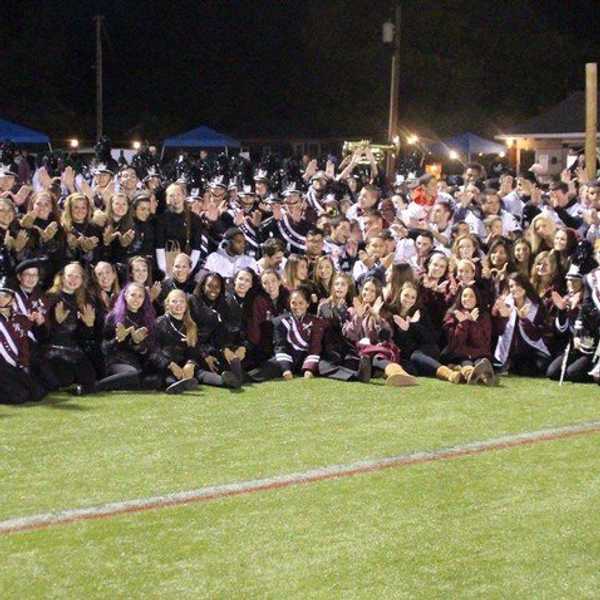
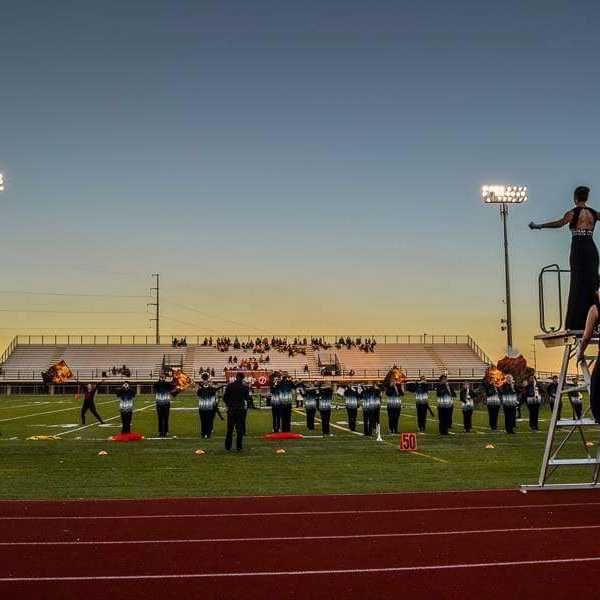
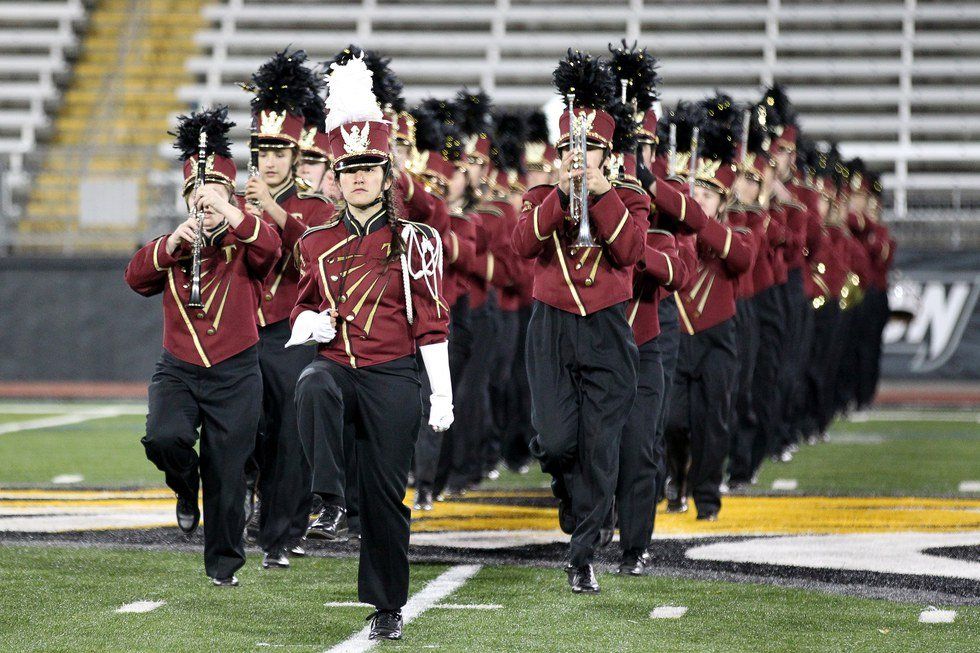
At a high school Friday night football game, you will see these things: the football team playing, the cheerleaders cheering, the crowd supporting, and the marching band playing. At the game, it is certain that the band will perform at halftime, just as the quarterback will throw the ball or the cheerleaders will cheer to the crowd. It’s a simple tradition for marching bands that causes a lot of controversy.
Fox Sports News reporter, Clay Travis, recently stated in a tweet that “the change I’d make (to football games) would be no damn bands at halftime.” (Here’s the full tweet.) This “solution” resulted in major backlash from the marching band community and football game attendees.
Why is it that some people still don’t think bands should be allowed to perform at halftime?
In a podcast, Travis explains his reasoning behind wanting to get rid of marching bands at halftime. He pointed out two things. (Check out his full response here.) For one, he said that the band takes up so much unnecessary time at football games. Secondly, he thinks people attending the games do not care about the band.
Bands, on average, have all of halftime to perform their show. This can range anywhere from 10 minutes to the maximum time of 28 minutes. The two schools’ bands split the time, both having shows that are about 8-10 minutes in length. Truly, halftime is not long enough for both bands to perform. More often than not, referees cut performances short in order to stay on track and start the game once halftime is officially over.
That is reasonable—of course football games should be starting once the clock runs out. Bands however, are allotted a certain amount of time that simply doesn’t allow them to do what they do in the given space. Travis’ case is that halftime should be shorter, and bands should perform before or after the game. However, that then makes the band’s “time to shine” redundant, as the crowd will obviously be much smaller if it isn’t during halftime.
Travis then continued to say that people who attend football games do not care about the band, therefore if they want to see the band, they can come before or after the game to watch them.
Marching bands in high school and college get halftime to perform their show, and it is not understood how much time truly goes into creating these performances. Just as a football team practices every day, a marching band also practices daily. Just as the football team warms up and prepares for a game, the band warms up and prepares to perform. Just as the football team is proud of their team whether they win or lose, the band is proud of themselves after every halftime show.
The misunderstanding of how marching bands work stems from the unfairness that results in high school. From coining terms like “band geek,” to giving them less funds every year, people simply are unable to understand why they do what they do.
When it comes to funding, it is known that the arts get funded less every year and “athletics” get funded more. The reasoning? Band is there as a support to these teams and without proper funding for the actual team, the band in question would have no events to go to. According to U.S. News, more than 80% of high schools have cuts their budgets for the arts within the last 8 years. Furthermore, schools are dropping art programs, like marching band, from their extra-circulars due to the fact that they can’t be funded.
The focus on Common Core diminishes the need for art programs because they aren’t being tested for it. The SATs and ACTs aren’t asking students about their musical and artistic knowledge, so schools have decided that those programs shouldn’t be available. Their theory is that by ridding of art programs, they can fund more Math and English classes, therefore improving students’ scores on those tests.
It is shown however, that participation in activities such as marching band improves scores. Students who take four years of some art class do, on average 91 points better on SATs. Even then, students who participate in marching band have better attendance and motivation to do school work. The same goes for athletes who play football, soccer, tennis—extra-curricular activities get students to class.
Why are students who participate in marching band held to a different standard? It is physically demanding. Students spend hours outside in the summer and during the school year practicing. Students have practice every day after school. By participating in marching band, students are able to get scholarships and pursue a college degree—just like a football player. They can get scholarships to perform at halftime—which is what they are there to do.
Marching bands get halftime—that’s how it has always been. Halftime shows are one of the reasons why crowds of people flock to stadiums on Friday nights. Seeing the many different aspects of a school—the football game, the cheerleaders and the band, shows how the school supports each other in a positive way.
Bands need funds, and bands need support. In order for marching bands to get proper budgets and respect, marching bands first need understood. Clichés like “band geek” do not truly represent the hard work that goes into their activity of choice. Just as athletics are funded, marching bands should be funded the same. All activities like football, basketball and band are physically demanding and require a lot of effort, time, and practice.