
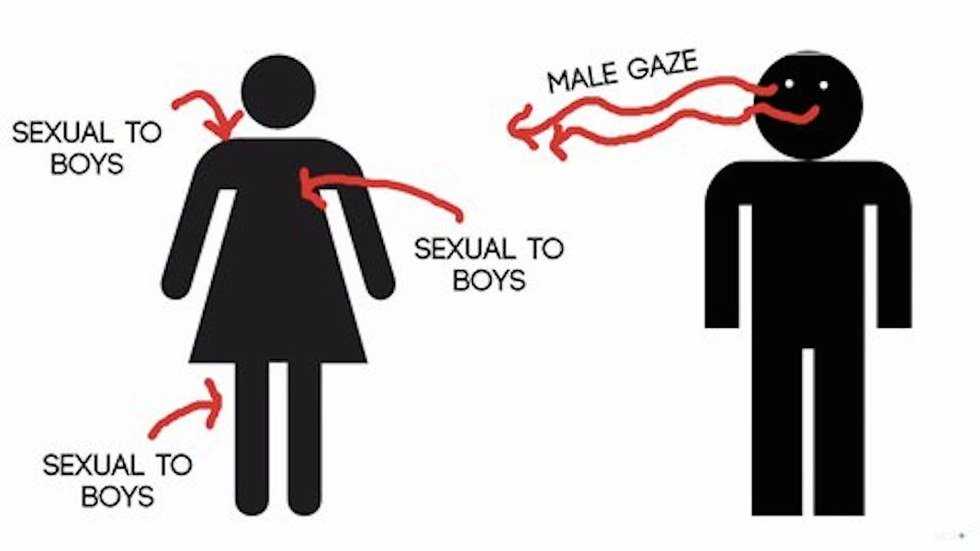
In high school, there was always a conflict between the staff and students over what was considered inappropriate or revealing clothing. While I rarely ever had issues with this myself, I knew plenty of people who did. After hearing of an incident this week where a young lady was scolded for having a shirt that revealed a portion of her shoulders, I feel the need to address this issue. The dress code itself has gotten out of hand and is a direct correlation to other issues regarding the over-sexualization of the female body.
As a college student who is no longer affected by such rules, I still find it extremely necessary to shed some light on an implicit form of oppression. Now oppression may sound like hyperbole for the topic at hand, but let me explain. By teaching girls from a young age that they are not entitled to make choices regarding their own bodies, we teach them a habit that will stick with them for the rest of their lives. In other words, we are teaching girls that it is acceptable for someone else to tell them how their body is allowed to be presented. While I realize that the dress code applies to males as well, note that issues don’t arise nearly as often as they do with females, so why is this such an issue? Well, at the root of it, the female body has been sexualized by this culture so much so that the exposure of the female shoulder equates to the “distraction” of a fellow classmate. There is an ever-present binary when it comes to the female body: if she shows too little, she’s a prude, and if she show’s too much, she’s a skank. Frankly, the world feels like one giant remake of Mean Girls. We’ve become far too comfortable in judging and shaming women for their bodies and the way they choose to present themselves. Society is constantly dictating what and how women are allowed to be.
On the other hand, this is not to say that there isn’t room for regulation, but the extent to which schools have taken this has gotten out of hand. When I was in high school, there was a “three-finger rule” that determined whether or not the straps on your shirt were acceptable. This, to me, is ludicrous. We’ve sexualized the female body so much to the point where a shoulder is offensive and needs to be covered in order to create a "safe" learning environment. When revisiting my high school’s dress code, I noticed how ambiguous these rules actually are. For example, my high school's Code of Conduct clearly states that "clothing that is too tight or revealing is unacceptable." By who's standards is this to be judged? What is "too revealing" to one person could potentially be perfectly acceptable with everyone else. Not for nothing, if students and/or faculty cannot control themselves around female shoulders, there is a way larger issue at hand.
This type of oppression follows women from high school to the workplace. I’m not talking about jobs with specific uniforms for professional purposes, but I’m talking about how “seriously” a woman is taken by what she chooses to wear and how she presents herself. When you Google search women being taken seriously in the workplace, a bunch of articles will pop up with suggestions on how to dress to seem more respectable. The concept of respect for oneself has been used as nothing more than a cop-out for people who take offense to the way a woman chooses to dress.
The severity of the school dress code goes hand-in-hand with the current issue of Rape Culture. For those who don’t know what I’m referring to, let me provide a few examples. Rape Culture is Time magazine referring to Brock Turner as "Stanford swimmer," rather than referring to him as a convicted rapist. Rape Culture is making jokes about sexual assault and being seen as overdramatic when you find them offensive. Rape Culture is the fact that ONLY 3% of rapists have actually done jail time. For some, that jail time may only be a few months. It is asking questions such as what the victim was wearing and how much the victim had to drink, as if she should expect to be harmed rather than a perpetrator be expected not to harm her? There is consistency in this culture of making conflict the woman’s fault by any means necessary. Now I understand that not all victims of sexual assault are women, but we cannot avoid the fact that the majority are.
As a whole, society has a problem with letting others represent themselves in a way that makes them feel comfortable and proud to be in their own skin. Whether that is covering themselves completely or revealing as much skin as possible, there is always an issue. The length of your skirt somehow turns into a measure of how much respect you have for yourself. Your decision to go braless is found as a distraction to the male gaze. Well, if one is distracted, one ought to take responsibility for their own actions and stop using other people’s bodies as an excuse.
The female mindset has been conditioned to accept being treated as though we are not entitled to our own bodies. We have been treated as an object of the male gaze so much so that girls can't go to their schools dressed how they please, to a certain extent, because it might hinder their learning environment. Shaming young girls' bodies needs to end and dress codes need to be clear, concise, realistic, and unbiased. No more girls need to be sent home because their school feels their body is a distraction. If there is ever going to be true equality, we are in desperate need of a conversation as to why the woman's body is always to blame.