

Like many others this past week, I reveled in the excitement of the return of one of Netflix’s weirder but quirkily lovable shows: "Unbreakable Kimmy Schmidt." The unabashed, hilarious Tina Fey has employed this show as a platform to explore some themes in an unconventional, sometimes uncomfortable, manner — racial identity, Stockholm Syndrome, and wealth were particularly salient last season — and season two is so far proving to be no exception.
This season of Unbreakable sees Titus, an openly gay black man, play a geisha in a one-man production, and meet the outrage of a myriad of “social justice warriors,” who find themselves ridiculously offended, in an extremely pretentious and overblown manner.
Of course, while the intent of this episode was to caricature the climate of “political correctness” that has become pervasive, and highlight the extent to which it oppresses creative integrity, real-life “social justice warriors” were not amused, taking to the Internet to argue that this portrayal marginalizes legitimate societal issues, and demeans the problems activists attempt to ameliorate.
Blatant irony aside, the obviously satirized central conflict in the episode forces us to question where we are as a society. Are we too sensitive? Ought we be exploring dissenting opinions more?
To what extent does society owe us the right to not be offended?
In a world of political correctness, trigger warnings, and debates over pronouns and bathrooms, we’ve certainly entered a new era, especially at the interface of expression and protection.
Personally, my rule of thumb has always been that if I can accurately communicate a message without offending anyone, there’s no compelling reason for me to be offensive just for the sake of it.
It’s when artistic integrity and personal expression find themselves at odds with “political correctness” that problems begin to arise.
Self-declared “politically incorrect” activists have jettisoned Donald Trump to the vanguard of their cause, applauding his brazen, unadulterated propagation of various beliefs.
He does, to an extent, represent a refreshing divergence from traditional political rhetoric. As he proliferates anti-immigrant, xenophobic ideas with such authenticity, he gives hope for a new type of politician to arise, a populist who cares about the people he represents.
In contrast with an extremely polished politician like Hillary Clinton, his honesty and willingness to push political boundaries is exciting. “Finally,” his supporters exclaim, “someone who isn’t focused on political correctness.” However, I find that the triumph of discarding political correctness is often a thinly veiled attempt at justifying bigotry and racism.
Yes, we should explore boundaries. We shouldn’t shy away from new ideas, and dissenting opinions. We ought to be engaging ourselves in vibrant discussions with people with different opinions, in order to enrich our perspectives and encourage open-mindedness. However, in doing so, we must remain cognizant of the different between sheltering, and protecting.
When people claim that social justice warriors are coddled, and refuse to listen to anything that may shatter their fragile world view, often they don’t understand the nuances in the idea of something being “offensive.” Yes, we don’t need protection from everything, and having to police what we say can sometimes be frustrating. In reality, however, many issues that have become particularly prominent in current discourse have less to do with fragility and sheltering, and more to do with basic human decency.
When we claim people are “too easily offended” over issues like casual racism, and micro-aggressions, we must realize this isn’t an issue of political correctness — this is an issue of racism. Similarly, while many people characterize transgender issues, such as bathrooms and pronouns as “silly” and “insignificant,” often the implications of invalidating someone’s identity go unnoticed.
Perhaps our generation is too easily offended. At the same time, we could easily just make the case that we’re not willing to put up with the disgusting perversion of human rights that has plagued our society since its existence. While we do appear to be too easily offended, this also reveals we have become cognizant of the theme of disenfranchisement in America — and abroad — and refuse to accept it.
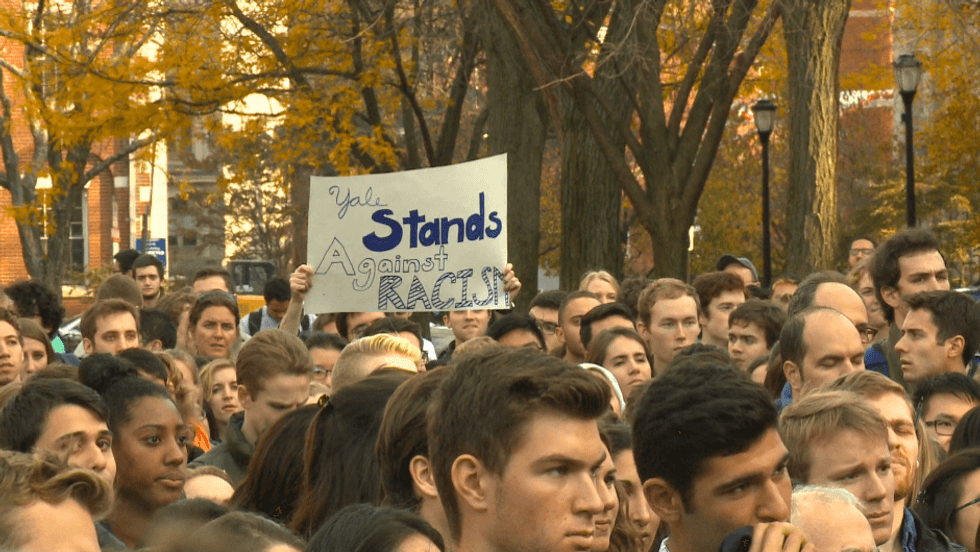
Consider the recent issue of “safe spaces” at Yale, where a group of students incited a movement following a professor’s go-ahead to wear costumes that may be culturally insensitive. We have to understand this isn’t a group of coddled, liberal elitists making a desperate attempt to avoid discourse with the other side. This is a group of people who have collectively decided that cultural appropriation is wrong, and will not be tolerated. Agree or disagree with their opinions; however, there is a difference between being sheltered and making the decision to not put up with ideas they have already established (read: already been exposed to, and made a call from there) as diametrically opposed to their values.
Perhaps there are bigger issues than culturally insensitive Halloween costumes. Maybe, as college students, we ought to be able to handle this without making a huge deal out of it. You can believe whatever you want about issues like this. We just have to remain conscious of the fact that often, spats like this are rooted in larger, racially motivated issues, which, if left to fester, will explode over conflicts like Halloween costumes.
At the end of the day, don’t be afraid to explore new ideas. Don’t shelter yourself. Embrace new ideas; alter your perspectives, or stick firmly to your beliefs. However, understand the implications of what you discuss. We have to understand that the “political correctness” debate is much more nuanced than a bunch of college kids not wanting to hear opinions discordant than theirs. Often, it plays into much larger themes of race and identity, which bear significant gravity and cannot be written off — we cannot let the crusade against “political correctness” become a justification for racism.