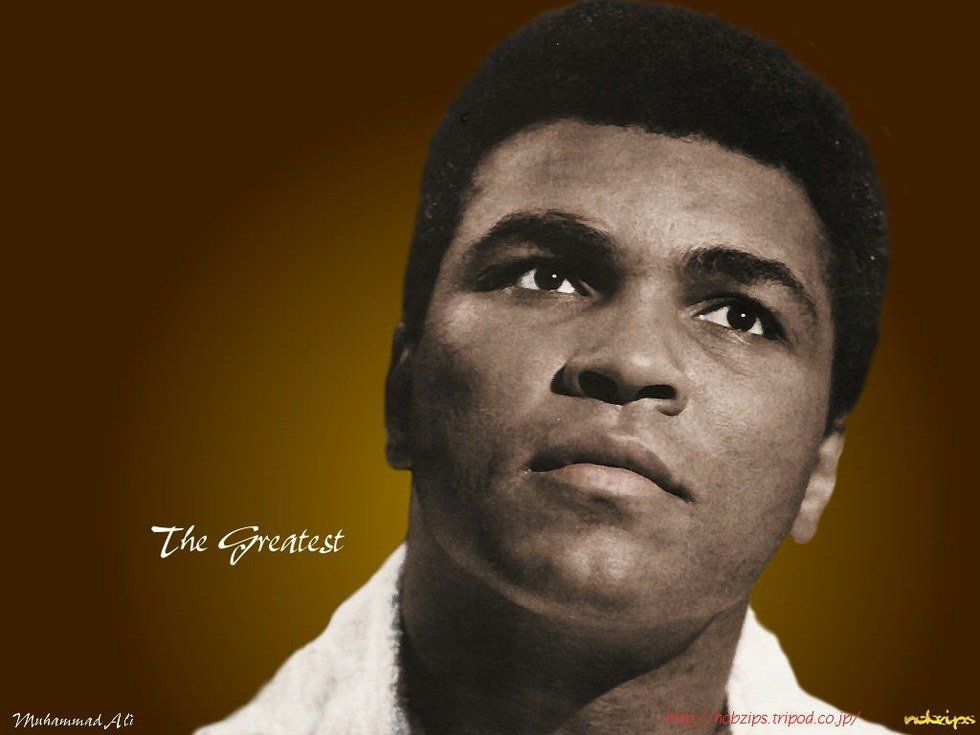
Last Friday night, the sports world was startled and saddened by the death of “The Greatest” fighter of all-time, Muhammad Ali.During his durable boxing career, Ali fought and defeated some of boxing’s biggest names: Sonny Liston, George Foreman, Ken Norton and Joe Frazier. His bouts with Foreman and Frazier were memorable, being nicknamed the “Rumble in the Jungle” (the fight took place in present-day Republic of Congo), and the “Thrilla in Manilla” (the final fight with Frazier took place in the Philippines). But he will not just be remembered for his success in the ring. Ali was remarkable in his life outside the ring.
Muhammad Ali was originally born Cassius Clay in Louisville, Kentucky, in 1942. He changed his name to Muhammed Ali, meaning “beloved of God,” in response to his conversion to Islam in 1964. He insisted people use his new name at all times. Just as Jackie Robinson broke Major League Baseball’s color barrier, Ali had to overcome widespread racism and discrimination in society, as well as overcome the race issue in the sport of boxing. Muhammad Ali was also a major voice in the civil rights movement, along with Dr. Martin Luther King, Jr. He strongly opposed the Vietnam War that occurred in the 1960s.Because Ali was not willing to die for his country, he was charged with draft evasion and was forced to sit out three years from boxing. In spite of this, Ali demonstrated courage and resilience. His long awaited return to the ring was powerful and strong both physically and mentally. He again soundly defeated his opponents and retook the heavyweight title. He also looked to the future with an aim to make a difference in the world.
After he retired from the ring in 1981, in spite of his own battle with Parkinson’s disease, Muhammad Ali focused more on being a great humanitarian, contributing and investing time into serving those less fortunate. According to looktothestars.org, Ali supported such domestic charities as Project ALS, Athletes for Hope, HELP USA, Beat Bullying, The Miami Project, The Special Olympics and many more. Internationally, he supported Watering Seeds Organization and UNICEF. He also founded several charities including Ali Care program and Muhammed Ali Parkinson Center. Muhammad was visible, involved and passionate about serving others. Additionally, Muhammad Ali co-founded a foundation aimed for young people and their eating and drinking habits, called “G.O.A.T.” According to 123help.com, G.O.A.T is a “food and beverage company that seeks to inspire young adults to eat smarter, to live healthier lives, and to rise above their current status” (2016). He used his celebrity status to make a difference. He inspired other celebrity athletes to do the same. His legacy is far reaching.
This prize fighter won many prestigious awards beyond the boxing titles. Muhammad Ali also won the 1974 Sports Illustrated Sportsman of the Year, the 1974 Associated Press Male Athlete of the Year, the 1997 Arthur Ashe Courage Award, the 2002BET Humanitarian Award ,and the 2009 NAACP President’s Award. In 2005, U.S. President George W. Bush showed his and his country’s appreciation to Muhammad Ali by giving him the Presidential Medal of Freedom, the nation’s highest honor for a civilian.
And so, Muhammad Ali, the greatest showman since PT Barnum, will go down as one of the greatest fighters that ever lived. His cockiness, passion, and words of inspiration will always be recognized and cherished. He called himself “the greatest” who could “Float like a Butterfly, and Sting like a Bee.” Muhammad Ali’s impact on the world was also intense. He will also be remembered for his many generous contributions to American society and to causes around the globe. Although he will be missed dearly by so many, Muhammad Ali will always have an important place in boxing history and in our hearts.