
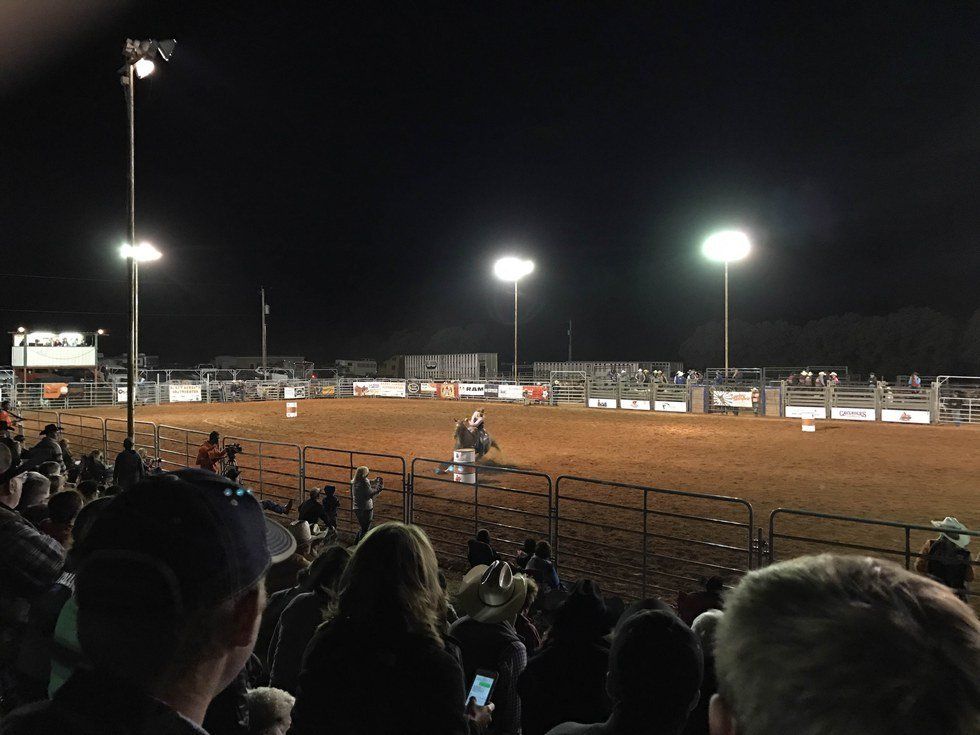
Rodeo has a tradition dating back as old as this great nation. Established by cowboys just trying to make a living, it became romanticized by the lure of the Wild West. From that spurred the sport of rodeo, which has become a way of life and a beloved past time for many people. Something about the mix of rough livestock, adrenaline, skill of the competitor, and the love of an older way of life has kept people in awe. Growing up in a rural community in southern Oklahoma, I've been around rodeo my whole life. Some of my best friends ride bulls, broncs and run barrels. This past weekend though I got to see some of them in action with 18 college rodeo teams bringing about 500 contestants out to compete in the Oklahoma State Cowboy Stampede, a three day event spanning Thursday, Friday and the finalist wrapping up on Saturday night under the lights of the Payne County Fairgrounds here in Stillwater, OK. Coming to college I never realized how many people had never been to a rodeo or even knew what it was about, so here is a list of events from this past weekend’s rodeo and what they mean.
1. Tie Down Roping - Also known as "Calf roping" is a timed competition of a rider running out of the box on horse with a calf in front of him. The goal is to rope the calf, dismount from your horse, sprint to the horse and tie three of it's legs together, a half hitch knot is used. The competitor then throws his hands into the air signifying he has finished the tie, and the time clock stops. The calf must remain tied for an additional six seconds to qualify officially. Typical times
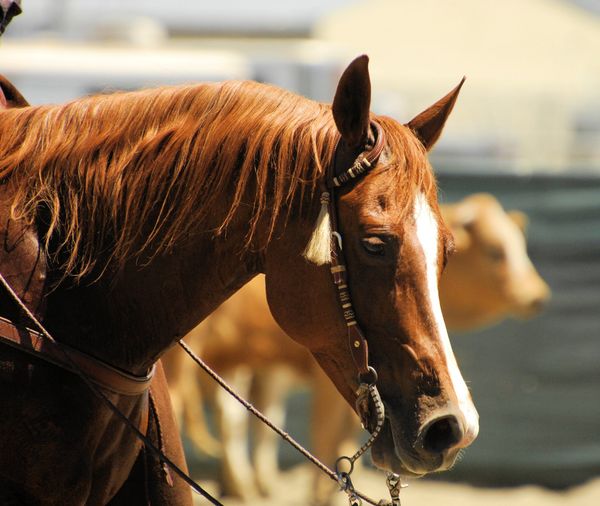
2. Barrel Racing - Sometimes coined as "can-chasers", barrel racing is a mostly female competition, it's all about, speed, skill, judgement and trust. A timed event where the competitor tries to follow a cloverleaf pattern around each of the three barrels that are placed in a triangle as fast as she can. This takes practiced horsemanship skills and tests the athletic ability of the horse itself.
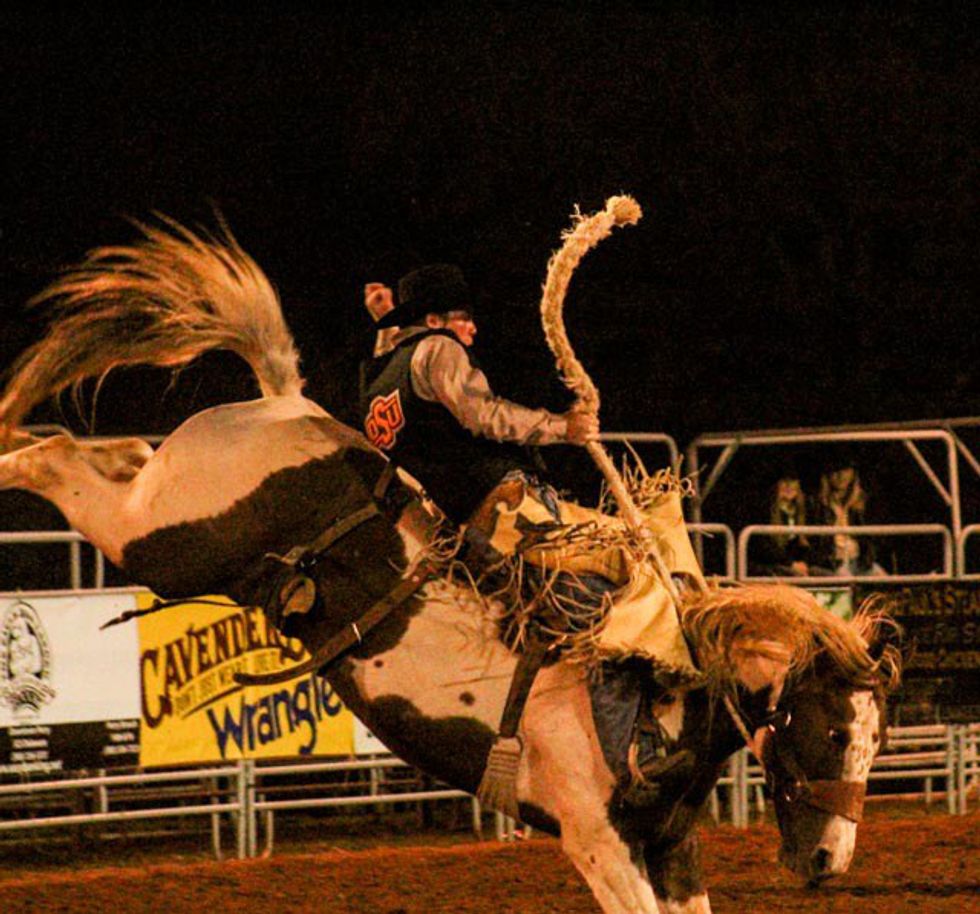
Photo by: Shelby Saul
3. Saddle Bronc Riding - Originally based on the necessary horse breaking skills of a working cowboy, this event is now a highly stylized competition that utilizes horses that often are specially bred for strength, agility, and their bucking ability. The rider sits down on the bronc which is enclosed in a chute. Nodding when ready, the gate is thrown open releasing the bronc and the rider. The rider can only touch the horse with his riding hand, and he must stay on for eight seconds. On the first jump out of the chute, the rider must "mark the horse out." This means he must have the heels of his boots in contact with the horse above the point of the shoulders. He is then scored on a 100 point scale, half on the horse and half to the rider.
4. Bareback Bronc Riding - Essentially the same as Saddle Bronc Riding it is a timed event where the rider does his best to hold on for eight seconds while riding the horse. One major difference is that they are not equipped with a saddle, but only a leather and rawhide handhold fastened like a saddle. This event though the rider absorbs more of the bucking through their riding hand.
5. Goat Tying - A mostly women's event that consists of the rider starting at one end of the arena and racing to the opposite end, then dismounts while the horse is still moving. She then runs the rest of the way to the goat, which is staked down with a 10-foot rope. Grabbing the goat she flips it onto its side and using a cotton or nylon rope ties three of its legs together. Once tied she throws her hands into the air to signify the knot is complete and to stop the clock, she then must move at least three feet away from the goat. This is a timed event so the fastest competitor takes home the title.
6. Steer Wrestling - a male’s event sometimes known better by the title of "bulldogging", is one of the fastest events in rodeo. Many steer wrestlers are heftier cowboys which is why this event is sometimes called the "big man's event." A steer is released from the chute on one end of the arena and the competitor must be one the left side of the horse chases it out of the shoot, jumps off his horse and must grab the steer’s horns, twisting it onto the ground. All four legs must be in the air for time to be called.
7. Breakaway Roping - At the collegiate level, is primarily a women's event. The horse with a mounted rider wait in a box next to the chute that has a spring-loaded rope, known as the barrier, stretched in front. A light rope is fastened from the chute to the calf's neck, releasing once the calf is well away from the chute and releasing the barrier, which is used to ensure that the calf gets a head start. Once the barrier has released, the horse runs out of the box while the roper attempts to throw a lasso or loop over the calf’s head. Once this happens the rider signals her horse to stop she ties the rope to the saddle horn and when the rope is tight the string breaks, which marks the end of the run.
8. Team Roping -The only team event in all of rodeo. It involves a header and a heeler pair mounted on their horses. Team roping is the only rodeo event where men and women compete equally together in both single-gender or mixed-gender teams. The team is split up on either side of the chute; the steer is released and given a head start. The team enters the arena and the header ropes the steer around the head either horns or neck. The header then turns the steer to the left and the heeler must rope both hind legs or one hind leg, if only one a 5 second penalty is added. The teammates then must face each other and the timer stops.
9. Bull Riding - Considered one of the more dangerous and thrilling rodeo sports, bull riding is a timed event as well as a point system. A male rider sits on the bull while in the chute, once released the rider must hold on only using one hand for a full eight seconds. If his free hand touches the bull he receives no score. The ride is 50 points to the bull and 50 points to the rider if he successfully rides for eight seconds.