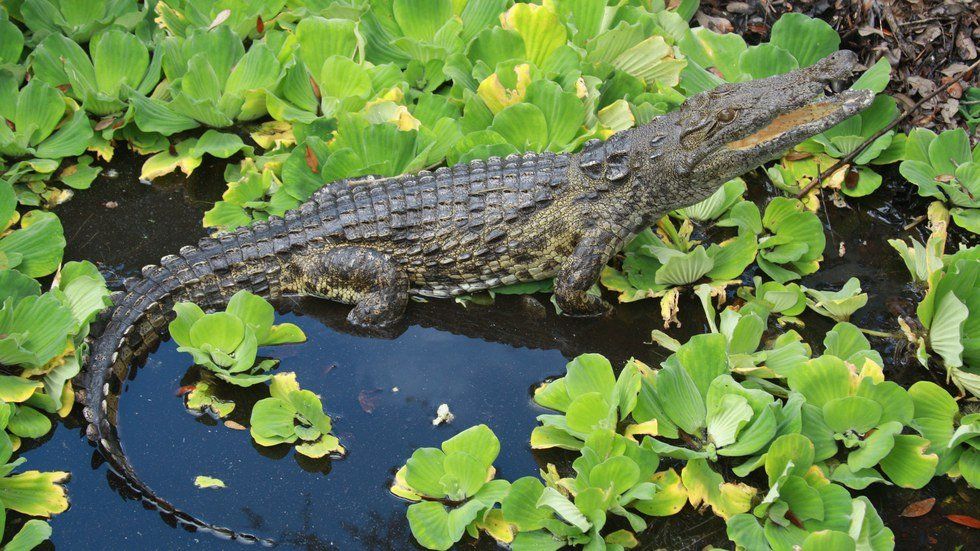
Earlier this month, researchers from the University of Florida confirmed that they had found Nile crocodiles (Crocodylus niloticus) in and around the Florida Everglades in southern Florida. These findings, published in the Journal of Herpetological Conservation and Biology, state that through DNA analysis, they have identified three juvenile Nile crocodiles. Two were found in the Florida Everglades and one was found on the front porch of house in Miami (a surprisingly uncommon occurrence with alligators in the state). These three animals represent the newest addition to the very long list of non-native species that thrive in the sub-tropical climate of south Florida. How the animals, native to Africa, got to Florida and their complete population numbers are not yet known, so whether or not the species becomes established and invasive will be a test of time.
As soon as the report was published, the headlines across news platforms started rolling in. "Man-Eating Nile Crocodiles Have Been Found in Florida," "Man-eating Nile crocodiles found roaming Florida swamps," "Florida Crocodiles: Man-eating Nile beasts confirmed in swamps" and "Monster African crocodiles found in Florida" are just a handful of the inflammatory grab-lines used to title articles reporting on the subject. There is a common, potentially dangerous similarity in these titles, and it's not the "crocodile."
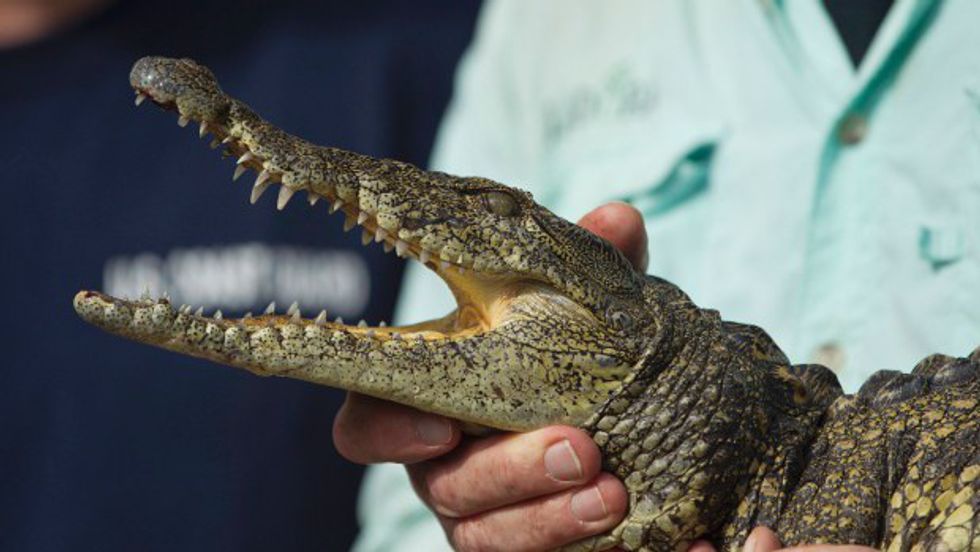
(One of the Nile Crocodiles (Crocodylus niloticus), found and captured near Homestead, Florida in 2012. Source: Pat Carter/Associated Press)
An overwhelmingly large number of these articles contain the phrase "man-eater" or "man-eating" when referring to the large reptile species. Such language is not uncommon. In fact, it is used almost ubiquitously when describing a large predator. Great White, Tiger and Bull Sharks are commonly referred to as "man-eaters," and big cat species and large bear species are certainly not exempt from the harsh description. Often, these animals are stripped of their reality as well, compared to fictitious beasts or monsters. Though it spices up a headline or creates alluring click-bait (pun-intended), such language can wind up hurting an entire species.
When someone uses the term "monster," what images does that word generate? Dragons? Chimera? Demons? Ghouls? Or does it generate the images of people, those who inflicted appalling human rights' violations? Do you consider Hitler, Stalin or contemporary terrorists (or all of the above) monsters? The common thread linking the aforementioned is the intention. In the mythology of the formerly mentioned monsters, beasts and demons, these were creatures with intent to seek out and kill humans. The latter mentioned, very real human beings, sought out and continue to seek out certain kinds of humans (based on race, religion or otherwise) to inflict pain, prolonged suffering or administer death.
Nile crocodiles, sharks of any species, large pythons, big cats, bears, truly any species bearing the description of "monster" or "beast" are nothing like their mythological predecessors or the aforementioned humans. They do not lurk in the dark corners of the water, woods or mountains waiting for a human to stumble into their midst. They do not seek out and attack specific people. They do not torture their prey with intention. In fact, many predators "go for the throat," meaning they attempt to kill their prey as quickly as possible. Crocodiles specifically perform a "death roll," or they submerge their prey to drown it quickly. There is no support that such behavior is done out of "mercy" (as there is no supported scientific evidence of morality in non-human animals), but it results in less energy expended by the predator. These are not crimes of passion or intent. They do not kill for sport, but for survival.
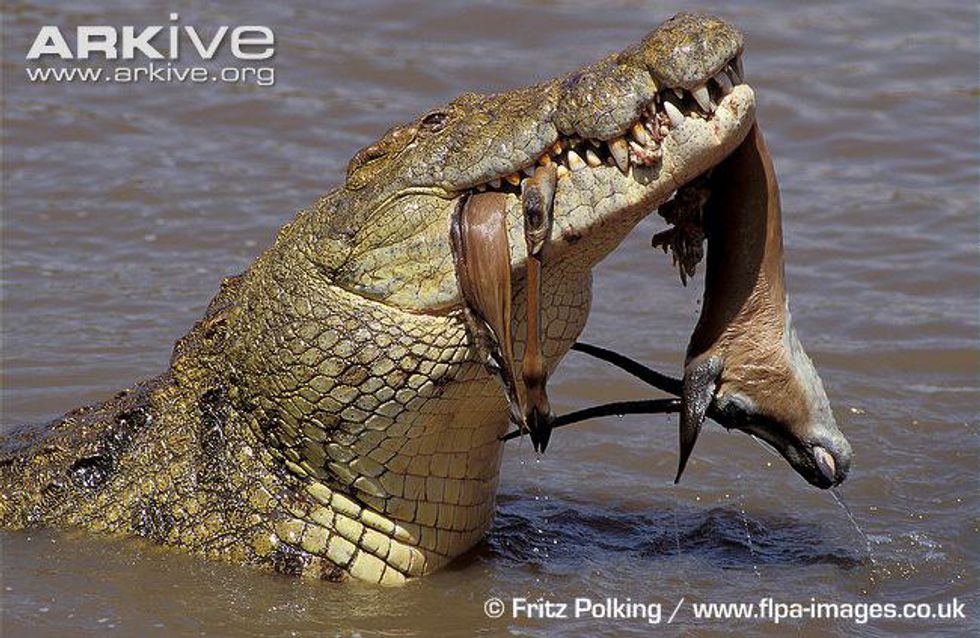
(A Nile crocodile with its kill. Source: arkive.org)
Humans don't like to consider the fact that as animals, we do not rank high on the food chain. Without our specially designed hunting knives, bows and rifles, we would fall prey to most of the animals we are now able to prey upon. It is a favored pastime of humans to draw the deepest line in the sand to separate humankind from the rest of the animal kingdom. It is against some religions to even suggest that we are the product of billions of years of evolution and cousins to non-human primates. Such ideals lead to the "us versus them" mentality. No matter the mentality, the line in the sand is just that: a futile attempt at separation that is easily wiped away with a strong enough force.
However, using language such as "beast," "man-eater" and "monster" fuels the destructive rhetoric that humans are separate from the rest of the animal kingdom. It also creates opportunity for cruelty. The "us versus them" mentality becomes an "us before them" ideal, where poaching the animals could be defended. Branding an animal as a man-eating monster stirs up enough panic and anxiety that "killing the animal before it kills a person" seems favorable to the general public. This mindset has led to massive culls of predator species in the name of safety that wasn't necessarily threatened in the first place, or minutely threatened at most.
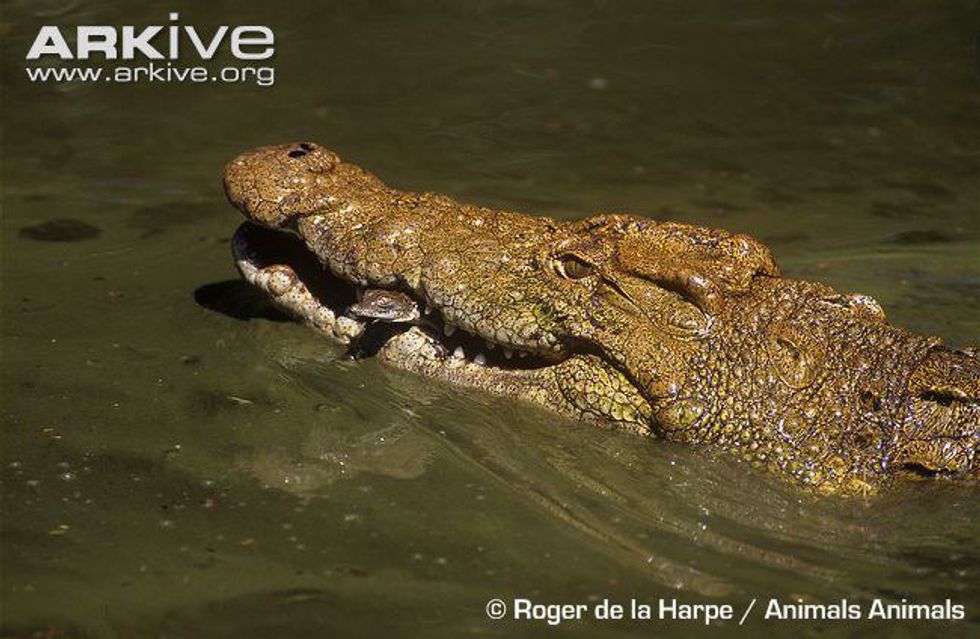
(Don't let looks deceive you. Crocodile species are attentive and protective mothers. To protect from predators, they collect their new hatchlings in their mouth and bring them from their nest on a riverbank and into the relative safety of the water. Source: arkive.org)
All this is not to draw away from the fact that Nile crocodiles are formidable predators. Nile crocodiles have killed and eaten humans (a little less than 350 between January 2008 and October 2013) but not because they are humans, but because they are simply seen as another prey source. There is no malice behind the actions, but that does make their behavior any less dangerous. Instead of attempting to preemptively kill or subdue all of the predators with the potential to attack and kill humans, education is key.
Most importantly, respect for the environment which you enter is paramount. The term "shark-infested" or any variance suiting a particular species is grating. The ocean is not shark infested, it is the habitat of the shark. The Everglades is not infested with crocodilian species, it is the habitat of American alligators and crocodiles alike, and newly an undetermined number of Nile crocodiles. Before entering either environment, one should be knowledgeable of the animals they might encounter and equipped to deal with conflict or emergency situations accordingly. Respect must replace blind fear and hatred. If we take up torches and pitchforks and feed into such feelings by resorting to mass culls "just in case," which species is the true monster?

(Adult Nile crocodile. Source: animals.nationalgeographic.com)
There are reasons that the introduction of Nile crocodiles could cause problems in the Florida Everglades. However, the biggest conflicts are not between humans and the species, but concern the fragile ecosystem to which these animals were introduced. Much larger and more territorial than their American cousins, if the animals were to reproduce, it is possible they may outcompete American alligators and crocodiles. This could lead to genetic depletion in American species, as well as cause a significant drop in mammal (prey) populations. It is an extreme scenario that Florida has already seen with the established invasive python species. As with the python population, decisions concerning the Nile crocodiles will be dealt with by the Florida Fish and Wildlife Conservation Commission.