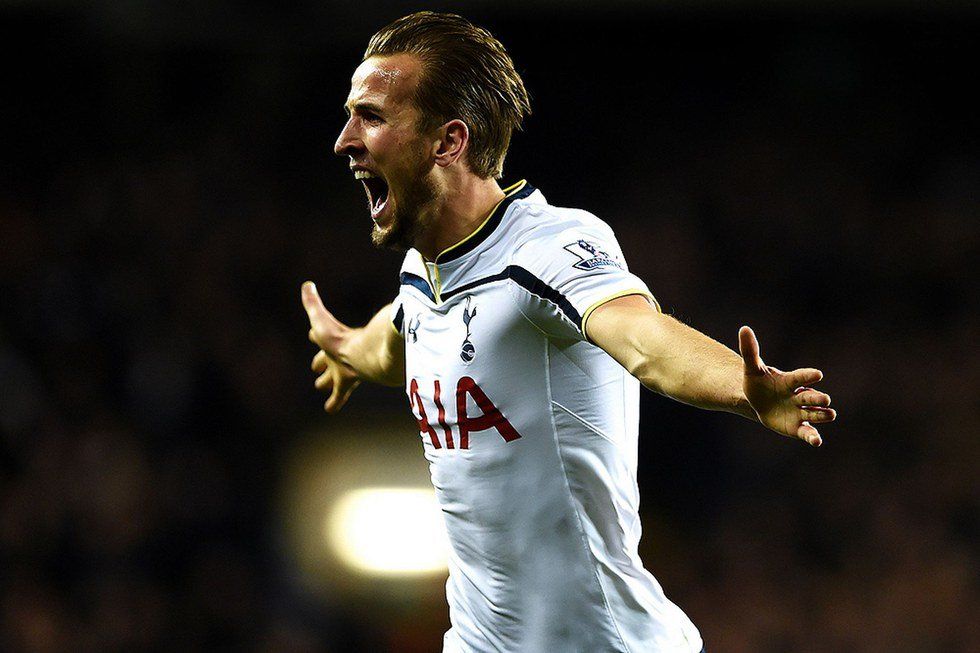
In 22-year-old Harry Kane, Premier League club Tottenham Hotspur possesses one of the world soccer scene's hottest commodities. Fresh off a 2014/15 season in which he tied a club record with his twenty-one league goals, sport media has run wild with summer speculation that the rights to Kane's services might be sold to such traditionally high-spending clubs as Manchester United or Real Madrid. Thus far, however, both Kane and Tottenham have denied all reports that either party entertains interest in such a move. Spurs, as the club is widely known, would be wise to maintain their refusal to negotiate; for both on-field reasons and the team's interests off the pitch, Tottenham Hotspur cannot afford to lose Harry Kane.
Simply put, Harry Kane is a player too important to be sold. Last season, Kane scored thirty-one goals in all competitions as a forward; Tottenham's other forwards, Emmanuel Adebayor and Roberto Soldado, combined for seven. Tottenham's inconsistency in attack makes Kane's presence all the more crucial, as his ability to convert threatening positions into goals both glosses over the team's lack of another option and offsets the goals conceded by a defense that ranked among the league's most porous. Furthermore, the Englishman also often supports the defense directly, retreating to midfield or even deep into his own half of the field to pressure the ball-possessor. His skill set fits the team's needs perfectly, and his ability to play as a lone forward both provides Tottenham with the flexibility to outnumber opponents in midfield and masks the club's lack of another forward option. In strictly football terms, to sell Kane would be tactical and strategic suicide.
Spurs have another incentive to retain Harry Kane, however - one that centers not around winning matches but around winning hearts. Tottenham is in a critical phase as an organization: the club has qualified only once for the UEFA Champions League since the competition took that name, and Spurs have not won the English Premier League since 1961. The team is consistently good, but rarely truly exceptional. Beyond this, the team's management and ownership have operated the team in a businesslike fashion that deters supporters, often selling the best player to the highest bidder and building nearly from scratch with the proceeds. This same corporate attitude that engendered the sale of such club heroes as Michael Carrick, Luka Modric, and Gareth Bale has also motivated chairman Daniel Levy to invest in the construction of a new stadium. Once finished, this magnificent and modern new complex will replace entirely the historic existing stadium at White Hart Lane. Fans are willing to bear with this project, and even to accept that during the process of financing team development, the team on the field will perform on a budget, but in return they ask for a club worth cheering for. Tottenham fans, myself included, are a nostalgic bunch. Harry Kane calls to mind the best aspects of a storied club, and his own story as a Tottenham boy from a Tottenham family appeals to our sensibilities. Tottenham Hotspur may be a business, but to treat it as only a business is both a mistake and a disservice to a loyal following.
There is a famed remark about Spurs, attributed to both former manager Bill Nicholson and captain Danny Blanchflower: "Spurs have set our sights very high, so high in fact that even failure will have in it an echo of glory." An apt identity they chose for a club of so many first successes and so few recent ones, but an identity of which the team has not yet lost sight entirely. For Tottenham Hotspur, to sell Harry Kane would be a capitulation of the soul. The team certainly will not win without him, and may not even win with him. Everything about Kane, from the clean-cut image that calls forth days past to the goalscoring record he now shares, bears with it an echo of glory.