During my recent road trip with my mother from Atlanta to New Orleans we passed the time by jamming to some of our favorites: Amy Winehouse, Q-Tip from A Tribe Called Quest, and DJ Bruno, an Atlanta DJ who makes amazing house music mixes. In between the albums we talked up a storm about what this upcoming semester at Xavier could hold for me. To pass the time I chatted away about my travel aspirations for the fall and winter season. Sure, they were lofty and unrealistic. I haven’t even paid for my physics and genetics textbooks! I’m a chick looking for champagne when I only have beer money. But the thing is, I’m not looking for a vacation. Hi my name is Indigo Gill and I crave conversation. I desire intellectual stimulation from those that represent walks of life I’ve never considered before. That’s the stuff that challenges you, motivates you, helps you to mentally evolve, and above all to be an advocate for those whose voices become a whisper in a roaring sea of capitalism, bureaucracy, and perhaps democracy. It was at Columbia University this summer where my capacity to learn from others expanded.
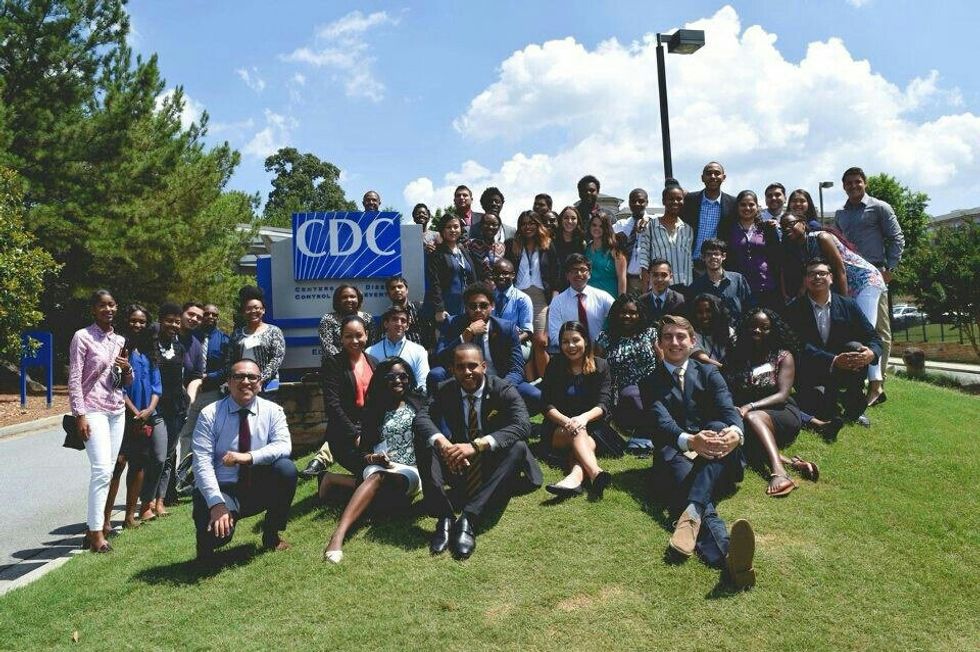
For summer 2016 I participated in the Summer Public Health Scholars Program (SPHSP) at Columbia University of Louisiana. This internship is one of six public health opportunities under the CDC Undergraduate Public Health Scholars (CUPS) program. It had an underlying mission of creating a public health workplace experience to increase student interest in minority health. In addition many of these internships were particularly aimed at recruiting minority students. Upon accepting SPHSP’s offer, I expected to broaden my horizons as a premed student interested in community health and behavioral research. What took me pleasantly by surprise was the fact that I gained 43 friends during a summer in New York City that I will never forget.
SPHSP from the very beginning was setup to help support an environment of diversity and inclusion. Its foundations stand on a partnership between Columbia University’s College of Physicians and Surgeons, Mailman School of Public Health, School of Nursing, and College of Dental Medicine. Not only that, but the year 5 cohort for SPHSP included students from 23 US states and territories. Strangers to one another during our orientation at the Centers for Disease Control and Prevention, who would have known that our bond would grow so strong through our late night confessions, conversations, tears, and we can’t forget the dorm room ‘kickbacks’. On May 31 we awkwardly but socially participated in ice breakers as we feasted on pizza and introduced ourselves with crust and sauce in our teeth. And on August 6 out hearts sank when it was time to say our “this is not goodbye but rather see you ‘laters’”. Flights home were spent sleeping, and eating the flight attendants’ measly snacks, dreading the trip home from New York, and hope for a chance to see each other again. At least that’s what our ‘SPHSP 2016!!!’ GroupMe is telling me. As I am returning ‘back to life, back to reality’ as the R&B group Soul II Soul might say, my mind frequently returns back to my 43 friends’ whereabouts from across the country and the oceans. Sharing memes and news articles on our GroupMe will have to do for now. And so I have no shame in my game when it comes to ‘watching’ trips on my Hopper app, searching for cheap round trip flights to California, Guam, Hawaii, New Mexico and back to New York City before the end of 2016. Let me indulge in my dreams of seeing all 43 of my friends okay. It’s just that with this cohort I gained more clarity considering: my personal wellness, my privilege, my professional potential, my capacity to serve and advocate for those without a voice, and the importance of confronting my fears, doubts and closeminded, stereotypical thinking.
Have you ever experienced friendships that encourage you to grow and succeed, even when the odds say that you have a higher chance of going to jail, having a chronic physical or mental disease, contracting HIV, committing suicide, or being deported? Have you ever gained someone’s trust because you corrected yourself on assuming there sexuality or gender? Have you sat in a bookstore for hours with your friends reading aloud passages from a book about love in all its forms? Have you ever exposed that you doubt your ability to make it in professional school even though you were the valedictorian and have a 3.94 GPA and your roommate helped you to see that your fears were valid and that it is okay. Did that same roommate also help you to see that your feeling violated at the airport is valid when the Black TSA guard who could be your aunt goes through your afro hair because it’s protocol? Have you ever helped your friend to try Vietnamese pho even though she is sometimes so scared to try new things because she has been hurt in the past? Have you ever been so happy that you teared up when your friend passed the NCLEX-RN exam. Did you tear up more and brag to your mother because he has a job set up at the Mayo Clinic even though he also had to complete public health case studies, an internship, a final 10 page paper, and a presentation all in the same summer?
Maybe you’ve asked your friend about what the term LGBTQIA+ really means and why it is okay for a transgender man to carry and deliver his children. Maybe your friend explained to you that the word queer is a more inclusive term for people who don’t fit into the Westernized idea of binary sex and gender roles. Maybe your friend bakes for everybody in the cohort and offers almost all of the scrumptious cake, cookies and donuts to her friends because she likes to share. Maybe you actually pronounced your friends’ names the way their parents pronounce them and not the way lazy people butcher them. What if you mess up their name at the beginning but eventually you get it and they appreciate your efforts. Maybe you learned more about HIV/AIDS and its relationship to Haitians, homosexuals, intravenous drug users, sex workers, and the homeless. Maybe your friend taught you about why disparities in organ donation among different ethnic groups is a major public health issue. Maybe your friends helped you to realize that colorism is not exclusive to the Black community. Or about how inclusion of folk medicine into Western medical practices could be more beneficial to the health of immigrant populations. Maybe another one reminded you that diverse immigrant populations have limited access to the US healthcare system. Maybe they brought up the fact that in some languages there isn’t a term for depression and that might contribute to a lack of using available healthcare services.
Perhaps you visited a needle exchange program for intravenous drug users? Perhaps you learned that these actually help more people to protect themselves against disease transmission than to encourage drug use. Perhaps your friend was overwhelmed by the immense opportunities she’s been granted, both domestic and abroad, but her being homesick brought her to tears and you gave her a hug. Perhaps you told her to take her time and not rush to put the tears away before it was time to go back to lecture. Perhaps your roommate says I love you every time she goes to sleep because she really means it. Perhaps when you get super anxious and frustrated and aggressive about packing and leaving your dorm in Morningside Heights, Manhattan your roommates help you to keep it together and tell you to breathe and you actually believe them when they say it’ll be alright. Perhaps you’re tired of reading this and you barely made it to the end of all my questions.
It’s possible that you have had these experiences. Maybe you have not. But I’ll tell you one thing, I have. This summer, a light bulb went off and it was beautiful. I am so grateful to my ‘#TooLit’ SPHSP cohort for teaching me to listen, to challenge my thinking, to be okay with letting go of my previous notions of what ethnicity and identity and public health really are. Thank you, my readers for allowing me to share with you just some of the ways in which these amazing scholars have affected my life for the better. The lessons I learned are endless. Today I am so happy that my new family includes people who identify as Black, Queer, White, Latino, Latinx, Straight, Mexican, Guatemalan, Cuban, Italian, Creole, Hawaiian, Filipino, Korean, Vietnamese, and the list is infinite if we truly analyzed everybody’s roots. Perhaps you’re an SPHSP Cohort 5 alumni and are thinking that I left you out; don’t forget that I love you. You know, my cohort was the epitome of diversity and inclusion in the US, at least based upon my past experiences. And yet we all connected because of that. At the end of the summer, it was amazing to see how public health could be the foundation upon which my new family stands. My advice to you the reader: don’t be afraid to connect with those who at first glance look like they have nothing in common with you. Perhaps that’s the exact reason why you should start the conversation. Who knows, they might be your next 3 hour long phone conversation. Or better yet, their hometown miles and miles away might be your very next flight destination. Don’t forget to use Hopper!