
In an interview with ESPN’s Sam Alipour in 2014, rapper Lil Wayne stated that “athletes wanna be rappers, rappers wanna be athletes.” This is especially true for NBA stars. As rap -- and later hip-hop -- breached into the mainstream media in the 90s, NBA stars wanted to ride that bandwagon and make some music. Over the years, we have seen the likes of Allen Iverson, Chris Webber, Shaquille O’Neal, Kobe Bryant, Tony Parker, and Ron Artest a.k.a Metta World Peace dabble in rap music.
The connection between rap and basketball is largely rooted in culture. Both professions are dominated by the African American demographic whose poverty rate, 26 percent in 2014, was more than twice that of non-Hispanic whites. For some of these young black males, hip-hop and basketball are seen as the only options for getting out of a life of poverty. In a sport rife with trash-talking, NBA players need to have a thick skin to make it. The same is true for rappers when they are dissed by other rappers, like Drake and Meek Mill’s feud. This synonymic relationship created the opportunity for both rappers and ball to players cross over into each other’s industries.
Shaquille O’Neal, one of the greatest centers in NBA history, is also one of the most successful professional basketball players to crossover into hip-hop. Over his 19-year NBA career, O’Neal amassed four championships, 15 All-Star selections, three championship Most Valuable Player awards, and a regular season MVP award. Off the court, O’Neal has ventured into acting, business, video games, law enforcement, and education. Of all of his side projects, his rap career was one of the most notable. O’Neal released four studio albums, with his debut album "Shaq Diesel" achieving platinum status. His most popular single "(I Know I Got) Skillz" peaked at number three on the Billboard Hot Rap Songs in 1993.
Kobe Bryant’s rap career, unlike his former teammate O’Neal’s, wasn’t as extensive. Bryant frequently appeared as a featured artist on songs like Brian McKnight’s “Hold Me,” O’Neal’s "3 X's Dope," and Destiny’s Child single, "Say My Name." However, in 2000 when his debut single "K.O.B.E" featuring supermodel Tyra Banks was met with negative criticism, the 17-time all-star was forced to forgo his debut album, Visions.
The basketball player most widely credited with bringing the hip-hop culture to the NBA is Allen Iverson. The 11-time all-star was one of the first athletes to proudly attire himself with tattoos, baggy clothes, cornrows, and massive amounts of bling. In the Showtime documentary, "Iverson," ESPN reporter Scoop Jackson anointed the 2001 Most Valuable Player as “the true representative of what hip-hop stands for and is about.” During his tenure with the Philadelphia 76ers, Iverson, and the NBA were criticized for embracing hip-hop culture and allowing the 76er legend to record a rap single, "40 Bars." The song was met with criticism for including violent, misogynistic, and homophobic lyrics resulting in the track never being released. Iverson was forced to rewrite the lyrics in response to the pleas of activist groups and NBA Commissioner David Stern. Due to this criticism, Allen’s attempt at a music career never saw the light of day.
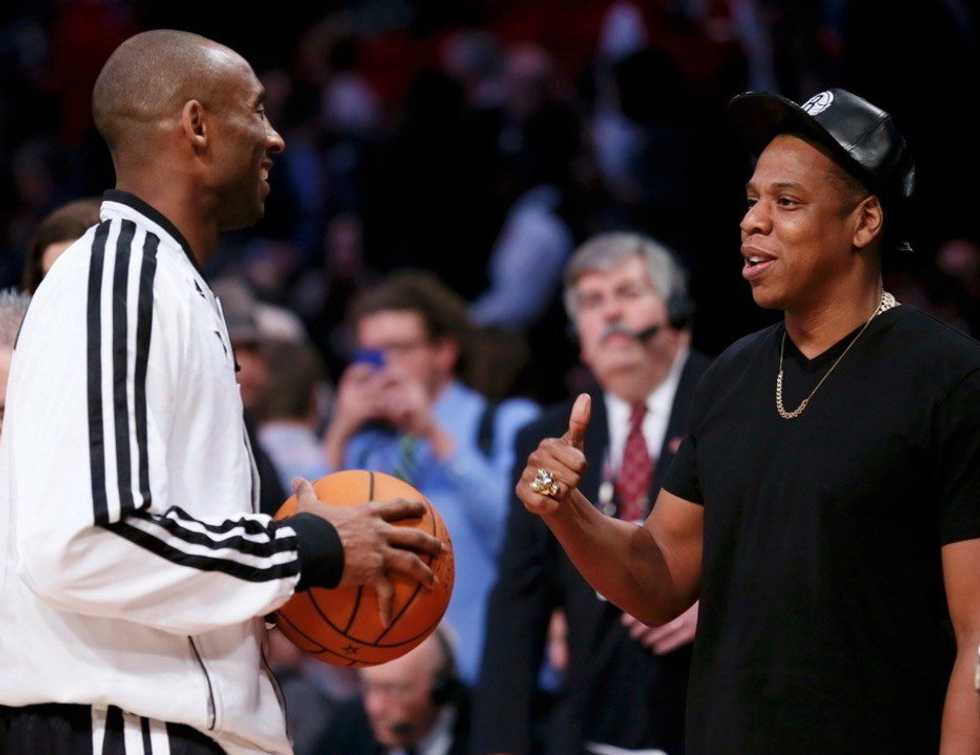
The relationship between hip-hop and the NBA has evolved to the point where notable rap artists like Usher, Nelly, Jay-Z, have stakes in NBA teams and have great influence on a franchise.
Canadian rapper Drake, who doesn’t possess an ownership stakes was named the global ambassador for the Toronto Raptors back in 2013. The Toronto native is a lifelong Raptors fan, who “wants to make the team cool again, and win some games along the way.” Similar to Jay-Z, who played a major role in the rebranding of the Brooklyn Nets as a partial owner, Drake has played a key role in the re-branding of the Raptors this past off-season. In August, the team revealed new game jerseys. The ensemble included an alternate gold jersey, inspired by the rapper's music label, OVO Sound. As a token of gratitude the Raptors has honored the “hometown hero” with Drake Night the last three NBA seasons.

Drake’s association with the franchise benefits their re-branding process. The team is currently on the rise of being a legitimate contender in the league.
The association with hip-hop and the NBA has come a long way. From a time when Commissioner David Stern implemented a dress code to repress hip-hop’s influence, to now where players Lebron James & Dwayne Wade, who still are fans of hip-hop, have a passion for fashion. Although it’s not perfect, the two professions' relationship benefits their growth and are forever synonymous.