
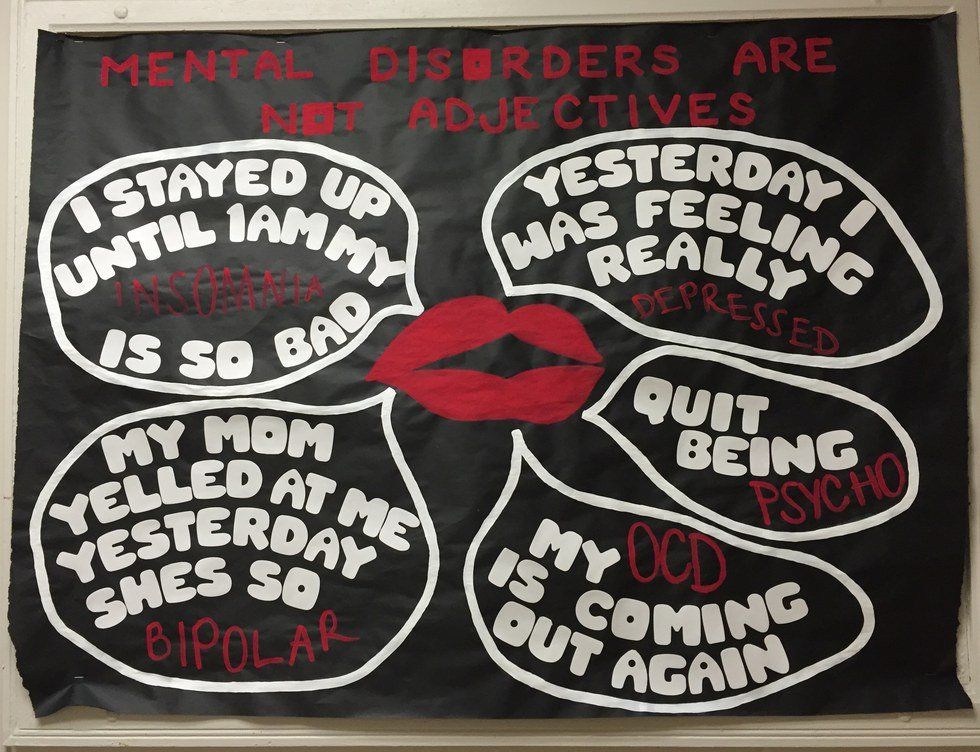
For a few weeks now, there has been a bulletin board in my hall that has caused me to think about the way I talk, as well as those around me. The bulletin board is featured as the cover photo for this article, and it is composed of ways in which we often use mental illnesses to describe a way we feel or something we have experienced. I felt like writing about the misusage of these terms to remind everyone that it is not okay. We need to eliminate these terms from our daily language. Some people might not even realize it when they say these types of things, but mental illnesses are not adjectives. They are not meant to be thrown around improperly. Please keep in mind that there are several people dealing with these illnesses, and relating them to petty things can be very offensive to those around us. It's time to be a little more careful about the things we say out loud or post on social media.
“My mom just yelled at me. She’s so bipolar.”
Your mom went from being calm to getting really upset with you. You may have even caused it. It’s actually quite normal to experience multiple emotions throughout a day – remember that. Bipolar doesn’t simply mean you react when you’re upset. Try replacing “bipolar” with “moody”.
There are more than 3 million US cases of bipolar disorder per year.
“Today sucked. I feel so depressed.”
People that experience depression aren’t just heartbroken or bummed out. It’s more severe than that and sometimes it might not even have an explanation that is easy to grasp. Feeling very sad or gloomy for some time doesn’t always mean you are depressed. People suffering of depression are not simply “feeling depressed” but rather living through a different state of mind than those who aren’t depressed. All levels of sadness should be handled with importance, but if you feel severely depressed it’s a serious matter and there are resources to get help. Try replacing “depressed” with “gloomy”.
There are more than 3 million US cases of depression per year.
“Sorry, my OCD is coming out again.”
Sure, you’re organized and you take pride in that. I know I do. But, this isn’t something to compare to obsessive compulsive disorder. People that live with OCD find themselves checking and re checking things, displaying certain behaviors, or trying to avoid specific things. OCD often gets in the way of someone’s daily routine. Liking your area to be tidy does not mean you have obsessive compulsive disorder. OCD comes with other serious things such as social anxiety. Try replacing “OCD” with terms relating to organization.
There are more than 200,000 US cases of OCD per year.
“I stayed up until 3 last night! My insomnia is getting so bad.”
I hear college students use this one so much. You may have just pulled an all-nighter to get work done or binge watch Netflix. Eventually, it has become a habit. Sometimes we stay up just thinking or trying to make ourselves tired. If you are getting NO sleep despite being exhausted, you have a more serious problem that isn’t just an outcome of overthinking or procrastination. People actually experiencing insomnia have a problem that could be related to depression, anxiety, or a chronic illness. Try replacing “insomnia” with something a little more honest. Just say, “I stayed up all night overthinking” or “I stayed up all night watching Netflix because I couldn’t sleep”.
There are more than 3 million US cases of insomnia per year.
There as so many other cases of mental illnesses being used as adjectives, but these are just the ones I hear most. Although I am sometimes guilty of misusing some of these words, it’s important to keep in mind that people actually live with these disorders. We as humans aren’t perfect and sometimes we speak without thinking, but we have to remember that there are so many adjectives to describe how we are feeling.
There are about 1,025,109 words in the English language. Choose wisely!