Trigger Warning: In this article, there is language that is potentially triggering regarding race, gender, mental illness, sexual violence, etc. This language is used for educational purposes, in order to make others mindful of the language they use. Regardless, we recognize that this language could still be triggering to some and suggest that one reads with caution.
What does it mean to be politically correct? Why is it important? What are some examples of political correctness? How do you change your ways to be politically correct?
Hold onto your seats; you’re in for a bumpy (but arguably necessary) ride.
Let’s start this off easy by defining political correctness. Merriam-Webster defines it as: “conforming to a belief that language and practices which could offend political sensibilities (as in matters of sex or race) should be eliminated”. Well, that seems pretty simple to me. Being politically correct means using language that is not offensive. Unfortunately, we live in a world of hot-headed ignorance, where we are also provided with definitions that are opposite of political correctness.
The Urban dictionary states that political correctness is: “a way that we speak in America so we don't offend whining pussies.” Clearly this definer has no understanding of the meaning or the intention. Luckily, I am here to help.
So why is it important to be politically correct? I will go into more detail later when I give examples, but for now, I will provide you with a brief statement. Despite modern conservative beliefs that aim to ignore political correctness, it is important to understand that not only prejudice and discrimination but violence and hate crimes (based on race, sexuality, gender, etc) will continue until we are able to revise our language and practices so that they no longer contain intolerant behavior. Women and Gender Studies major Michelle Lee explains:
“I guess for me, it's less about being "politically correct" and more about being conscious and, like, a decent human being, because I think it would be the height of hubris to think I have not internalized some really racist, sexist, homophobic, classist, ableist, and all sorts of toxic messages that have been ingrained into our society for hundreds of years because of our history; and when people try to tell me that they don't care about being "politically correct," I find it really disheartening because it tells me that they don't really want to be a part of a society that holds itself accountable. The words we use have power, they have to mean and they hold history, and as our society changes to be more inclusive and aware, our language should evolve with it.”
Brilliantly said, Michelle. I don’t think I need to explain any further.
Before I go on to discuss larger themes of attitudes and ideas that are politically “incorrect”, we should look at basic words and phrases that are unacceptable in everyday language. For example, the term ‘person of color’ is more appropriate than ‘colored person’. (Which I will give an explanation to later in the article).
Words like “oriental”, “nigger” or “retarded” are inappropriate because they date back to a time in which the phrases were used to discriminate against a group of people. Instead of oriental, use “Asian”; instead of “retarded” use intellectually disabled. (This is the same reason that it’s offensive to wave confederate flags- it dates us back to a time when our nation was heavily prejudiced against many groups of people.
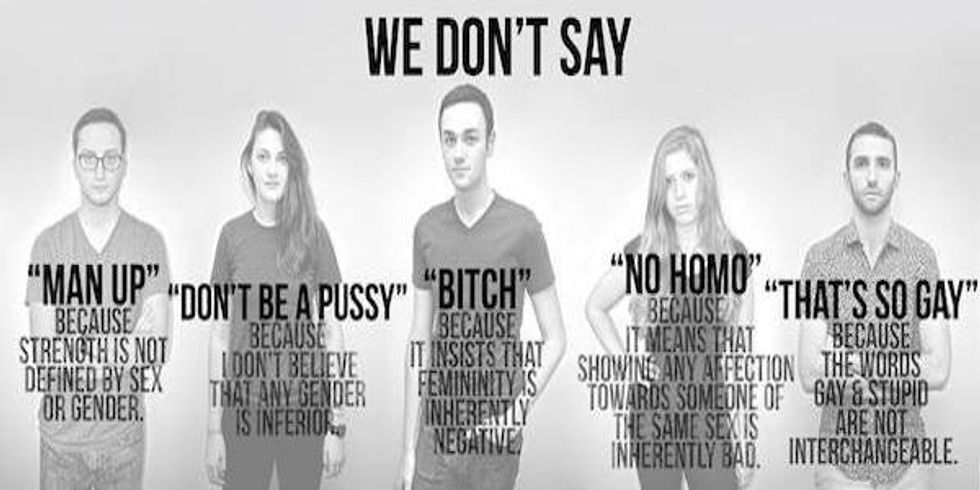
Also, the term oriental more so refers to objects than people, and we don’t want to use language that portrays those as the same thing.) Though it may be confusing because terms are constantly changing, we should aim to use updated terms like LGBTQIA+ instead of LGBT, so as to recognize different groups of that have long been ignored. Gender-biased phrases should also be removed from our language- such as calling someone a ‘pussy’- which suggests that inferiority is directly related to being female.
Similarly, the word gay or homo should not be used in place of ‘lame’ or ‘stupid’ because it uses a sexual orientation to describe inadequacy. Also, we should recognize changes that people make, and respect them. For example, we should stop calling Caitlyn Jenner "Bruce" because it’s funny. When a person makes a choice to be defined in a new way, we should respect their choices. Another misuse of language is body-shaming, aka using words like "fat,"chunky," and "stick-figured" in a negative connotation. Fat is a descriptive word, but it shouldn’t mean that being in that state is wrong, because it’s not.
Finally, there are everyday words ingrained in our language that we have normalized despite their subtle insensitivity. These words include "bum," which suggests that those in poverty are in their situation because of laziness, when it may be because of unfortunate events that we are unaware of; or ‘thug’ which is used to suggest criminality via racial profiling.
Now that we’ve covered specific words, we can move on to habits and practices that are not "politically correct." First, let’s discuss mental disorder. Society has a tendency to normalize mental disorder to a point where it becomes casual. Psychology major Andrea Gould explains:
“There are phrases that are said too often that are painful to hear. Perhaps an organized person talks about how 'OCD' they are today. Or maybe a friend comments on how little her friend is eating by saying, 'What are you, anorexic?' Or how about when someone is moody one day and states, “I’m being so bipolar.”
How about when a guy calls his ex-girlfriend a 'psycho.' No. Mental illnesses are not adjectives. Having these disorders is a daily struggle, in which you have no idea how it feels unless you have experienced it. By using these words in this way, you are invalidating the pain of experiencing a mental illness. It’s saying that everyone experiences mental illness, that they are simple, that they are not a big deal, and that they can come and go easily.
By using this language, we stigmatize mental illness. We make it harder to talk about. We make it harder for individuals to seek treatment. We make individuals ashamed to have these labels.”
People are not defined by their mental disorder, but they are also not the same as people without those disorders. Wanting to be clean does not mean you have OCD, and being stressed does not mean you suffer from anxiety. It’s essential to understand that mental disorder is a serious issue, and should not be broken down into words and phrases that are used to describe everyday situations.
MANSPLAINING. Don’t freak out if you are a man and already offended by this term. Let me explain. Mansplaining is a modern term used to describe the way in which men explain something from a skewed male perspective, usually speaking over a woman and acting as if there is a difference between male and female viewpoints, and that the male viewpoint is superior.
Mansplainers say things like, “catcalls are just compliments” or “you’re good at *performing some task* for a woman.” This type of language suggests that not only are women held to lower standards than men but that women should conform to these standards and accept the influence of a patriarchal society.
The world is not a binary. Society often feels the need to split ideas into halves- to assume that there is right and wrong or this and that. The fact of the matter is that the world is not black and white, it’s shades of gray. There are more sexual orientations than gay and straight, including bisexual, asexual, pansexual, and more.
There are more skin colors than black and white. There are more body types than fat and skinny, and there are more genders than male and female, including gender-fluid and agender. Binary is a way of dismissing or disregarding people who don’t fall into traditional ‘left or right’ definitions. When we conform to these specifics, these left or rights, we ignore a unique qualities of people that make them who they are. We can improve upon this by updating our language, for example, removing phrases from our language that enforce traditional male and female roles, and using gender neutral pronouns.
A big issue that specifically women face is slut-shaming. In all honesty, I didn’t understand this when I started college. I had prejudices against ‘sluts’ and I most definitely judged women who ‘slept-around’. Luckily, I had amazing friends who were able to explain to me why I was in the wrong, and here’s why. Slut-shaming stems from a heavily sexist history, where men could have sexual relationships as often as they wanted while women were expected to be devoted only to their husbands. Somehow, hundreds of years later, this sentiment still exists, and because we don’t understand it’s background, we as women continue to fall under the influence of this dated philosophy.
There is no reason that men should be allowed to have sex without judgment while women should be seen as "used" or "dirty" or "undesirable" if they have had many sexual partners. That is literally the definition of inequality. If men can do it, women can too. Also, this logic comes from almost ancient traditions, primarily religious ones, that prohibit sex before marriage. Well, welcome to the real world.
Men and women have sex every day at almost any age, and that’s something that needs to be accepted. So, stop calling women “sluts” because they have a lot of sex, and stop setting standards for women regarding their sexual history. On a somewhat related note- rape jokes aren't funny. Even if you "don't really mean it," making a joke about violence against women is disgusting, stems from an abusive male-dominated history, and needs to be over now. For more information, see Kailin Kucewicz's "Rape Isn't Sweet, Stop Sugar Coating It."
A final practice, and arguably one of the most important ones, is the existence of casual racism. This expression refers to the subtle forms of racism that exist within our culture. Chances are, you don’t even realize that you acting this way because it has been inherent in our language since before many of us were born. Perhaps you call someone Mexican when they are actually Colombian, or you call someone Chinese when they are Korean.
Making generalizations or assumptions dismiss the existence and importance of other cultures. Another thing that you might do is get nervous around someone in a hijab, or feel uncomfortable around a person of color. You might not do so intentionally because you have likely been taught to react this way, but associating every person of middle-eastern descent with terrorism, or every black man with violence, is internalized racism.
Now, let’s get into some politics. Or maybe some history, per-se. A major issue with the status of political correctness is that the government and society continue to accept federal customs that encourage offensive behavior; for example, national holidays. The most obvious are hopefully Columbus Day. Sure, Columbus sailed the ocean blue, he discovered a land that Europeans had yet to find, and he paved the way for America to be born.
However, it’s not something that should be romanticized. As a history major, I can attest to the fact that Columbus was not the greatest guy. He, along with many other European explorers, founded this nation on a basis of manipulation, terror, and violence.
The Europeans who colonized America did so by committing Native American genocide, by raping native women, by enslaving native children, and by adopting the principle that they had the right to take what wasn’t theirs. And somehow, we celebrate this day. Now dads across America might tell you, “we wouldn’t have America without Colombus.” Well, we wouldn’t have America without the indigenous people who worked the land and spread humanity across the continent long before European conquerors ever got there. Luckily, some cities have begun adopting the title “Indigenous People’s Day” over Columbus day. Baby steps, I guess.
Another issue that I am all too sick of dealing with is that of Christmas. If one more person rants to me about Starbucks cups, I am going to lose it. PSA to all you close-minded Christians: you are not the only religion, and you are not more important than others. From now on, we should resort to using the term “holidays.”
Say "Happy Holidays" instead of "Merry Christmas," or say "Holiday Break" instead of" Christmas Break." You may celebrate Christmas, but that doesn’t mean that the rest of the world does, and that needs to be respected. Getting upset about being told to use the word holidays is equivalent to being upset that someone got a bigger piece of cake than you- it is childish, and it comes from a place of assuming that you deserve to be better than someone else. Saying "Happy Holidays" is a way of being inclusive instead of exclusive. It’s understanding that the world isn’t entirely Christian, and it’s respecting those who aren’t by using language that isn’t Christian-dominant.
Finally, I will make a brief statement about Halloween. As my good friend Annabelle once put it, “someone’s culture should not be your costume.” Dressing as a Native American, or a priest, or wearing blackface, are ways of making fun of someone else’s culture or history. Halloween should not be used as a day to joke around about someone’s experiences. Minorities deal with enough intolerance on a daily basis- the last thing they need is a day to see people thinking that it’s "funny" or "cool" to pretend to be them. This devalues their way of life by diminishing it to a holiday-driven stereotype. Also, when we dress up as someone’s culture, we are treating like it’s not real, rather that we are just playing the role of a fictional character. But those people were real and their heritage did (and still does) exist.
A big way that we can rid ourselves of politically incorrect language is by refraining from the use of generalizations. Not all Muslims are terrorists, not all blacks are criminals, not all women are sluts or virgins, not all immigrants are illegal, etc. Donald Trump has risen to fame by his use of statements that generalize minorities in America. For example, his famous line that all Mexican immigrants are rapists. There’s no reason to assume that someone’s race, gender, or religion in any way defines their entire personality.
It is important to understand that what makes somebody different is not what defines them. We should try to eliminate "people-centered" phrases like the colored person or disabled person or gay person. Race, sexual orientation, and gender are not the only factors that make people who they are. Instead, we should aim to define people by their personality, their interests, and their achievements by using "people-first" language like "person of color" or '" person with a disability," because this explains a characteristic of a person without defining them by that sole term. Additionally, I am always asked why it’s okay to call a group of people "people of color" instead of black. This goes back to the use of binary language. A huge portion of our population includes people of mixed-race and boiling it down to black and white means disregarding their ethnic qualities by stating that they are one thing.
However, this does not mean that I am suggesting we fall into the realm of “I don’t see color." We do not live in a colorless society, and we shouldn’t want to. We should value diversity. People are different. We can be respectful without being devaluing. Just because we are eliminating hurtful language doesn’t mean we need to eliminate descriptive terms that can create appreciation. It’s okay to say that you appreciate darker skin tones, or you think Judaism is really interesting. That’s great, and there should be more of this type of recognition, so long as it is not used to single out or segregate people who are different from us.
Before I explain how to go about making these changes, let me address the in-between; the people who think that they can just eliminate offensive words without using better ones. (Or more commonly- the people who think they can refrain from being offensive in the outside world but continue it in their own homes). Not amending your language or your actions are essentially the same as supporting the continuance of offensive behavior.
Even if you don’t support mass murder, taking off Columbus Day as a holiday shows that we are willing to overlook its history. Saying that we can’t accept the testimony of 45 rape victims against Bill Cosby because they could be lying shows that we are willing to accept the word of one man over the word of 45 victims (and, unfortunately, we live in a victim-blaming society). Refusing to take part in change is the same as accepting current practices, so don’t call yourself a "good guy" just because you aren’t a part of the bad guys.
So, how do we make these changes? How do we adapt to the world in which we no longer conform to traditional internalized hatred? Well, we can be open to change. If we have constant tunnel vision, we won’t be able to open our eyes to new ideas. If we stop and think about the things we say and do, we can produce amazing results. Speaking from experience, it’s incredible how much can happen by simply being open to new thinking.
Also, we can educate ourselves. We live in a world where knowledge is at our fingertips. I always look things up that I don’t understand. Knowing the history, and the arguments behind a movement that I am not attuned to makes me more inclined to become a part of it. It’s all about history, and as a history major, I know the background behind a lot of racist and sexist ideas, and knowing where they came from and why they were created helps me realize why things need to change. Use people as resources too! I’m lucky to have people in my life who can teach me about issues that I don’t understand.
As for people who are different than you, ask them what phrases or pronouns they prefer, and use them. You can’t assume that you know best when it comes to something that doesn’t apply to you. Ask what they like, and respect it.
So we’ve come to the end; the final statements. If you’ve made it this far, you’re likely to be someone who gives a damn about being respectful and tolerant and open. If you’re not typically that kind of person, but you gave me a chance and read what I had to say, thank you. I hope you’ve changed your mind, at least, a little bit.
Sometimes I worry that no matter how many times I try to get someone to understand the viewpoints of victims of oppression, they will never care because they have never been in that situation. That is the unfortunate reality of our world: those who have not experienced oppression are unlikely to take the time to learn about it. I guess I can just hope that one day, that will change.
Lastly, I respond to people who say that they won’t change; either because it’s too difficult, or because they believe that others are just too dramatic. I remember seeing a Facebook post that said “2015, the year everyone was offended” (likely from one of those right-wing relatives that I am always having to delete). I mean, I’m just so sick of hearing people complain that others are too sensitive.
That phrase is just the easiest way to undermine the experience of someone who hasn’t had the privilege that you have. So here’s what I say those people, the one’s who think we don’t need political correctness, we just need people to be less sensitive:
When you tell a minority or just somebody who’s different that you can’t listen to them because they are too dramatic or too sensitive in complaining about their oppression, then you’re just silencing a victim by finding another way to victimize them.
The ideas in this article are not to be taken lightly, or used to joke. My *relative who will not be named* will tell you that if it's so important not to offend people, then when I correct his or her language, he or she can just say "well you're offending me."
If you use politically incorrect language, you don't get to use the idea of political correctness in your own defense, because again, you are disregarding the treatment of people who face real prejudices by making someone's else struggles about you. You're using the argument to ignore the argument. That's wrong.
Even this might be hard to understand for someone who has spent years being "politically incorrect," internalizing racism, adapting to patriarchal society, and freely using language without questioning it. So I will end with this- being “politically correct” is nothing more than having respect. It’s understanding, without questioning, that your actions may unknowingly be offensive, and making strides to change that. It’s simply r-e-s-p-e-c-t.