
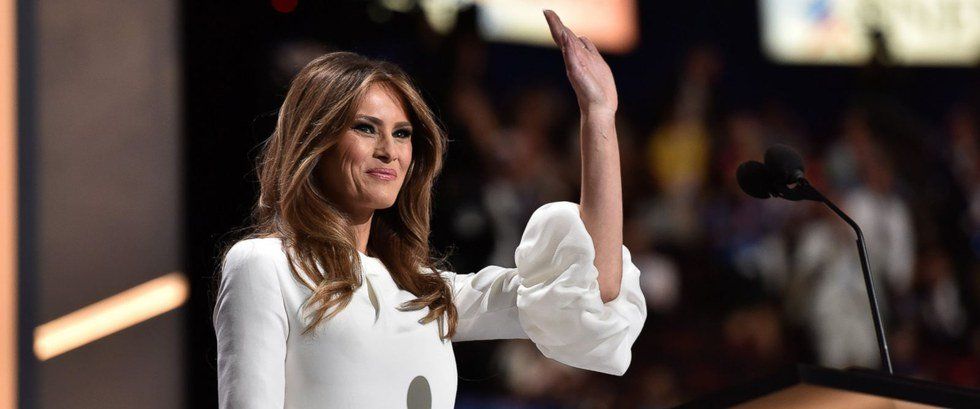
This week, French fashion designer Sophie Theallet released a statement via Twitter announcing that she would not be offering her fashion services to future-First Lady, Melania Trump. Theallet has, over the course of the past eight years, frequently dressed the current First Lady, Michelle Obama. In her statement, Theallet cited the racism and bigotry of Melania's husband, president-elect Donald Trump, as the principle reason for boycotting the White House for the upcoming four years.
Open letter | Sophie Theallet | November 17th, 2016 pic.twitter.com/g1hIAyBmdF
— sophie theallet (@sophietheallet) November 17, 2016
Supporters of Theallet are arguing that a brand should be able to choose who they serve. Opponents are coming after the brand, saying that the designer and her call for other fashion leaders to boycott Trump's White House are creating unrest and unnecessary difficulty. The current and future first ladies have already begun their own transfer of power (clearly they've started patching up the whole plagiarized speech fiasco).
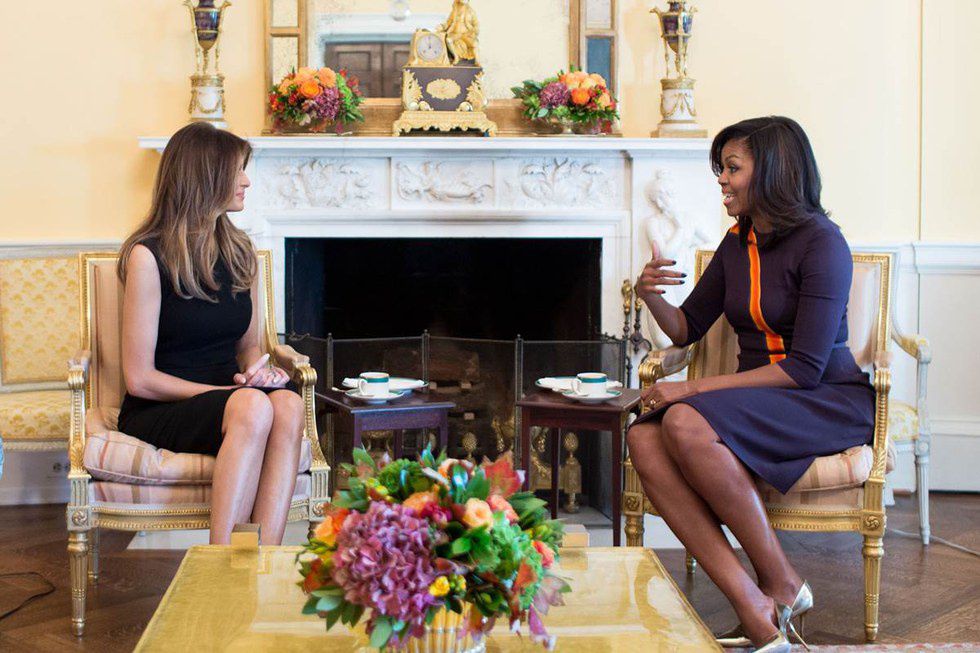
Above: Melania Trump(L) and Michelle Obama(R) discuss the responsibilities of the role of First Lady of the United States.
There's an underlying issue with Sophie Theallet's decision and her call to action: Imagine that instead of a fashion designer refusing to dress a first lady, Sophie Theallet is a Christian baker and Melania Trump is a lesbian woman looking for a wedding cake.
In recent months, there has been an ongoing debate about the rights of private entities and their ability to discriminate when it comes to their customers. Whether it's Twitter and Milo Yiannopoulos or Christian bakeries and gay rights, it's widely disputed if people should be able to deny anyone services for a reason that is non-economic. On the one hand there is the ever-famous slippery slope argument: If you allow someone to say "I won't serve you because I dislike you or because I disagree with you or something about you," it could devolve hard-core bigotry. What is there to stop people from choosing their customers on the basis of skin or ethnic groupings? Why shouldn't people be made to serve everyone equally?
On the other hand, shouldn't vendors be allowed to decide who they will or will not sell to? At the end of the day, it's their monetary loss if they choose to refuse service. Should we force people to partake in things where they feel their values or beliefs are at stake? I think most people would agree that a restaurant owned by a black family should not be forced to cater a Ku Klux Klan event as a question of principle, not money. A Muslim family should not be forced to have a booth at a pork festival. Sophie Theallet should not have to dress Melania Trump if Donald's policies conflict with her values. Christian bakers should not be forced to bake cakes for every wedding that comes through their door. Let businesses do their thing, independent of some forcing hand requiring them to behave beyond what they'd like.
Do I agree with Sophie's decision to not dress the incoming First Lady? Truthfully, no. I think the brand had an incredible opportunity to aid a peaceful transition in the White House and this decision is only continuing to aggravate an already tense passing of the baton. But the beautiful thing about democratic, free-market societies is that it's none of my business what she does with hers. Other designers will vie for the opening in Melania's closet and the market will work its magic. I think, as an artist and as a creator, that Theallet should have the autonomy to decide who can own and wear and, ultimately, represent her brand—it is for her to decide. That applies to all circumstances, not just the ones we cherry pick because we agree with them.