

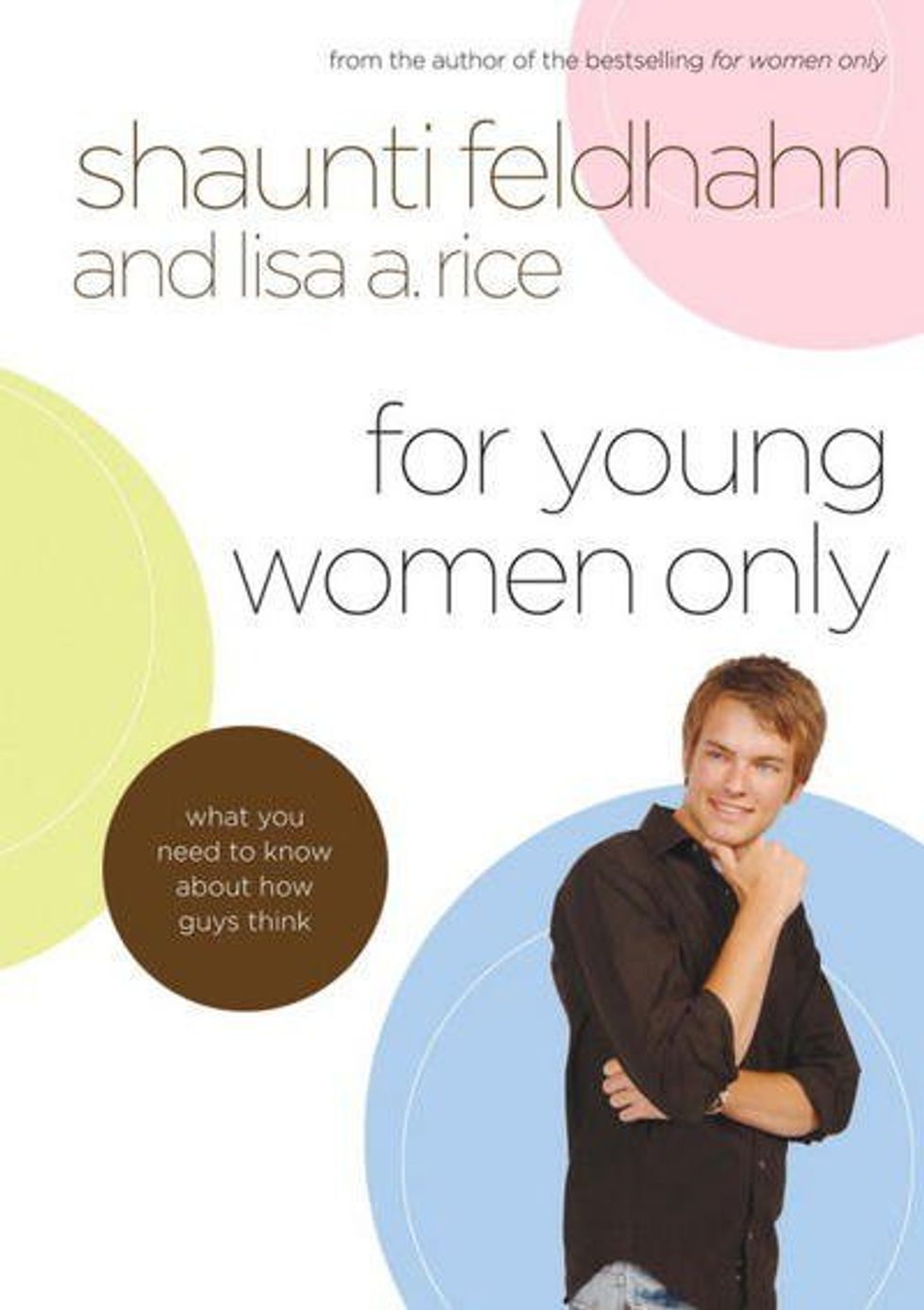
This is what I looked like when I first received the book "For Young Women Only" by Shaunti Feldhahn and Lisa A. Rice. I was around 12 or 13 years old. Fresh into middle school rocking braces and an unfortunate eyebrow-plucking incident. I was awkward, naive, impressionable and (like any middle school girl) constantly thinking about boys. This book promised to give me all the answers about "the unique way guys are wired."
I read "For Young Women Only," a book marketed to Christian teen girls, with my middle school church group. We gathered every couple weeks to analyze all the surveys, quotes and "insights" on the young male brain that this book had to offer. At a young age, "For Young Women Only" shaped my view about men and led me to believe that I was solely responsible for "tempting" men. It left me feeling self-conscious, confused and objectified.
So here are six reasons why this book is literally the worst.
1. It completely objectifies women.
In the chapter, "Keeper of the Photo Files," a teacher explains to girls how they are like a piece of candy—something that boys just can't resist. She writes, "I told them that by showing off their breasts or rear ends, that was just like saying, 'Come have a piece of candy.' That is what they put the boys through every day that they show off the wrong things! And I explained that even the nicest boys are going to have to fight not to look."
I don't know about you, but I am pretty tired of being compared to inanimate objects. These comparisons are constantly pushed onto young girls, teaching them that they are less than human and something to be consumed. These ridiculous analogies are used to simplify and normalize objectification of women.
2. It slut-shames and fat-shames along with teaching young girls that they are the problem.
The book glorifies dress codes telling us to "see dress codes as a blessing" because they are designed to "protect the guys." It emphasizes how wearing a short skirt or a top that shows some cleavage puts men in harm's way.
On top of this, the book also points out that while women shouldn't tempt men with our scandalous shoulders, we should look attractive and be a healthy weight. The book reads, "For most of the guys, a significant weight gain acted like a 'blocker' that simply blocked out the ability to be physically attracted to the girl—no matter how wonderful and beautiful she otherwise was."
I really wish I was making this stuff up.
3. It makes excuses for men and further pushes the stereotype that they are unable to control themselves.

Almost all girls have been warned about men's "powerful hormones." We are taught that men are unable to control themselves or as the book puts it: "Once it's on his mind (which is a lot of the time), hormones can override his brain."
These stereotypes of men with uncontrollable hormones not only give men an excuse to behave however they want but also completely insult and underestimates the gender as a whole. Young boys and girls are taught so early on about this stereotype that we start to believe that it is normal and OK.
4. It reinforces rape culture.

The chapter "Body Language," is full of quotes from men saying that once they start getting physical, it is hard to stop from going all the way. One man was quoted saying, "With a guy, if you want to be able to stop it, it's safest to not even start."
Another guy in the book says, "With basic making out, it's usually innocent for me. But once the hands start moving, it leads to more stuff. I can usually restrain myself if the girl isn't pushing things too much, but if she is..."
These are the kind of thoughts that are eventually used to rationalize rape. We are taught to believe that for men, getting physical is an all or nothing. And if women push towards anything more than kissing, then they are expected to go all the way.
5. It praises virginity and teaches us that our sexuality is something to be ashamed of.
In the seventh chapter of the book, virginity is put on a pedestal. While this is expected (because it's marketed towards Christians), keeping your virginity is not talked about in a religious sense, but rather emphasized that a guy will only want you if you are a virgin. The author shares, "Believe it or not, although so many guys want to convince their girlfriends not to be a virgin, they want to marry one!"
Thank you, double standards.
The book then goes on to quote a man who slut-shames women by saying, "We want a girl without a history because the more guys she's had, the higher the chance that she'll cheat on you."
Girls who are taught this kind of mentality at such a young age are more likely to feel shame about their sexuality and feel as if their worth is tied to their virginity.
6. Women are told at a young age that their worth is determined by men.
This whole book is all about how to be a "good" woman for a man. It reduces a woman's value to her clothing, attractiveness and virginity. And all these requirements are set by men in the book that aren't even named.
The messages from this book stayed with me a long time. Throughout middle school and high school, I always felt responsible for being sexualized and thought that objectification was just part of being a woman. It took me a long time to let go of these messed up standards that women are held to and learn that no man can or will define me.