


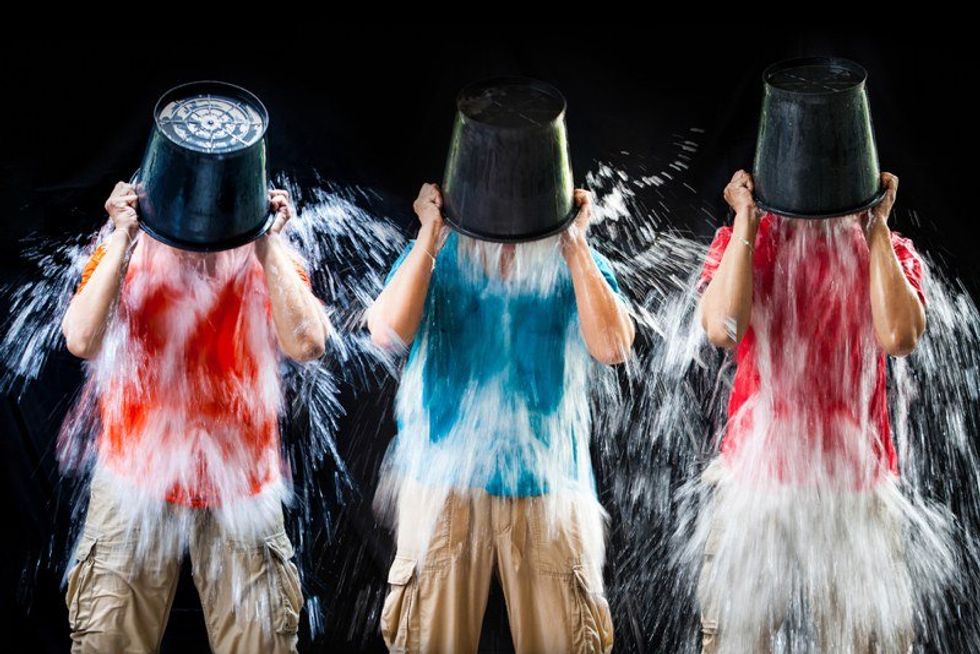
Wouldn’t it be strange for millions of people to record themselves dumping ice water over their heads and post it on social media? This is exactly what people were doing only a year ago, and now every August to raise money and awareness for Amyotrophic Lateral Sclerosis (ALS), also known as Lou Gehrig’s disease.
While there were many supporters of this challenge, there were also some people who opposed the challenge. I had friends say it was dumb because people were only doing it for attention and not donating money. Some religious groups tried to dissuade supporters from making donations due to research involving stem cells. To me, none of these things mattered. As long as something was being done to bring ALS to the media, I was happy. You see, for my family the Ice Bucket Challenge was more than a silly little bet. It was hope. It was a blessing.
In 2013, both my grandmother and my uncle were diagnosed with ALS. While my grandmother passed away last January, my uncle is still putting up a fight. Never in a million years would I have thought that I would have to see family members go through this, especially because of how active they were before it affected them. I thought that my grandma would have lived to be 100 years old, just like her aunt had. She was always very active. Tennis was her go to way of exercise. This was one hard realization of ALS. It can affect the most active people. Watching loved ones struggle with this disease has taught me not only how terrifying it can be, but also how resilient the people are who have been diagnosed.
The symptoms can be different for everyone. They start out small, with my uncle it was trouble speaking, with my grandmother it was trouble using her hand. As time progresses, more symptoms arise such as losing the abilities to walk, talk and eat on your own. The body slowly stops working, although the mind is always present. It can feel as if you are trapped inside of your own body. The Ice Bucket Challenge was chosen to represent ALS because it can create the sensation of numbness in the body ALS patients endure.
To reflect back on the Ice Bucket Challenge, I’m sure you are wondering where all of the donations went. $77 million went to research, $23 million to patient and community services, $10 million to public and professional education, $3 million went to fundraising and $2 million to external processing fees. That makes a total of $115 million raised through the Ice Bucket Challenge. If someone isn’t interested in dumping ice cold water over their head, there are also walks to defeat ALS and money can be donated to the ALS Association online.
Losing my grandmother was difficult for my whole family. She was the matriarch who held everyone together while keeping everyone in line. She was loved by everyone she met. I’ve never known anyone with as many friends as she had. She taught me that, “It is just as easy to be nice, as it is to be nasty,” so why would anyone choose the latter?
My hope is that through greater awareness of this terrible disease, more donations will be made available for researchers and they will be able to find a cure.













