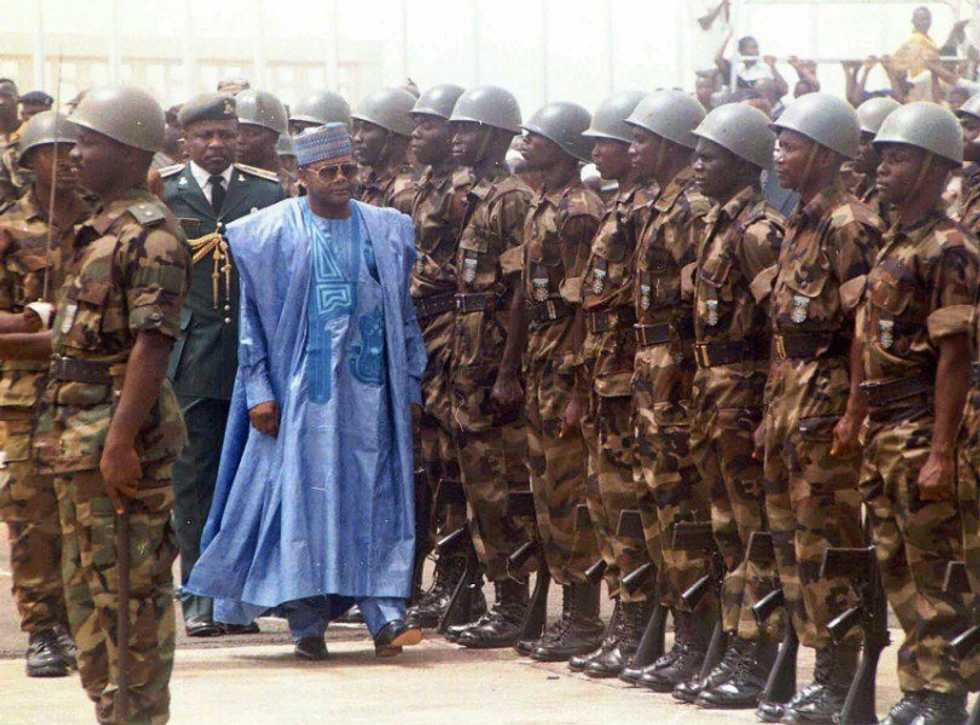
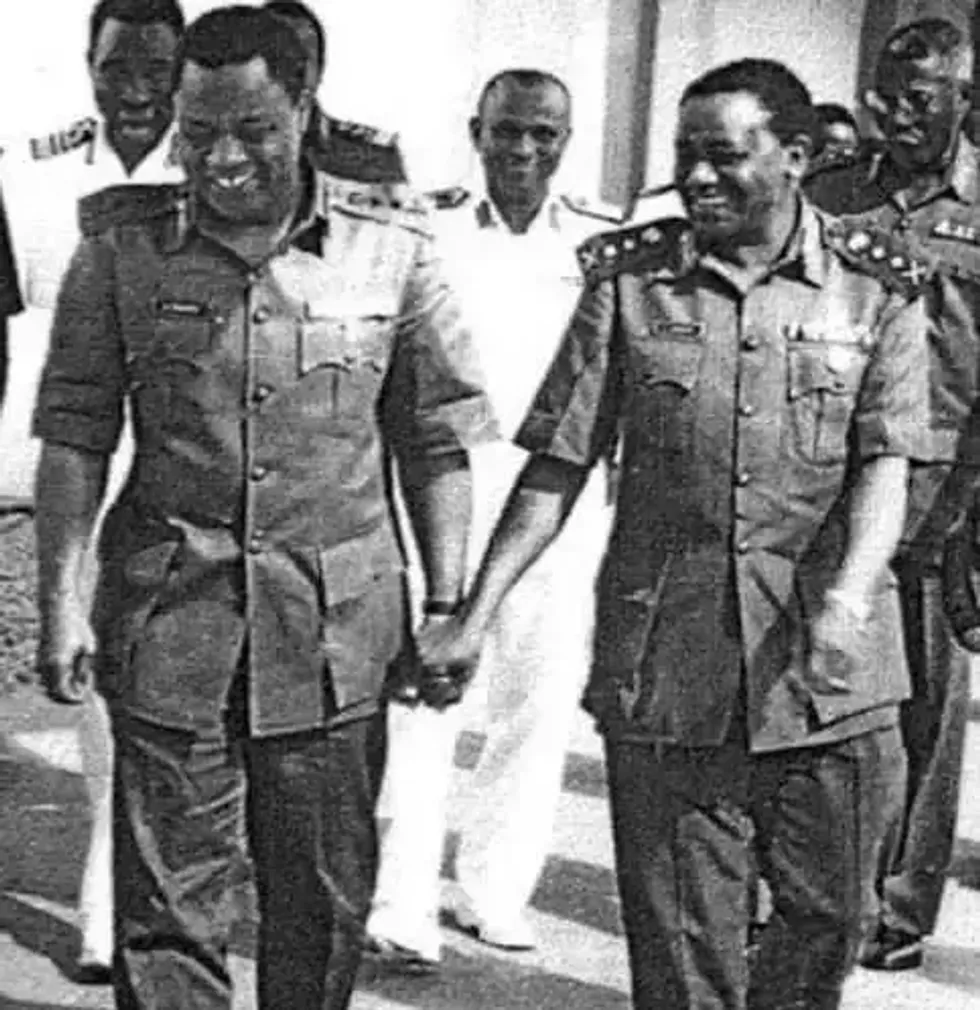
Generals Ibrahim Babangida and Sani Abacha during the 1966 coup d'etat
This week's article delves into the history of Nigeria from the end of the Biafran Conflict to 1999, when the current period of Nigerian politics began and democratic civilian rule began again. Military rulers came to power through armed coups against the ruling government, mainly toppling administrations of other generals. While civilian rule was reinstated briefly in the 1970s and 80s, the military quickly ousted the democratically-elected president and retook control of the government. In 1998, the last major ruling general passed away, leaving his successor with the fate of Nigeria.
With peace and order now restored to the country, Nigeria officially joined the Organization of the Petroleum Exporting Countries (OPEC) in 1971, resulting in a substantial increase in oil revenue. As a part of OPEC, Nigeria took part in the 1970s oil embargo against the United States and other Western nations in protest against their support of Israel during the Yom Kippur War. The Nigerian economy was now energized and development was taking place. Nigeria’s oil wealth helped to create an overpowering central government that intervened in the affairs of the local and regional governments. This led to the death of true federalism in Nigeria.
In July 1975, a bloodless coup took place, ousting General Gowon and replacing him with General Murtala Mohammed. General Mohammed was assassinated in a failed coup attempt in February 1976 and was succeeded by General Olusegun Obasanjo. Stability returned to the Supreme Military Council during Obasanjo’s rule. The government placed a heavy focus on industrialization under Obasanjo and a rising middle class began to develop. With Soviet assistance, Nigeria’s steel and heavy industry sectors began to rapidly develop. Because of incredible oil revenue, the country’s per capita income rose sharply, helping to improve the lives of many Nigerians. During this time of prosperity, however, many military officers and government officials were embezzling state funds, effectively stealing money that would have made its way to everyday Nigerians.
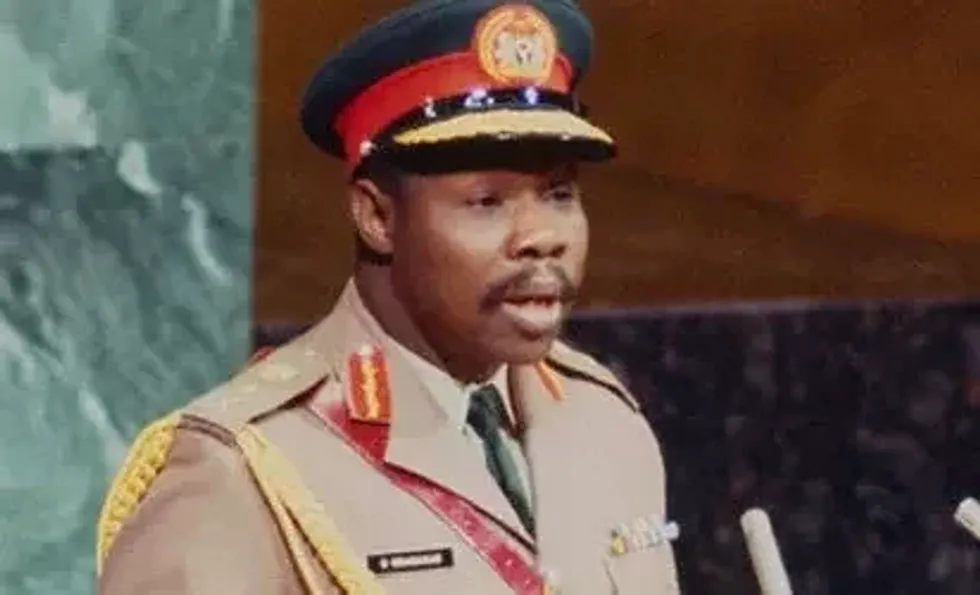
General Olusegun Obasanjo speaks at the United Nations as the Nigerian head of state
The federal capital was based in the southern city of Lagos and Obasanjo planned to move it to the more central city of Abuja during his term. Abuja is not associated with any particular ethnic group, making the choice a logical one to appease both the North and South. Obasanjo dissolved the Supreme Military Council and transitioned the country back to civilian rule in 1979 before the capital was able to move, however.
General Obasanjo announced a transition to civilian rule and planned elections for 1979. A northerner of Fulani extraction, Shehu Shagari, was democratically elected with 33.77% of the vote, beating out four other candidates, including Former-President Nnamdi Azikiwe. Shagari immediately pursued policies that targeted the continued development of Nigeria’s heavy industry and oil sectors, but also advocated for the increased focus on agriculture. He pioneered the introduction of heavy machinery in the farms, hoping to help farmers become mass producers. President Shagari’s early initiatives were supported by the oil boom in the late 1970s, although his attempts to reform farm production were inhibited by retired military officers who were granted land as gifts during Obasanjo’s rule.
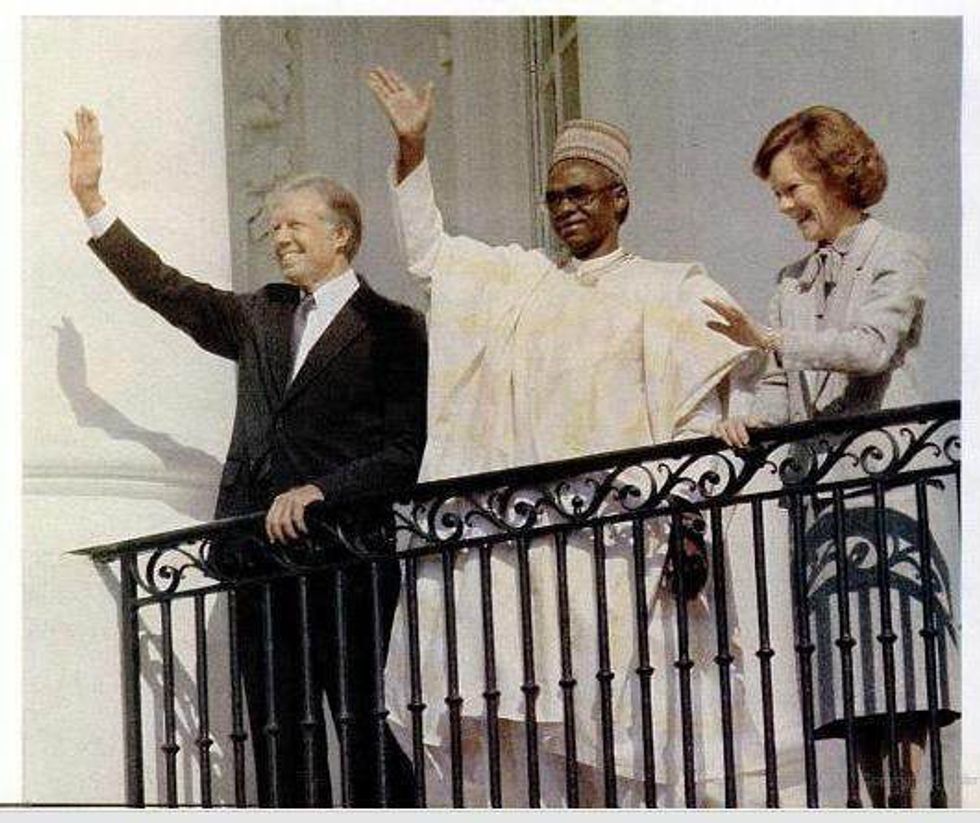
President Shehu Shagari waves to onlookers while on a state visit with U.S. President Jimmy Carter
By 1981, global oil prices had begun to fall, leading to a depression in the Nigerian economy. Shagari initiated an Economic Stabilization Program in an effort to slow the decline and position the economy for a rebound, but the program was able to do very little. On top of the hard economic times, the Shagari administration was accused of widespread corruption, including accusations of election fraud during the 1983 presidential elections. Many Nigerians had become discontent with the regime and ethnic and religious violence was becoming more common. As a result, General Muhammadu Buhari staged yet another military coup against the democratically-elected Shagari government on December 31, 1983.
During the coup, a key player, Brigadier Ibrahim Bako, who also helped lead the 1966 counter-coup, was shot dead under suspicious circumstances while attempting to arrest President Shagari. Bako was chosen because his father was a close friend of the president, and the arrest was supposed to take place once the presidential Brigade of Guards had been peacefully neutralized. Unfortunately for Bako, the coup plans had been uncovered by Shagari and the Brigade was placed on high alert. Bako was shot dead in the passenger seat of his truck when his armed detachment arrived at the presidential residence. While official sources claim he was killed in the gunfight between the guards and Bako’s troops, some, including his son, say he was executed by his fellow coup conspirators for refusing to go along with a bloody coup.
At the end of the coup, President Shagari was removed and General Buhari reestablished the Supreme Military Council of Nigeria as the governing body. Buhari began to take intense measures to reform the economy and get the country back on its feet. Nigeria broke off ties with the International Monetary Fund (IMF) in protest of the fund’s request of a 60% devaluation of Nigeria’s currency, the naira. Despite his backing out of the IMF, Buhari implemented reform policies that were as, if not more, rigorous than those suggested by the fund. He moved Nigeria down the path of import substitution industrialization, in which foreign imports were replaced by domestic goods, boosting use of local resources and curbing imports. Buhari largely continued the foreign policy pursued by President Shagari, focusing mainly on Nigeria’s neighbors and other African nations due to financial interests. Nigeria remained open to talking with international organizations like the United Nations, but took no leading role in pushing any agenda on the international stage other than its role in OPEC. He made and kept a commitment to all treaties and obligations with other countries entered into by previous governments.
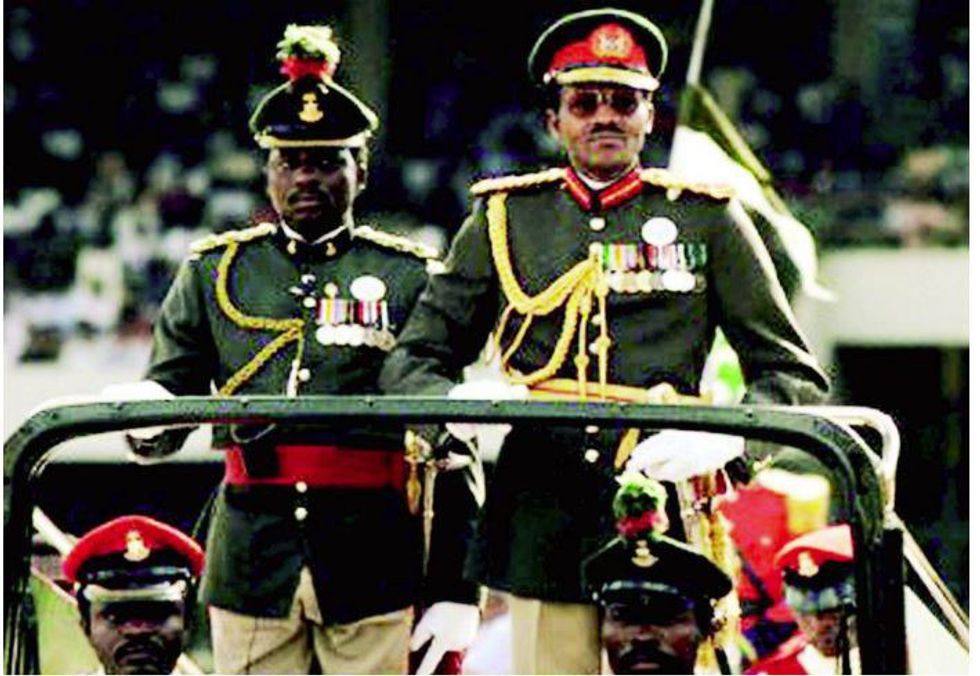
General Muhammadu Buhari during a military parade in 1984
In 1984, Buhari issued Decree Number Two, the first of numerous decrees granted the National Security Organization (NSO) unprecedented powers. In this decree, the NSO was authorized to detain citizens for three months without charges against them before their case was reviewed. The NSO banned all strikes and public demonstrations, harassing, intimidating, and jailing those who dared to defy their orders. Decree Number Four targeted the press and journalists who spoke out against the government. They were arrested and tried in an open military tribunal, not a civilian court, making any kind of appeal impossible. Decree Number 20 brought the death sentence to anyone who was found to be dealing in or using cocaine or related drugs. On March 20, 1984, Buhari launched the War Against Indiscipline to combat a perceived lack of public morality and civic responsibility. The program brought harsh consequences to minor offenses, including a 21-year prison sentence for any Nigerian over the age of 17 who was found to be cheating. At bus stops, Nigerians would have to form neat lines or face being whipped by omnipresent soldiers. A botched operation against corruption within the government occurred in 1984, when the NSO worked with Israel to find and extract Umaru Dikko, the Minister of Transport under President Shagari. Dikko was accused of embezzling over $1 billion from oil revenue, and was found in exile in the United Kingdom by Nigerian intelligence officers, who kidnapped and drugged him. He was then placed in a plastic bag and loaded into a shipping container labeled as diplomatic baggage destined for Nigeria. The intent was to discretely fly Dikko back to Nigeria to stand trial, but British airport officials found Dikko in the shipping container and foiled the plot. Before Buhari was deposed in the 1985 coup, he waged a campaign against corruption, imprisoning more than 500 government officials and businessmen.
In 1985, a coup was set in motion by General Ibrahim Babangida and other mid-level military officials in the Supreme Military Council. General Buhari was removed from power and Babangida pledged to transition the country to civilian rule over the next five years and to steer Nigeria away from Buhari’s human rights abuses. Both promises were not kept, however, and Babangida went on to commit the worst human right abuses in recent Nigerian history. The general replaced the import substitution program with his own Structural Adjustment Plan (SAP), which included the deregulation of agriculture and the loosening of restrictions on foreign imports. Nigeria upgraded its status within the Organization of Islamic Cooperation (OIC) under Babangida from observer state to full member state, causing an outcry from the country’s Christian population. Brigadier General John Shagaya was appointed to lead a commission on Nigeria’s participation status in the OIC, but the commission took no stance on the issue. Shagaya instead advocated for stability and secularism in the country. Another military officer was removed by Babangida after vocally opposing Nigeria’s participation in the OIC, arguing that the country should remain secular.
On January 24, 1992, the announcement by the Independent National Election Commission stated that a legislative and presidential election would come that year, marking a move to civilian democratic rule. The announcement followed General Babangida’s 1989 legalization of the formation of political parties and a national referendum on the matter in 1991. Babangida formed two parties, the Social Democratic Party (SDP) and the National Republican Convention (NRC), and banned all other parties from the political system. Nigerians were encouraged to participate politically through either of the two government-approved parties, and the SDP won big in the legislative elections. In the presidential election, the SDP put up Moshood Abiola as their candidate, facing off with the NRC’s Bashir Tofa. The results indicated that Abiola received 58.36% of the vote, and therefore the presidency, but Babangida and his new National Defense and Security Council (NDSC) annulled the results and announced another election. Neither candidates from the SDP or NRC were permitted to run in the national election, sparking nationwide unrest, with many people being killed in the southwest, where Abiola was from. In an attempt to control the situation, the NDSC ordered the SDP and NRC to join a new interim government that would be sworn in on August 27, 1993, and on August 26, General Babangida announced he was stepping down as ruler of the country, handing power over to Chief Ernest Shonekan.
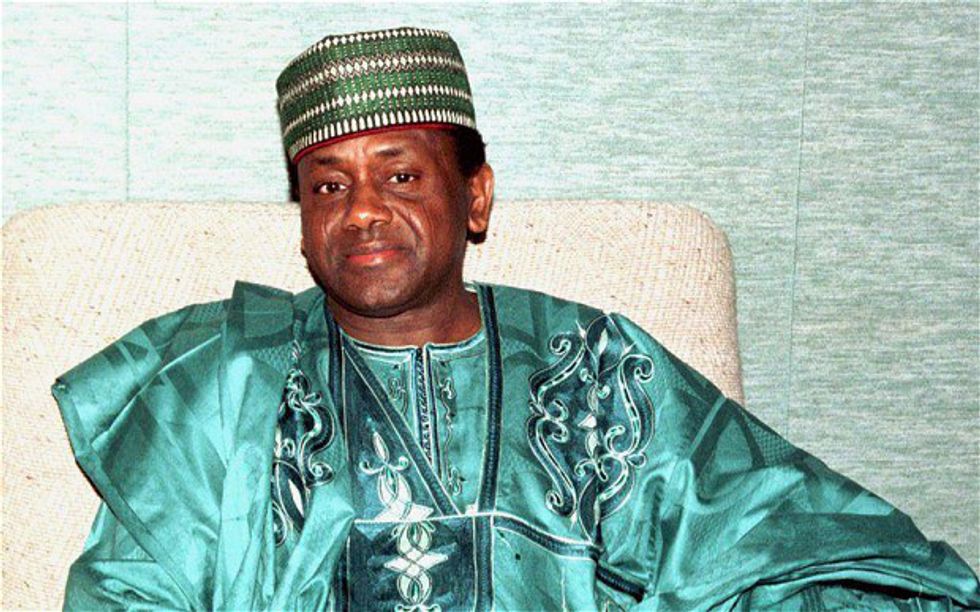
General Sani Abacha ruled Nigeria from 1993 to 1998, overseeing government crackdowns and rapid economic development
On November 17, 1993, General Sani Abacha ousted Chief Shonekan and overthrew his transitional government. Abacha issued a decree in 1994 making his regime above the jurisdiction of the courts, effectively granting him absolute power in Nigeria. During his administration, Abiola and General Obasanjo were arrested for treason, signaling Abacha’s determination to maintain control by stamping out potential threats. Obasanjo had condemned the Abacha regime for alleged human rights abuses and was arrested and tortured in order to extract false confessions. Although he announced a free presidential election in 1998, the general strong-armed all the major parties in Nigeria to endorse him as the sole candidate. Abacha maintained close tied with several American politicians and religious leaders and enjoyed the support of much of Nigeria’s West African neighbors. Nigerians troops were sent to Sierra Leone and Liberia by Abacha to help restore democracy to those two countries, despite the fact that it was nonexistent in his own. The Economic Community of West African Monitoring Group (ECOMOG) saw numerous military successes in the region due to Nigerian efforts, raising the country’s military profile under Abacha.
Nigeria’s economy flourished and the country saw a rapid increase in development. The country’s GDP in 1993 was about $494 million, but skyrocketed to almost $9.6 billion by 1997. Abacha reversed the controversial privatization programs initiated by Babangida and reduced inflation from 54% to 8.5% by 1998.
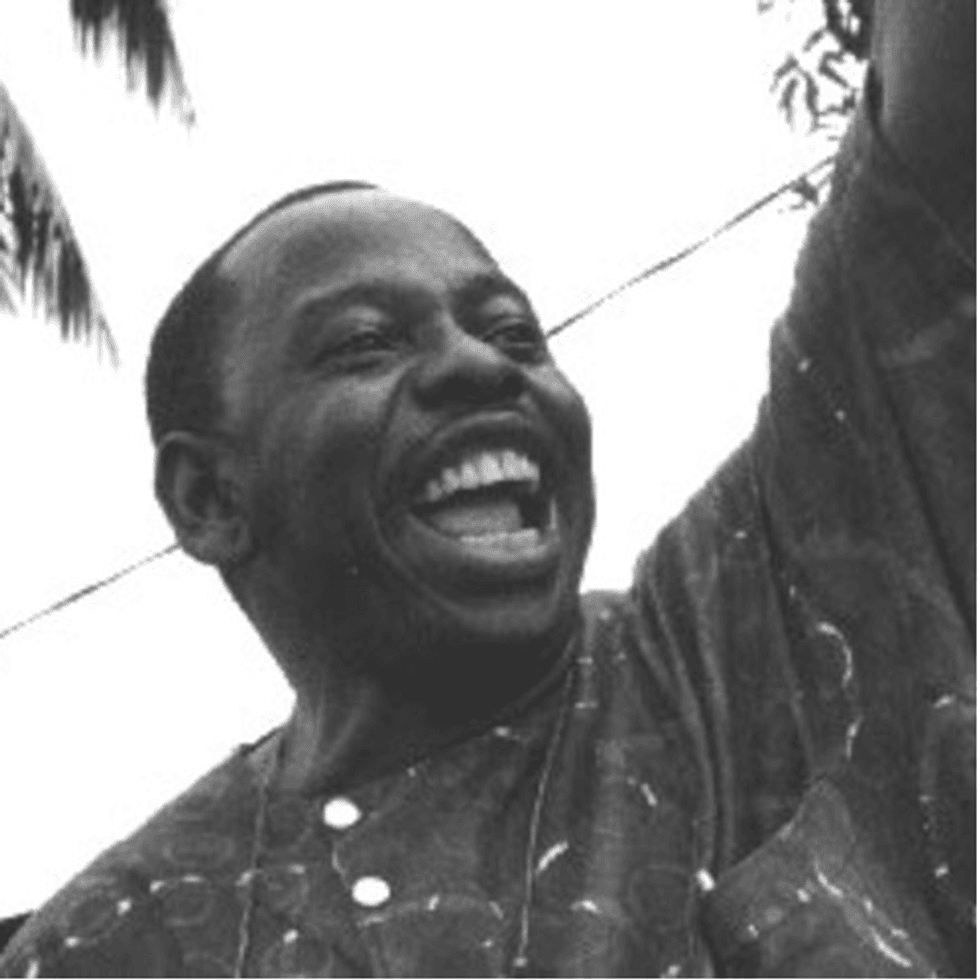
Ogoni activist Ken Saro-Wiwa was executed under Abacha's regime after a mock trial connecting him to the brutal murder of four Ogoni chiefs
In addition to arresting Abiola and Obasanjo, the Abacha administration targeted activists, especially those who worked against government objectives. Nobel Laureate Wole Soyinka was tried in absentia and found guilty of treason, and Ken Saro-Wiwa was hanged for his opposition movement in the Niger River Delta. Saro-Wiwa was an environmental activist who founded the Movement for the Survival of the Ogoni People, which opposed the intrusion of the Royal Dutch Shell company. He was arrested for his alleged involvement in the murder of four conservative Ogoni chiefs in 1994, and his trial became an international controversy. Ultimately, despite accusations that Abacha rigged the trial, Saro-Wiwa was executed along with several of his supporters.
In what many described as a “coup from the heavens,” Abacha died suddenly on June 8, 1998 from a heart attack. No autopsy was allowed and the general was quickly buried in accordance with Muslim tradition. Many believe Abacha was assassinated by two prostitutes flown in from Dubai, who laced his drink with poison on orders from political rivals. Immediately following the death of Abacha, Major General Abdulsalami Abubakar, Nigeria’s Chief of Defense Staff was sworn in as the new head of state. Unlike the generals who preceded him, Abubakar lacked experience in public office and he announced democratic elections soon after taking control of the government.
Next week will look at the most recent period of modern Nigerian politics. Civilian rule will be reestablished following General Abubakar's announcement of democratic elections in 1999, but the rulers who come to power will have surprisingly-close relations to the military leaders who ran the country during the latter years of the 20th century.