


Many individuals have specific moments in which they question their existence or even feel off about reality. As intellectual creatures, this is a perfectly normal response to a rather curious and stimulating environment that we dwell and explore in. These moments of mortal awareness are typically called a existential crisis, in which a person questions their existence and mortality. This phenomenon can seem frightening, but actually is a quite normal process for human beings. In small doses, it is not pathological to the human being. However, as the presence increases, so does its harmfulness to the person.
Imagine these existential crises taken up a notch and shaped into an an emotion component rather than a mental component. An individual actually doesn't feel real or feels the environment around them isn't real either (mayoclinic.org). This differs from the existential crises questioning of existence, in which it is the real feeling of nonexistence and/or simulation. Both of these feelings are called depersonalization and derealization.
Imagine feeling as if you aren't you or that you don't recognize the environment around you.
“[Depersonalization] gets you through a brutal experience, letting your basic survival skills operate unimpeded…Your ability to survive is enhanced as the ability to feel is diminished…All feelings are blocked; you ‘go away.’ You are disconnected from the act, the perpetrator & yourself…Viewing the scene from up above or some other out-of-body perspective is common among sexual abuse survivors.” ―Renee Fredrickson, Repressed Memories: A Journey to Recovery from Sexual Abuse
Depersonalization is a feeling of detachment from your own body and sense of self (mayoclinic.org). Someone could look in the mirror and not recognize themselves or question if they are real or not. The individual could also feel that they are watching themselves from afar. The person sees themselves as an "outside observer", seeing themselves as not themselves but possibly someone else (soul-mind.org)
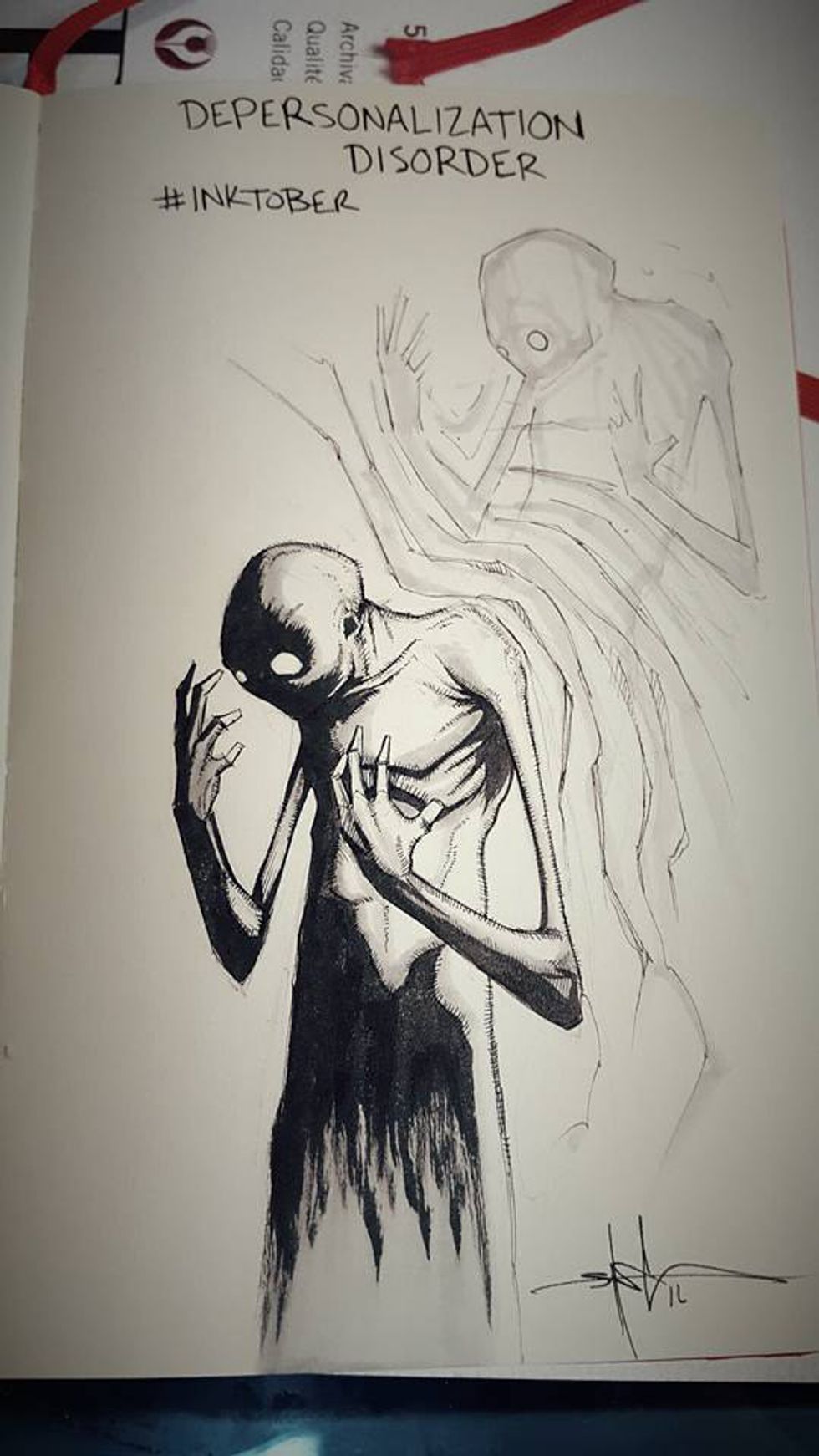
(twitter.com)
Derealization is a feeling of detachment from the surrounding environment (mayoclinic.org). People often describe derealization as watching everything as if it were on a movie screen.The individual may also feel that the world they are in and the environment around them is not real.
Both of these are symptoms of various mental disorders, such as anxiety disorders and Borderline Personality Disorder (mayoclinic.org). However, if the symptoms are persistent and severe enough, it can be known as depersonalization and/or derealization disorder (mayoclinic.org). When it becomes a disorder rather than a symptom, the criteria for the disorder are much more severe. Individuals with depersonalization/ derealization disorder could be in an episode for as little as a few minutes... or up to many years (webmd.com)!
Theories state that depersonalization and derealization happen as the body's coping mechanism to huge amounts of stress (mayoclinic.org). When a stress reaction happens in a human being, their body chooses to "opt out" of the feeling or moment. This is where a lot of individuals feel "out of body" and like they're watching a movie from their eyes. It's also theorized that people who have been exposed to traumatic experiences have developed a sense of depersonalization/ derealization. This is their body's coping response to other stressors within their lives.
Depersonalization/ derealization symptoms or the disorder itself can be quite frightening. If you or someone you know describes these feelings to you, it is best to get them the help they need in order to understand such a frightening, yet fascinating phenomenon. Contact your local physician and get an appointment to see a therapist. A therapist or mental health professional can help determine if these symptoms are a precursor to another mental disorder or actually depersonalization/derealization disorder itself.