
When is the last time you looked at a work of art?
“I don’t remember,” you might answer, struggling to recall that trip you took in high school to a gallery whose name has faded from your memory. Or maybe you think back to the digital photography class that you took last semester, and you remember how at the end you all made portfolios and shared your favorites with one another. You remember that one student did a portrait series showcasing traditional Cambodian dance. “Does that count?” you wonder.
I’m here to tell you that yes— yes it does.
At the beginning of November I went with a group of fellow students and friends to the famed Museum of Modern Art in San Francisco, a place I had never been before. The space is spectacular, and it’s certainly easy to see the reason for its renown. From postwar Japanese photography to slightly confusing American abstraction to a street artist documenting Urban Ruins, the walls are lined with things to ponder. Things to make you stare. Things to make you wonder.
I think that a lot of people have sort of a high-sounding, perhaps unrealistic, notion of what it means to be an artist— what it means to produce art. Sometimes I get that. Standing on the second floor of a famous art museum, staring at a huge canvas that is literally just painted monochromatic blue from top to bottom, it’s easy to get lost in the thought that “art” is unattainable. “How can I do this?” you wonder. Everything seems either so abstract or so skilled that, either way, it’s impossible for you to emulate it. “Maybe it’s all in the name,” you think, and you really hope not, because you’re pretty sure you’re too poor to get famous based on your name alone.
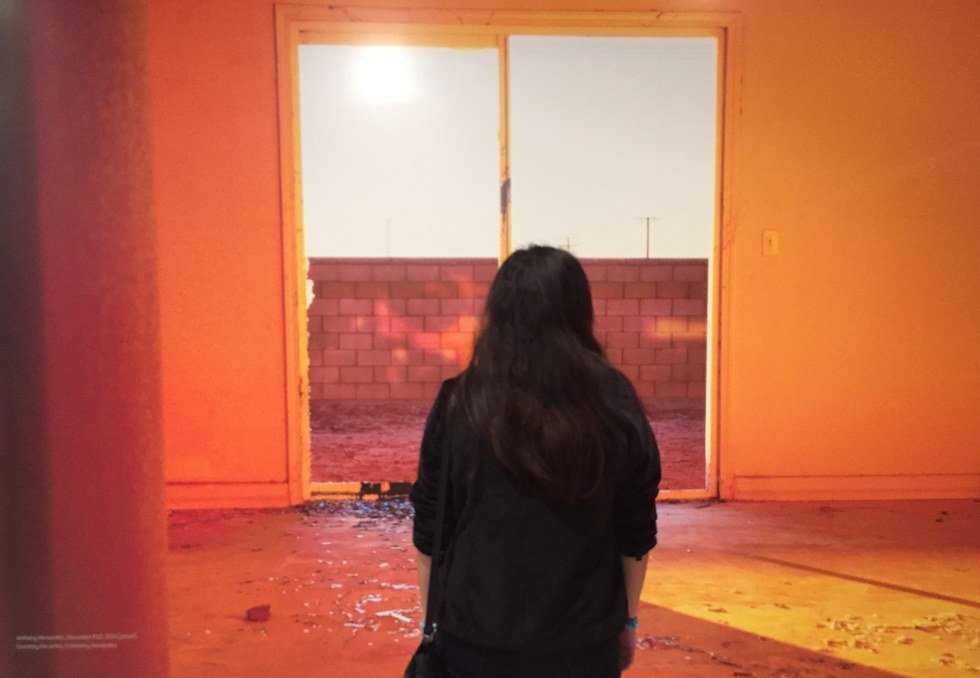
But then you climb a flight of stairs and find yourself immersed in the photographyof Anthony Hernandez, the photographer I mentioned earlier who specializes in defamiliarizing everyday surroundings. He goes behind shrubbery and under overpasses to capture the living conditions of the homeless, their lives divided from yours by some invisible, strikingly hazy line. He walks through dilapidated homes and worn-down parking structures that you see every day and shows you how they’re falling to pieces inside. He captures what stands just outside of your vision, and then he tells you to look.
You move through these images as you move through stories, taking it all in little by little. You feel them resonate with you. You feel them demanding answers from you that you do not have, and savor the way that it makes you feel just a little uncomfortable. You consider the possibility that art does not need to be glaringly conceptual or painfully complex in order to be art.
So yes, those beautiful, striking portraits that your classmate took of his family count.
The mixed media art that you saw on your Facebook feed depicting the feeling of an anxiety attack counts.
The sketch that you drew of your mother’s hands while sitting on the floor of your dorm room counts.
This isn't to say that creating art is easy. It takes time, practice, and a lot of TLC. But when it comes down to it, the purpose of art is not simply to be hung on the wall of a gallery. It is not to become famous enough that your name can make a torn piece of canvas worth millions. It is to connect with others. It is to connect with yourself, with parts of you that you had forgotten were still there. Art is about community as well as about self, and it is about reminding us that those things are not nearly as hard to find as we might think.