This past weekend, my family decided it was time to do some summer cleaning (and by that I mean my mother’s neurotic tendency to clean was made the executive order of the weekend). If you live in a house like mine, then you know that part of the cleaning job is to review and dust the stacks-upon-stacks of books, novels, textbooks and reference texts. I bring this up because the inspiration for my article this week came from one of those books that got dusted off and, in light of our country’s 240th year of independence, it led to some reflection.
"Urban Society" is a textbook that, using articles that are divided into units, aims to discuss the problems that afflict the modern metropolis. From racism to affirmative action to education to exploring the ways cities grow and shrink and change, the book is not your average textbook. It talks about topics that directly affect many people, including the students who read it. But maybe the most striking thing about this book isn't the relevancy of its content; it's the fact that all the articles within its covers are over 16 years old and still are extremely relevant. So while they may be discussing Coleman Young’s mayoral policy in Chicago or referring to Bill Clinton as president, the issues are still ever present in today's “urban society.”

So my question today is this: have we made progress? Looking in context of our 240-year history, I think the answer is yes. Americans left behind the agricultural society dreamed by Thomas Jefferson and became leaders on the global stage. When we talk about the idea of civil liberties and a government led by the people, we always cite America as having been the first to recognize that your rights are born within you. Not only that but it should be made clear to the government what those rights are and the fact that the government cannot arbitrarily decide to take them away. When we talk about diversity, it is the United States that is always referred to as the global melting pot. And when we talk about a place where people can truly arrive with nothing, not even clothing on their backs, and become something — homeowners, business owners, members of families and participants in politics — America is the prime example of a place where self-improvement through hard work and perseverance is summarized with the American Dream.
I guess a better question would be are we making progress today? And the answer for my part is I’m not sure we are. It seems to me that in many ways America is trying to treat cancer with aspirin. That is to say that we might be treating symptoms, but we’re not addressing the source. An issue that was discussed in the '90s was the state of the welfare system. We see a homeless woman with children and our reaction is to give her food stamps, low-income housing and health insurance. Problem solved right? Except we’ve done nothing to give her vocational or job skills that she could use to seek better employment, we haven't given her an incentive to leave the system in the future — we are essentially counting on her personal motivation to improve herself, and this does nothing to resolve of her single motherhood, to say the least. One would think that in 15 or 20 years, a civilized democratic society would have found a more effective way of helping poor and working class people but we’ve now been beating this dead horse for precisely that long and longer.
Another combination of issues discussed was police brutality and affirmative action. Coleman Young, the first African-American mayor of Chicago, attempted to deal with police brutality by delivering a 50-50 black and white police force. Young initially lowered standards on entrance exams and requirements to become an officer to make it easier for African American applicants to gain entrance but frustrated by the slow growth and promotions of these new officers he eventually made two lists. One with black officers and one with white ones. For every white officer promoted, he would promote a black officer. Worse than that, crime in Chicago began to skyrocket and tensions grew worse between the police and the local communities, as the black community would refer to the new officers as "traitors." Riots ensued and new gangs including the Errol Flynn’s and the Black Killers emerged. This was in 1973. Today we may not be lowering entrance exams at a police academy but it's no secret that National Achievement and National Hispanic Merit, awards that are supposedly comparable with National Merit, are granted with lower test scores because these test takers are non-white. And in recent years there has been an undeniable tension between the Black Lives Matter movement and the response movement, Blue Lives Matter, over multiple recent allegations of police brutality and abuse of power.
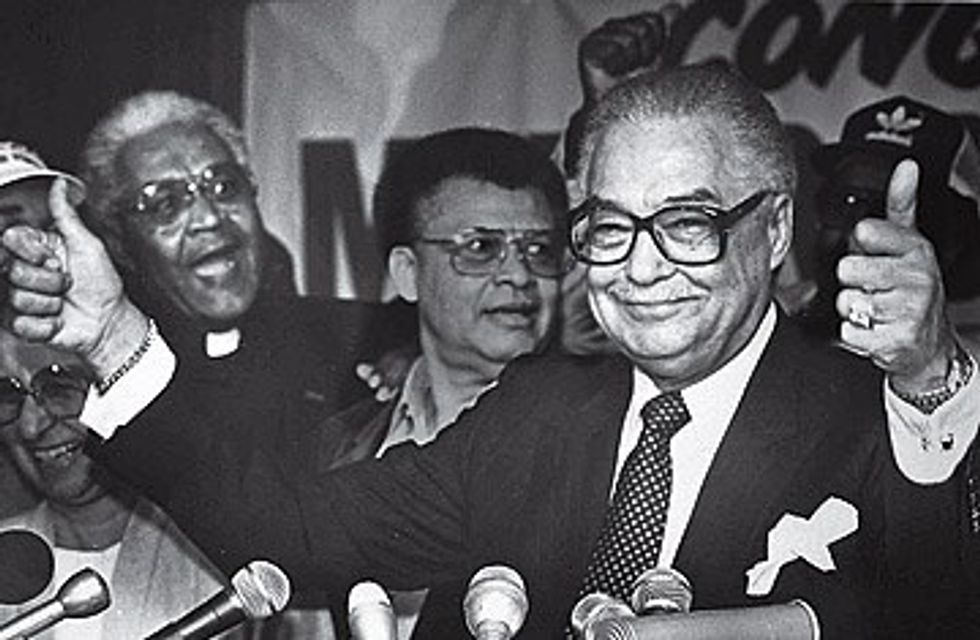
Above: Chicago's first black mayor Coleman Young, whose police department policies have been credited with the rise in crime in Chicago.
A newer issue, that still illustrates this idea of not treating the problem but addressing symptoms: A debate has arisen surrounding the benefits of trigger warnings and safe spaces in light of language or stories or images that are deemed offensive. The safe space spares our feelings but does it treat the growing problem of intolerance? Does it do anything to teach people, especially students in college, that not everybody is going to agree with you? Does the way we're responding to offensiveness actually harm us more than help us?
These issues and others are tales old as time. And yet it seems that either we lack the means or the ability to think creatively. So maybe I am reading a book out of 1990, but the headlines aren't changing. Maybe it's cynicism. There are those, like my father, who have resigned themselves to the idea that America is in decline and that to some extent it is futile to fight it. I would liken this to people who are aware of their cancer, but prefer to die peacefully without suffering from radiation or chemotherapy. There are those proposing radical solutions and political revolutions. These people would be comparable to those who propose cryogenics or cloning — something that might work in the future but ultimately is not really a full option at this time. Finally, there are those like me. We want to deal with the issues. We want to cure the cancer in a way that is effective and beneficial. On that front, as long as there are people looking to cure the ills, society has hope. As long as there are people who look for a tomorrow in America, you can count on progress.