
Looking for something different, thrilling, fast-paced, or adrenaline rushing? My first experience playing 9-Man was eye-opening. The sport opened up to me a whole new level of Volleyball. It was a hard adjustment from playing 6-Man however once I got the hang of it, I didn't want to stop playing.
After having about a year of experience I can say that between 9-Man and 6-Man, nine-Man is a whole other ball game that is two times faster and harder. My parents always told me when I was younger that they played this different type of Volleyball called 9-Man in New York. My father played with the New York Freemasons and my mother played with the New York Vikings. I had no idea about the sport until I started playing last year with my team the New York Vikings. It wasn't until two years ago, in 2014 when Director Ursula Liang came out with her documentary of 9-Man. This is where I learned more about the history of the game of 9-Man.

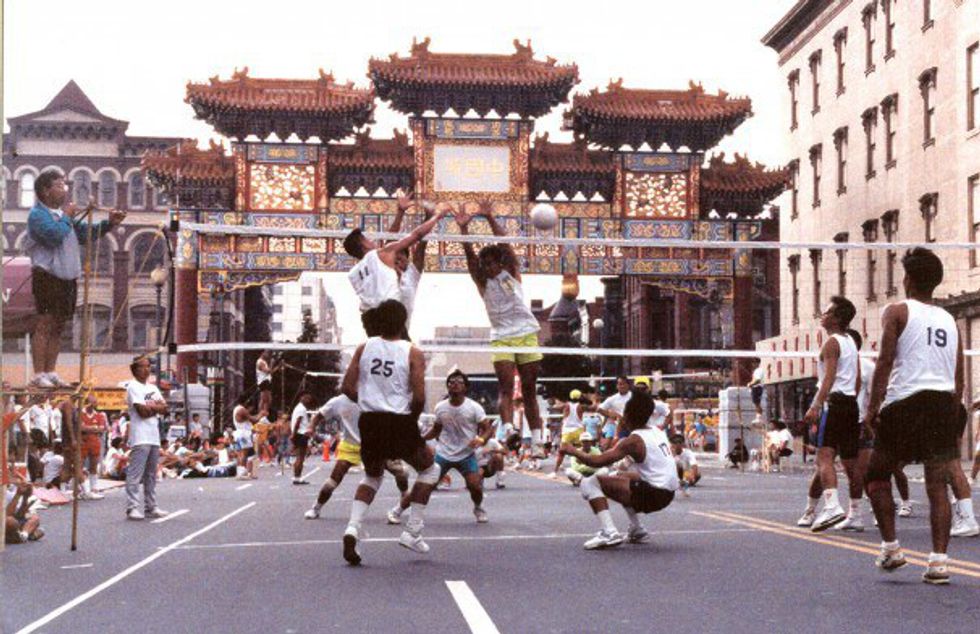
Nine-Man Volleyball is very different to today's usual 6-Man Volleyball. The sport originated from laborers, who mostly immigrated to the United States from Toison (a city in the Guangdong Province of China). This sport arose from the 1930s and it was meant for laborers to connect with each other in their local Chinatowns. There are 8 major 9-Man cities: New York, Toronto, San Francisco, Montreal, Los Angeles, Washington D.C, Philadelphia, and Boston.
Now compared to regular 6-man Volleyball, 9-man has many different rules as well as bigger courts. The courts are about 10m x 20m and the net is a little shorter than men's regulation at (seven feet and 8.5in high). We play with nine players on the court consisting of: five front row and four back row. The front row positions are outside hitter, two-ball, Fai-Gok (Hook), Setter, and Opposite Hitter. The Back row consists of the middle middle or what we like to call (Suicide), and three passers that rotate between serves.
The reason we call the middle middle position "suicide" is because that player ends up facing hitters of the opposing team up close, therefore they could be attempting to receive without a block or they pick up balls that come up short. A Fai-Gok or "Hook" is a player that basically kind of dunks the ball onto the opposing team, this position is taken by one of the faster hitters who can hit 1-balls (sets that are about one-foot above the net).
There is no rotations in 9-Man and only the three passers may serve the ball. Jump serves are not allowed in Traditional 9-Man, also if the serve touches the top of the net and happens to go over it is a redo. According to NACIVT Rules, at least six players must be 100 percent Chinese on the court. The rest of the players may be of any kind of Asian descent (Korean, Japanese, Taiwanese, Thai, etc).
Also only men are allowed to play 9-Man, women only play regular 6-man. During the game, each team may only have three touches on the ball, this is including blocks. Therefore if a player of the opposing team hits the ball into a block, then that counts as one touch for that team and they must send it back over in two touches. Other rules that are unknown to 6-man players are that front row players are not allowed to penetrate or cross the center plane (the net) this results in a loss of a point and is known as "piking". Another rule that is considered a carry in 6 man volleyball is something called chai ball where it's basically a scooping motion in order to get the ball up.
There is a play in 9-Man where you can push the ball into the net and play the rebound which acts as a reset and would count as one touch. One last important rule is, any contact made with your head is an automatic point to the other team, in other words if you six-pack someone, it's your point. The reason i love 9-Man is because I feel like I am playing and representing my family and the game feels more personal then club 6-man or high school volleyball. I also feel like I'm a part of a tradition that is a big part of my culture and its history.
But I urge anyone who reads this article to check out the 9-Man Website and the Documentary.