


Midterms are right around the corner. It seems as if the weather has cooled down just in time for the rain to come and just in time for the academic marathon to start. Soon campus will be full of overheard complaints about how little sleep someone has gotten, or how many papers someone has to write. It will start to rub off on you. The worst part about this season of the semester? The general aura of exam panic has its way of rubbing off on all of us. I'm here to give you five tips specifically tailored to both your personality and temperament to help you through the next two weeks without having a stroke or crying to your mother over the phone.
1. Give yourself time.
I know you've probably heard this a million times, but don't wait until the last moment to get things done. Doing that can leave you stressed on a normal school day, but when you have big tests or papers coming up that determine 30 percent of your grade, you don't want to be rushing. I've found that the panic about getting things done on time and satisfactorily is actually what makes me panic the most. So when a big chunk of your grade is counting on performing well academically, don't leave everything until the last minute and then rush to get it done.
For introverts: Find yourself a nice, quiet corner of the library where you won't be distracted and set yourself a time limit. Depending on how much you need to get done and just how long you can stand to work before breaking out in hives, this can be anywhere from a half-hour to six hours. Bring anything you need (textbooks, readings, etc.) and sit there for as long as you have to. Once you're done, take a break. Didn't get everything done you wanted to? That's alright, since you're starting early. You have time to get back to things later. After your time is up, go hang out with your friends for a while, or take an hour to do something that gets your mind off studying. You won't even feel bad about it because you've already gotten work done!

For extroverts: Find friends that have to do the same work that you do and go someplace to work on it! Bring some food and something to keep yourself hydrated. (Snacks are always a must.) If you can listen to music/watch television without getting distracted, put something on. Having your friends there to complain to or talk to while you're working will keep your motivation and energy up. Set yourself a time limit as well and when that's over, reward yourself with some non-studying time. Remember: your whole life shouldn't be devoted to studying. Midterms are important and do deserve the extra work, but it would be ridiculous to expect yourself to be studying 24/7. It's just not possible.
2. Make lists!
Work better with schedules? It can be a little overwhelming when you suddenly have much more work than usual; it can seem that a day is no longer 24 hours! You're wondering how on earth anyone expects you to get this done on time; it seems like an impossible amount of work for one human to accomplish. If you find that you're the kind of person who works well if you schedule out every hour of your day, do that. Take all your syllabi and assignment lists, your calendar with your midterm dates/paper due dates on it, and take give yourself and hour to sit down with them. Make a list of all the things that absolutely need to get done before midterms are over. Calculate how long it will take you to achieve each task. Make sure when you're doing this that you include a fudge ratio: every task takes more time than we think it's going to take, and creative tasks generally take more time than non-creative ones.
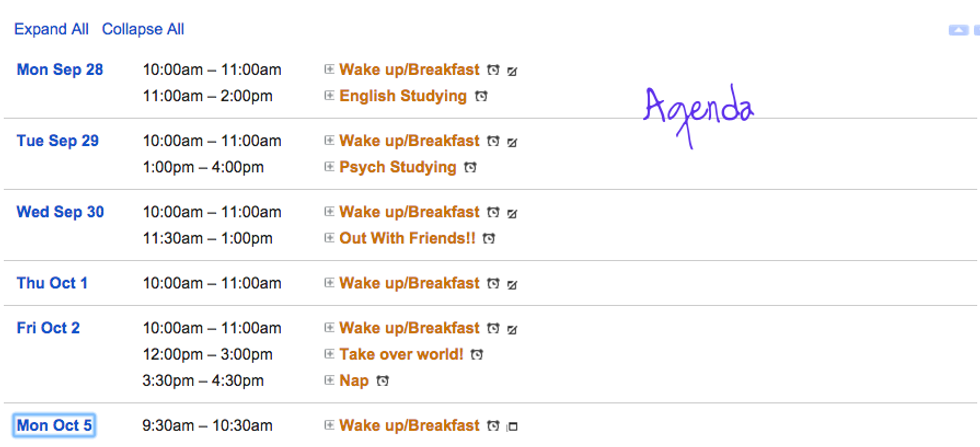
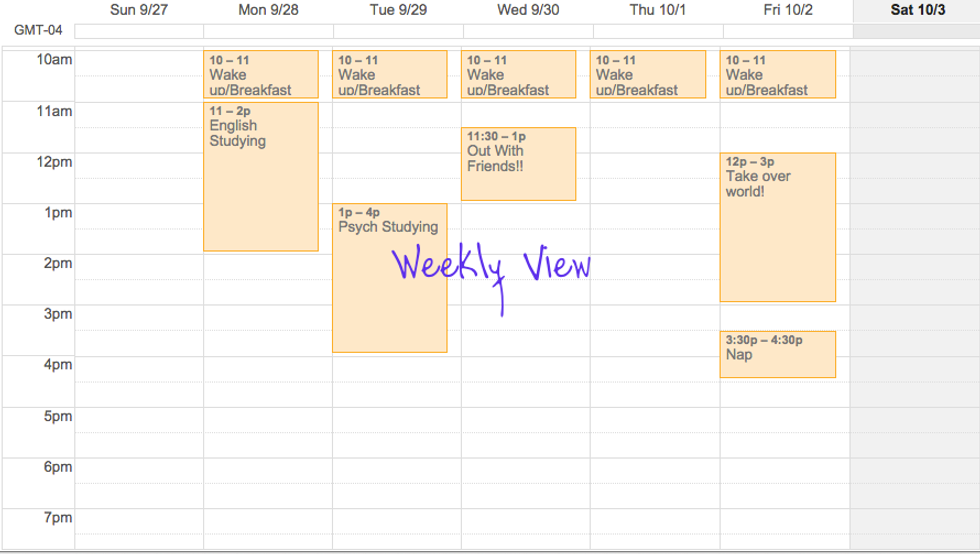
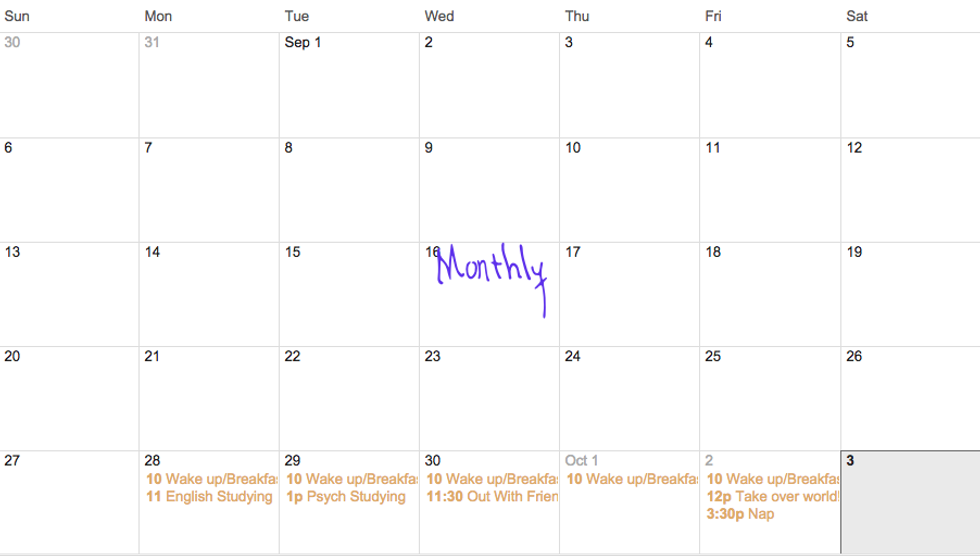
There are tons of ways that you can schedule your day. You can use Google Calendar to section out blocks of your time and then look at an agenda, weekly, or monthly view. Here's a sample that I wrote up. You can color code as well, but I didn't do that here.
If you're more on the artistic side, you can do something called a " chronodex/spiraldex
" that looks very gorgeous to plan out your day from hour to hour. I'm definitely not this artistic but they look amazing: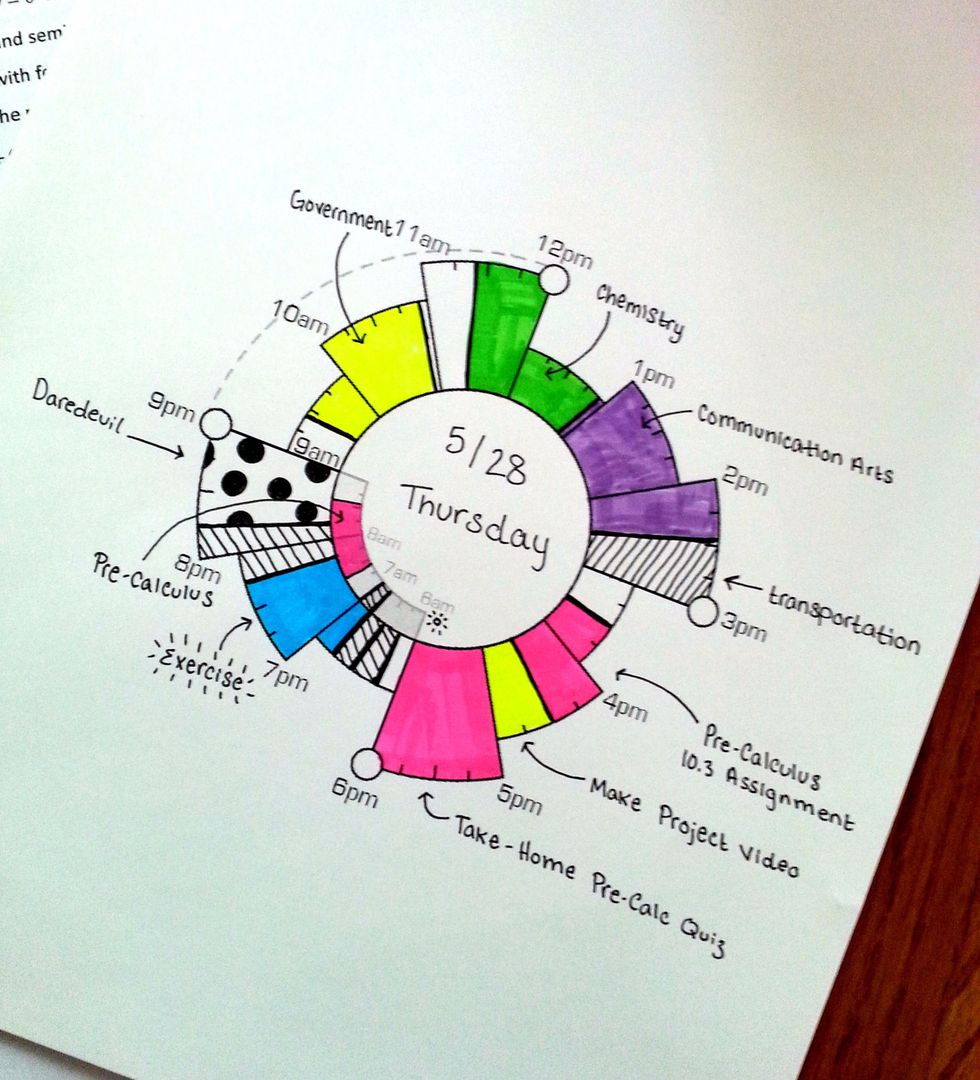
If you're more productive with To Do lists? If having a strict schedule to adhere to freaks you out and then bums you out if you can't stick to it directly, forget that idea. You may just need to organize and prepare a different way! Now this sounds like a no-brainer, but make a list. If you're one of those people who write all their assignments down in your planner on the day they're due, you might want to think about making a list of all the tasks you have to get done and when they're due. You can even list them by urgency. One user on Tumblr makes these lists for every week during the semester so she's never surprised by an assignment and rushing to get it done. Organization is a huge part of not having to rush when it comes to exam time. If you already know that you have three papers due and two in-class midterms in seven days, you won't be overtaken by last minute panic. Sit down with all your syllabi and write everything out that you need to do. I promise it will make things so much less overwhelming. When you first look at the pure volume of it you might freak out, but in the end you'll be grateful that you weren't surprised by any assignments that you forgot about.
If you want your lists to be organized and nice-looking but don't want to take the time to do it, here are some free printables from the internet that can get you going:
Weekly Schedule: can be used for just listing tasks you need to get done on that day instead of planning out your studying hour by hour.
More detailed weekly itinerary of tasks
24-Hour Schedule/Task List: want to combine both parts? This is perfect for you. There's a list section to put down all of your tasks and a 24-hour schedule section. If I were going to use this, I would rely more heavily on the task section, but maybe lightly shade in some guidelines of what hours I want to be working.
Color coded To Do List
To Do List for things other than just studying, to keep your entire life on track.
And finally, a regular To Do list but with an interesting feature: once you get to a certain point in the list, it tells you that you have too many tasks and that you should delegate. This might be helpful for studying for exams to let you know when you need to cross unnecessary things off.
If you need more help figuring out which planning style will work best for you, here are two great videos from the awesome Thomas Frank over at College Info Geek to help get you started with planning your day/week!
My 3-Tier Planning System for Getting Stuff Done
How to Get Massive Loads of Work Done Every Day
3. Find the most effective study technique.
Studying correctly can be the difference between coming out of the test feeling okay about it and feeling dismal about everything always... which to be honest is my default emotion. Oops? There are different techniques to help everyone, so let's get right into them.
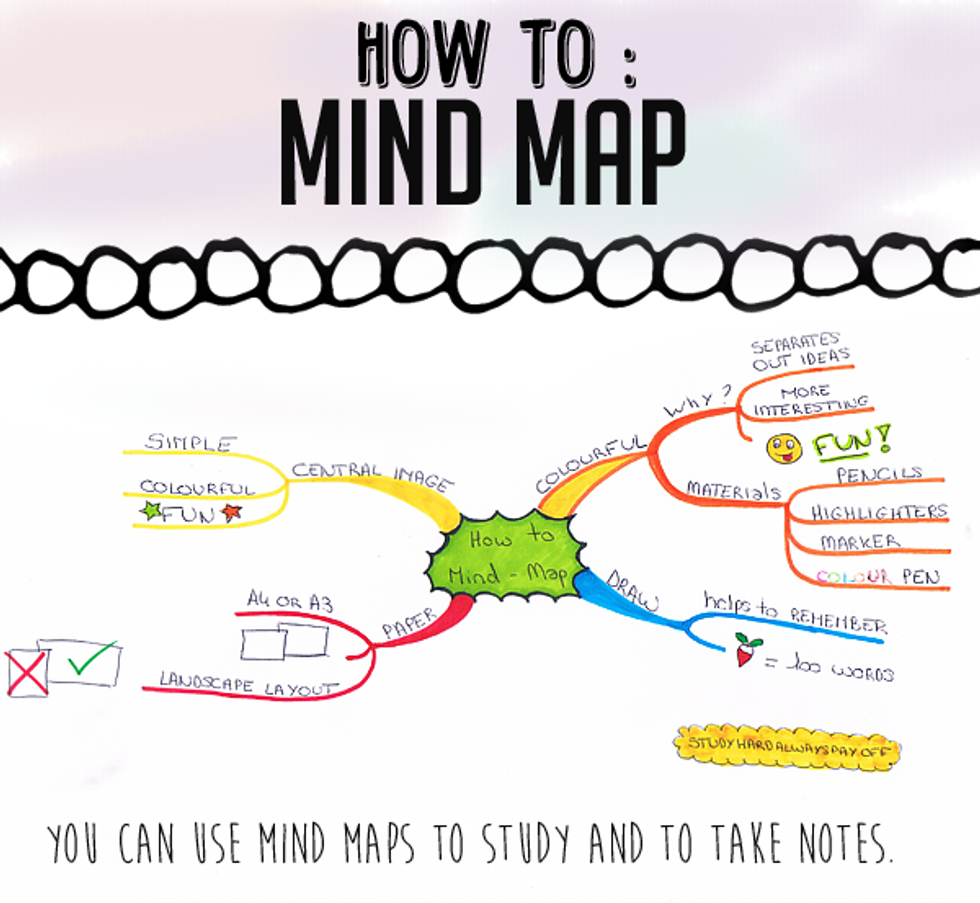
More a visual learner? If you're a visual learner, reading a text and/or notes repeatedly isn't going to be much help. You might want to try a mind map.
Studying with a lot of literary texts? Annotating can be your best friend! Underline phrases or words that are important, sure, but the real magic comes when you active read. Making connections within the texts, drawing arrows to connecting ideas, and interacting with the text in the margins. If you see something that relates to something you talked about in class, write that down in the margin. (Or on a post-it if you don't like writing in your books). See if you can rephrase big ideas in your own words. If you find that you can effectively explain/teach the material to someone else, you can be confident that you've got it down.
You can also use post-its to summarize chapters or paragraphs that you've already read so that it's easier to look back and remember. This helps a lot if you are reading novels for class and need to remember plot points or even quotations for an essay. (Never underestimate the power that a quote from a text in an in-class essay has.)
Easily distracted? If you find that it's hard to work for hours on hand without your mind wandering, you might want to try the Pomodoro technique. (And no, I'm not talking about that horrible pizza place on campus that sells burnt garlic knots. Ahem. No bitterness here, none at all.) This technique is based on the idea that you work uninterrupted for 25 minutes and then take a break. After four 25 minutes sessions, you take an even longer break. This makes sure to keep you alert and moving around periodically. No chance of falling asleep at the desk here! Unless you're extra tired because you've pulled an all-nighter. Speaking of which...
Do not pull all nighters! It seems like you're getting a lot of work done, but you're not. You're depriving yourself of much-needed sleep and leaving your brain unable to function at an optimal level. From the source linked comes this quote:
"Scientists have long known that sleep, memory and learning are deeply connected. Most animals, from flies to humans, have trouble remembering when sleep deprived, and studies have shown that sleep is critical in converting short-term into long-term memory, a process known as memory consolidation."
If you want to really know that material, go to bed. It's the best thing you can do for yourself. If you plan well and don't procrastinate (a battle in itself), you'll be able to get enough sleep to keep you going. After a certain level, the symptoms you feel when you're sleep deprived are almost the same as that of someone who has a BAC anywhere from 0.05 to 0.1 per cent. And no, it's not cool to be part of that crowd of students who "never sleeps." Taking care of yourself is way cooler.
Quiz yourself. Self-testing yourself on material that may or may not be on a test will help you figure out which material you're not so great at so you don't end up wasting your time studying subjects and units that you feel comfortable with. Use flashcards or make tests out of quizzes you've taken. If your teacher provides review questions, treat that like a test and then take it without any distractions. Look at the ones that you got wrong and study them more. You can also use the website Quizlet to make a set of online flashcards and play games with them. Repetition is your friend when it comes to flashcards.
Depending on your classes, you might not need to study the same way for every class. If you're taking a lot of GEs in different subjects, take a look at how you might study effectively for each one and tailor your habits to that. It might take a little extra effort, but you'll feel more prepared when you go into that test.
4. The tip no one wants to hear.

I know it's hard. Everybody wants to procrastinate. Everyone wants to procrastinate together while complaining about how much work they have to do. Trust me, I know. I want to do that right now. But the hard truth to hear is that none of that is going to get anything done. An acceptable amount of complaining will definitely make you feel better for a while, but there comes a point where you just need to buckle your bootstraps (is that the saying?) and just do it.
If it seems like you absolutely cannot make yourself get up and do anything, you can try one technique. Get up and make yourself do something for two minutes. The key word here is make yourself. Of course, the procrastination is telling you to keep laying there. That is what making everything so much harder. But often the only thing stopping us from getting work done is starting. Once we've done that, it actually becomes easier to keep going. So for two minutes, force yourself to study. After that, if it's easier to keep going, do so. If it's not, you can go back to procrastinating. But only for a while. If you wait too long, you'll leave everything until last minute and rush to get it all done, stressing yourself out and radically lowering the quality of your work. It's also much easier to procrastinate the closer you get to deadlines because you start to panic at all that you haven't done. So the best tip on here is just to get started and start early. Just do it. I know it sucks, but do it anyway.
5. Forgive yourself.
You're human. Chances are if you're studying for exams, you're also young. It's only about two weeks, and then this is all over. Two weeks. You can do that, right? It's not that long. 14 days. But if you mess up somewhere along the way—if you procrastinate, or forget an assignment or get so panicked that you shut down and just lay in bed and pretending you have no work until the night before all your exams—you've got to forgive yourself. If you beat yourself up over it, you're only wasting more of your precious time and being mean to yourself in the process. No one needs that.
If you mess up, or fail a test or even fail a class, forgive yourself. Maybe that class wasn't for you. Maybe you had other stuff going on. Your worth is not determined by your academic success. Okay? This is a hard time for everyone; where we have so much pressure put on ourselves that it often feels like we can't take it anymore. But I promise that you can. Just breathe and work your way through this and you'll come out alright.
Now, get out there and rock those exams!

















