
1. How to Act.
Yes, theatre taught me how to be an actor, but more than that, theatre taught me how to act every day. I learned workplace etiquette, meaning how to respect peers in their art and authority in their place of power and their vision. We always responded to notes with a gracious, “Thank you.”
2. How to be Punctual.
While there are variations on the saying, it is simply put: “Early is on time, on time is late, and late is unacceptable.”
3. Ensemble Attitude.

We treat our peers with respect, remembering to work with one another, to respect our differences, respect each others' efforts and appreciate what everyone has to offer the team. With this attitude in mind, I learned to be grateful for others.
4. How to use sympathy and empathy.
In order to understand others' emotions and to relate to them, we all use sympathy (relating to someone by “stepping into his or her shoes”) and empathy (relating to someone by using your own experiences and emotions). More importantly for theatre, I have been learning to separate the two, striving to separate myself from my characters for my mental hygiene. It is known that when people around us are stressed out, we likewise begin to feel stressed. Learning to find the division between our sympathies and our empathies for others can help us to relax as we try to help those around us with their problems.
5. How to be understanding.
Aside from sympathy and empathy, learning about character development helped me to understand why people do what they do in terms of what they knew and motivations.
6. How to do my own homework.

To my surprise, I thoroughly enjoyed doing homework for theatre. I only ever felt ready to create art when I was fully educated, whether that meant researching an era's history or studying the components of an acting technique. Moreover, I knew that I needed to be prepared if I did not want to inhibit the progress of the group or let my peers and directors down.
7. World history.
Theatre history ties in nicely with world history, as we studied various cultures and how they influenced our craft. For example, we learned about ancient Greek life, Elizabethan life under puritans and some about the Renaissance era all the way up through how the World Wars influenced culture to create absurdism and existentialism in the art world.
8. English.
As boring as it may sound to some people, analyzing the plot structure, the themes, the motifs and so on for a play is actually extremely helpful to the development of an artists' vision, whether the artist is the director, the actor or even a technician.
9. Psychology.
Specifically dealing with emotions in psychology, I learned a lot about how to maintain mental hygiene. There is a lot to be said about the risks and difficulties that actors take on when giving certain performances, so I will leave that for another article, but in short, actors should never use emotional recall, affective memory or emotion memory, if they can help it.
10. How to GO FOR IT.
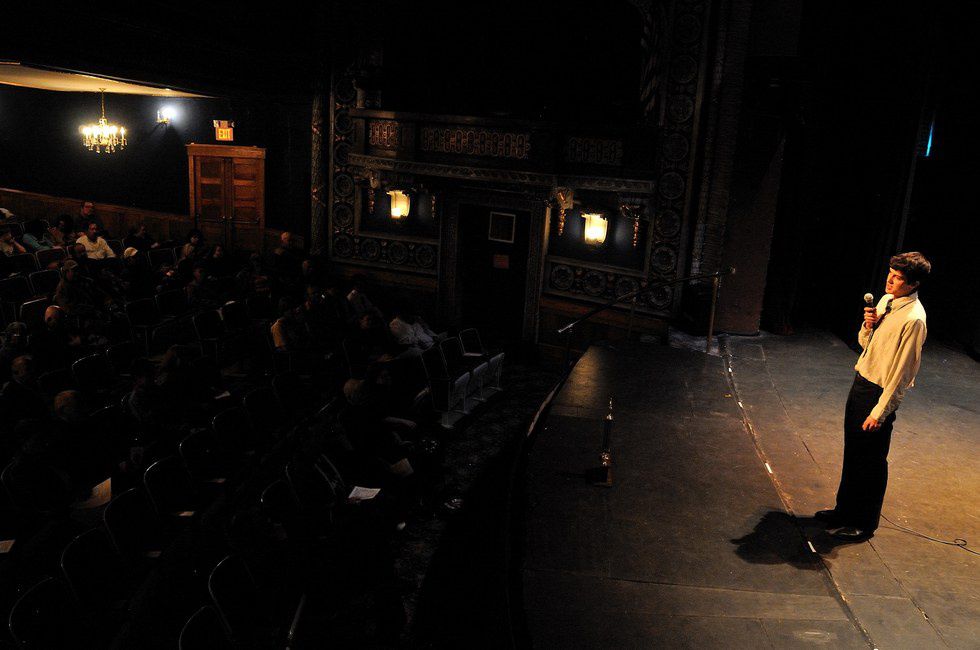
I learned to not be afraid to make a mistake because, for the most part, mistakes don't matter, especially if you can learn from them. “Forgive yourself instantly,” my teacher always said. For a lot of things in life, you won't ever learn if you don't try, and although I felt vulnerable at times, I learned to be comfortable with the feeling.
11. Confidence.
Theatre has given me the courage to be vulnerable in front of others and not worry so much about what they will think. I am not afraid to be myself in front of others, nor am I ashamed to hide a part of myself from others.
12. How to relax.
Oh, yes. I learned the basics of yoga for control over breathing and to bring unity between my mind and body.
13. How to safely use my voice.
When it comes to projecting my voice to be loud, I never wanted to strain it. This is something that I would struggle with, but, as everyone knows, you should always use your diaphragm when trying to push your voice to be louder. What's even more interesting though, is that, when I played a male (even though I'm a female), I learned not to push my speaking voice too low; when talking, you should never speak at a lower tone than when you naturally say “Mm-hmm.”
14. How to use my body.
Like dance, theatre helps people to find a greater kinesthetic sense and more control over their bodies. Such skill is especially helpful when trying to correct your posture and breathing habits.
15. How to “leave it at the door” for the greater good.
I learned to not let my personal problems interfere with my art and likewise with the work of the group as a whole.
16. How to apply makeup.

The purpose of stage makeup is to put the actor's face back on when the bright stage lights hit it. In order to give the face its form and shape back, makeup comes in handy. Painting on different shades of shadows and highlight contour the face while rouge gives it some colour. What's even more fun in a theatre class is learning how to do old age make-up, too!
17. How to take constructive criticism.
As an actor, I am used to taking notes from my director. When I receive a note, I respectfully write it down immediately so that I don't forget it, which is something that directors often like to see since it means that you are truly paying attention and are willing to hear them. I, of course, understand that the director can see the performance from the audience's perspective and will see how my performance translates to them. The director knows how to help me give the best performance that I possibly can, and I am always delighted to improve wherever I'm able.
18. How to learn from others' mistakes.
When a director gives another actor a note that I think I can use to improve my own performance, I take it as if it were meant for me. I now know what the director is expecting of all of us to listen when he tells one actor to project more.
19. Who I am.
Being forced to write theatre journals made me become a lot more introspective. I reflect on myself more to understand my place in the world and why I do the things that I do. Of course, the journals also helped to to digest and process the things I was learning in theatre and my progress in rehearsals.
20. How to review art.
Goethe's three questions outline what a critic should look for in an artist's work: 1) What is the artist trying to do? 2) How well does he/she do it? 3) Was it worth doing?
21. How to respect art:
When I see art, I remember to dress appropriately and nicely for the performance, display or whatever it might be. In the space where the art is being presented, I refrain from badmouthing it, respecting the effort that was put in to making the art instead.
22. How to maintain personal hygiene for others' sake.

Especially in a more intimate setting, like theatre, I have learned to make certain that I am always staying clean and that I don't smell bad. At the same time, I don't try to smell really great and flowery by using perfumes in case someone is allergic to them. For hand-to-face touches in particular, I make sure to use hand sanitizer and wash my face in advance. If I am sick, NO PHYSICAL CONTACT! Moral of the story, be aware and be considerate of others.
23. How to guide, not instruct.
In a directing role, I have learned how to get actors to find artistic choices on their own, so that they can own their performance, instead of blindly instructing them to do things mechanically. Encouraging creativity empowers the actor's passion for art, and the actor will, in turn, produce a more genuine performance. Such a technique may be used to persuade and influence others at will any time.
24. Artistic economy.
I am getting this term from the term “economy of movement” which, in simple terms, describes having just the right amount of movement, where too much can be distracting and too little won't hold the audience's attention. By “Artistic Economy,” I mean to say that every detail in art has purpose. Theatre teaches me that every detail in life has purpose too. The concept can be applied to everything from psychology, to art, to mechanics.
25. How to hug.

The best hugs occur when, in the embrace, you and your partner “share a breath,” meaning that you each inhale and exhale together. A person should receive five to eight of these good hugs per day in order to maintain emotional stability.
26. How to have fun!













