
If you haven’t seen the halftime performance given by Beyoncé, you're missing out.
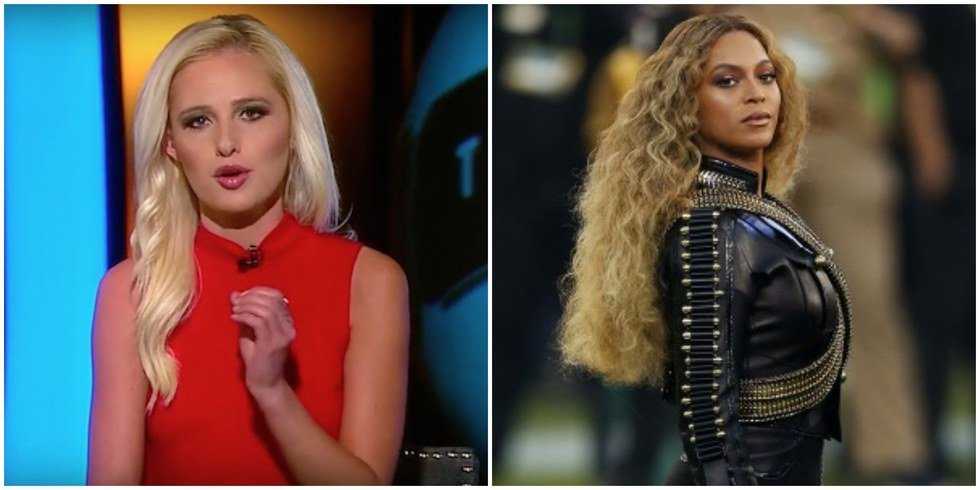
Now…I get the overwhelming impression that Beyoncé and her art have outright-offended people. There was one person who has made their stance know. Blaze reporter Tomi Lahren has a few words for Beyoncé (click here).
I’ve tried to be offended by Beyoncé’s performance. I’ve given it my best effort to be uncomfortable. And you know, for a second it almost worked. Of course, I noticed the reference to the Black Panther Party, with the all black attire and the black berets worn by Beyoncé’s dancers. Lahren takes immediate offense to Beyoncé’s reference, and posed the question “A salute to what? A group that used violence and intimidation to advance, not equality, but an overthrow of white domination?” The only problem is…The Black Panthers were never a party solely based on violence. They did believed in taking action and they definitely believed in direct action. If anything, The Panthers taught Black-Americans to protect themselves when confronted by the abounding waves of violence funded by the government against them. Lahren has to know that things weren’t exactly peachy for Black when the Pathers party was founded in 1966. In fact, the voters protection act had just been passed by congress the year before and the fair housing act wasn’t to pass the senate (by a narrow margin) until 1968, the same year that Dr. Martin Luther King Jr. was assassinated. I say this to say that the battle against injustice and for equality was far from over. The Panthers had things to do, and quite frankly…they had no time to worry about the feelings of a few oppressors. To quote Bobby Seale, then chairman of the Black Panther Party
“What is being done to us is what we hate. And what happened to Martin Luther king is what we hate. You darn right we respect nonviolence, but to sit and watch ourselves be slaughtered like our brother – we must defend ourselves, as Malcom X said, by any means necessary.”
In villainizing the Panthers Lahren showcases her inability to recognize the immense injustices that Black-Americans faced at the time. These were people swearing to protect their communities from the predatory hands of the police force of the 60s – at a time where being hosed, clubbed and sicced by dogs was commonplace for protestors, young and old.
Here is something The Panthers call “The Ten-Point Program”. A document pulled directly from the Black Panther Party, you can see for yourself what they were all about. In support of violent direct action? I think not. They believed in arming themselves, much like Lahren describes in this 2015 “report”. Sorry Lahren. You’re inconsistent and your research is lacking.
I think it’s safe to assume that Lahren’s response has everything to do with respectability politics. If people in the media can shame Black-Americans into softening their political voices and caressing White fragility, people like Lahren would be happy campers. People like this blame Blacks being outraged about police brutality or the depiction of Blacks during the after math of Katrina. The people in support of respectability politics are the same ones that silence anyone’s voice that doesn’t sound like theirs and never attempt to understand what marginalized people are so upset about.
Quick Public Service Announcement! (Inserts sarcasm)
Black people everywhere! All we need to do is pull our pants up and our injustices will disappear. If we just speak clearly, stop wearing such distracting hairstyles, stop playing the race card, stop having inopportune run-ins with the law, stop talking about police brutality and stop half dressing ourselves at the SuperBowl. If we could just up the complexity of our rhetoric and up the number pentasyllabic words we inject into our arguments maybe we would be taken seriously by Fox News and Friends.
Even more so than Beyoncé’s halftime performance or her music video, Lahren’s response has shown us where we truly are as a nation. As said by Jay Smooth,
the function of respectability politics is to implicitly blame Black-Americans for their problems as a means of making oneself feel better about seeing us have problems.
Lahren never gave considerable advice. She gave her half-a-cent as a way of gaining the attention she so fervently accused Beyoncé of seeking, and used that attention to project shame onto every young woman who expresses political concerns similar to Beyoncé.
Black empowerment and pride does not mean anti-White. Black empowerment and pride is not an attack on White America.
To me, Beyoncé’s message was more so one of female empowerment, a reclamation of Black beauty. In a statement from a Beyoncé representative
"It was a celebration of the beauty unity and power of the Black women in the Black Panther Party, to their fight for social justice 50 years after their founding."
The Superbowl may be the most watched sports event on television and White people do in fact buy Beyoncé’s music – all the more reason to show the world that it’s okay to be unapologetically Black. Beyoncé is a public entertainer, so she gets to “seek attention”. Maybe Lahren is upset that for once, a mainstream, Black performer has so blatantly decentralized her eurocentrism while centralizing everything that Blacks have been shamed for. We, a nation, are more comfortable with a Black Woman apologizing for her Blackness than embracing it. We Black people have been living with art that hasn't reflected what we see in the mirror for a long time, and Beyonce has offered us a glimpse of ourselves. If former American President John F. Kennedy would allow, I'd finish his phrase by saying “If art is to nourish the roots of our culture," we must stand by artists who are willing to say the things that must be said. We must stand by the artists who are willing to represent the misrepresented. Beyoncé's performance was a huge victory for all women, showing us that it's okay to be loud, outspoken, sexy, and politically relevant and socially relevant. Lahren, you can’t steal this one and call it your own, but you can sit this one out. Honestly! You don’t get to police our anger or our pride.