
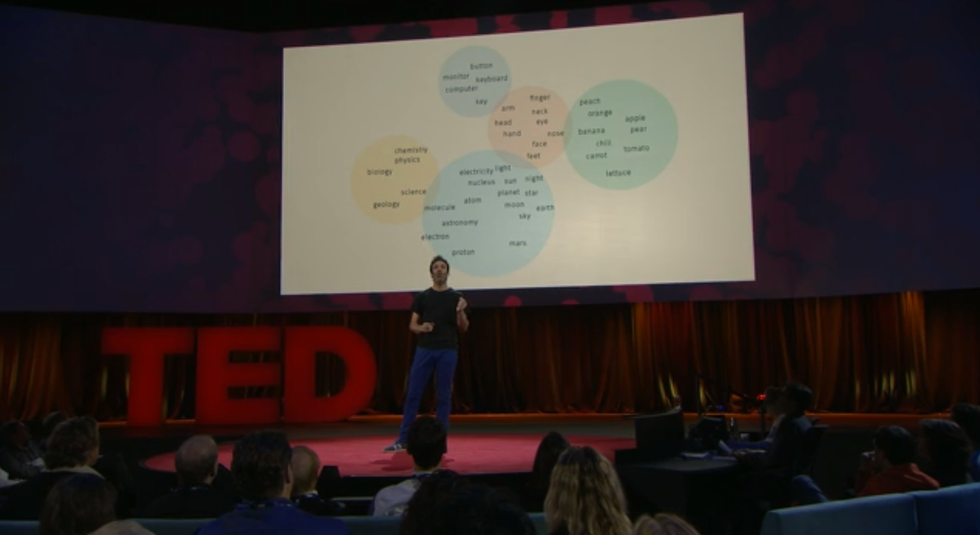
Neuroscientist Mariano Sigman delivers a fascinating talk on a new form of speech analysis which may revolutionize the way we confront mental health in the future. Sigman hypothesizes that the structure of human thought is reflected in the way we speak. To demonstrate this assumption, he created a word-mapping algorithm which organizes words into a multidimensional space according to their association with other words. Words that appear closer together are more related semantically than words farther apart. Such a system puts considerably vague or ambiguous concepts into a concrete, quantitative picture.
Sigman expects that as new concepts are born, words associated with them will be used more and more frequently over time. He analyzes the development of the human quality of “introspection” indicating that our current belief about human experience is unique to our timely existence. According to ancient Greek texts, people of that time period behaved as if they were obeying inner voices. That society would have been considered schizophrenic under our current definition, and it wasn’t until about 3000 years ago that humanity undertook the mentality that we are “pilots of our own existence,” or, in other words, that the voice inside our heads is our own introspective stream of consciousness. Using his word-mapping algorithm on ancient Greek texts, Sigman shows that introspection arose alongside increasing frequency of words like “self,” “guilt,” and “reason.” He effectively pinpointed the emergence of our mental state based on the written records alone.
This then begs a new question. Using our present day speech, what can we learn about the future of our consciousness? Sigman advocates that this word-mapping algorithm can be translated and applied to countless different domains. In another study of his, Sigman recorded the speech of 34 young adults who were at a high risk of developing schizophrenia. Word-mapping had 100 percent accuracy predicting psychosis after including measurements for how far and fast the speaker switched semantic categories. The speaker’s persistence within a single semantic category, which he terms “semantic coherence,” correlates to mental stability. No other clinical measure is currently able to make predictions like this.
The implications of this new technology are definitely far-reaching. Sigman’s algorithm gives us the possibility to objectively and quantitatively sense feelings through words, just as we would when we read between the lines when we talk to our friends. The abstract concepts of our mental health may be no more than a complex formula. What could be next for the field of psychology as we continue to break intuition down to a science?
Click HERE to view the talk.