

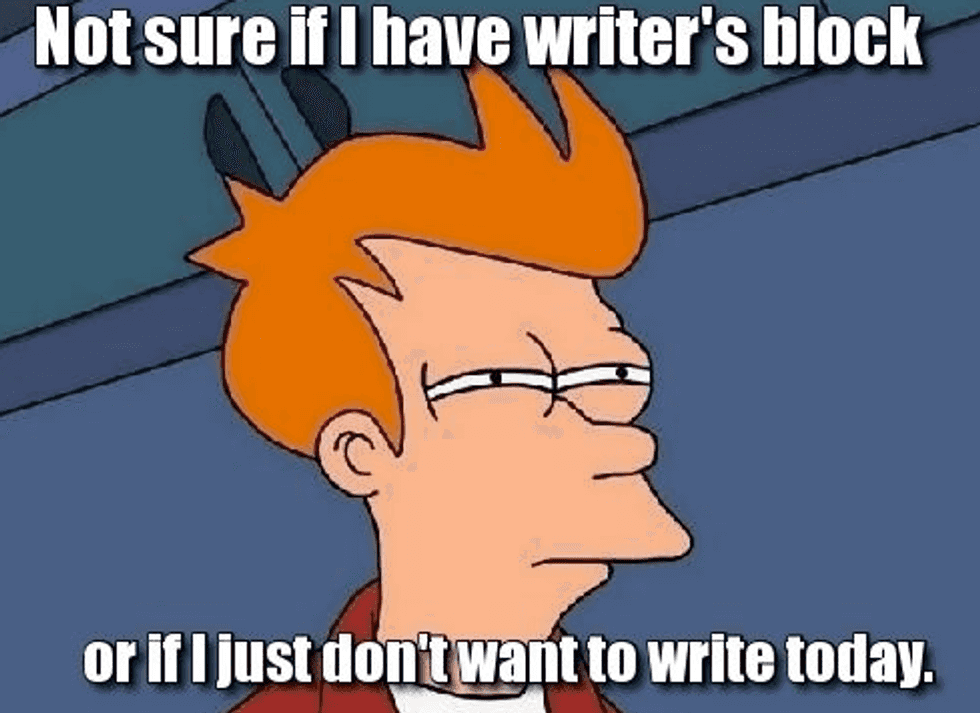
Have you ever sat down, ready to write your next masterpiece…but nothing comes out? No ideas come to mind and you are quite literally at a loss for words. That’s how I feel right now. As I attempt to write my weekly article, I simply have nothing to write about! The topic of Trump’s tirade as the Republican candidate and Hillary’s email scandal has been exhausted. I haven’t listened to any new, awesome music, seen any good movies, or discovered a new show on Netflix. I still can’t articulate the sorrow I feel for the victims of the Orlando nightclub shooting to eloquently write about the topic. I could write about my life, but, this week, my life has been extremely boring. My life has consisted of waking up to go running, going to my internship, battling rush hour traffic to go to my other job, and then finally, coming home and entering an eight-hour coma. This leaves me with nothing to write about. Actually…it leaves me with nothing entertaining to write about.
I am suffering from a textbook case of writer’s block. I have no ideas and nothing creative to say. It is so frustrating! I realize that everyone experiences writer’s block. So, here are some tips on how to beat writer’s block:
1. Take a walk. Maybe you’ll find some inspiration on your journey!
2. Change your scenery. Do you always write in the same spot? Maybe just a change in surroundings can help you come up with a topic to write about
3. Try freewriting. Freewriting is simply writing down whatever comes to mind for a couple of minutes. You let your mind go blank and write anything and everything you can come up with. Maybe you’ll find a topic to write on in your freewriting. This is a method I’ve used when I haven’t been able to come up with a topic.
Sometimes figuring out how to say what you would like to say, rather than coming up with a topic is the issue. I struggle with this issue as well! When I have a brilliant idea, sometimes, I’m not exactly sure how to execute it. This can be extremely annoying! This is where outlining your article, essay, or story can be useful. Yes, outlining can be tedious. And yes, outlining your pieces is what your high school English teachers nagged you to do before starting your essay, but it really helps! Once you have decided what to write for your intro, middle, conclusion and a few main points, you can literally see your writing unfold. The more detailed the better! Also, it’s okay to stray from the outline. As you write, you may be struck with a new idea or direction. An outline is a starting off point that is meant to help guide your writing.
These are just a few ways I cope with writer’s block!