

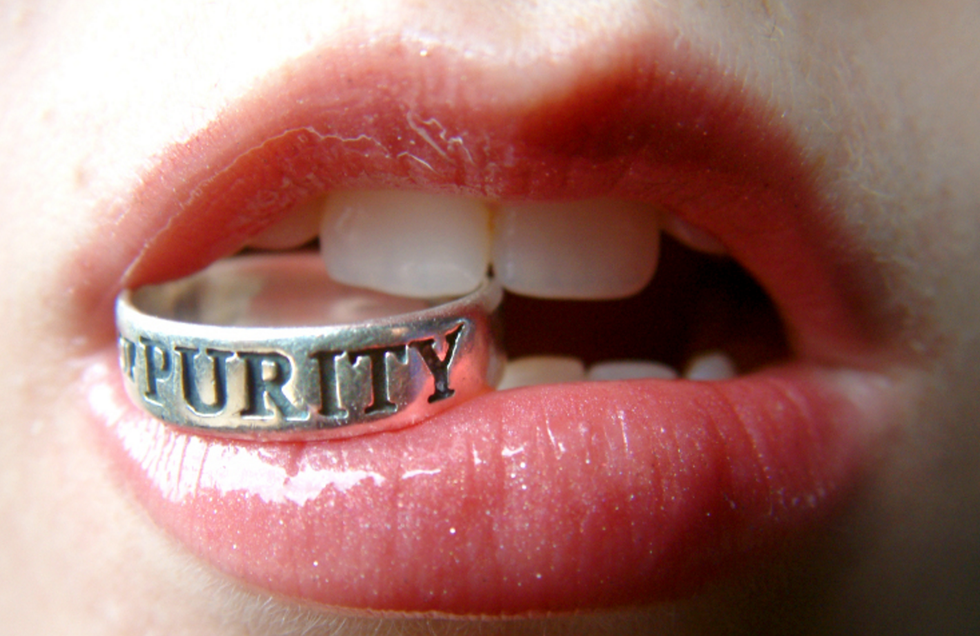
I’ve already mulled over the consequences of writing this article. I’ve thought of all of the terrible comments and over-the-top reactions that will pop up in my inbox. I’ve thought of the friends that I’m going to piss off and the parents who will privately message me. I’ve thought about it, but I’ve also thought about the individuals in the nation who are gauging their human value on whether or not they have had sex—who think they are less of a person because they have engaged in a completely natural act. Here’s why I’m over virginity.
1. It encourages society to police women's number of sexual partners
As young women, we were taught (by parents, friends, or society) that once we have sex, we have physically lost something. We are no longer the same person. We are somehow transformed from respectable young women to out of control degenerates. We have been battered to believe that our body is a temple. Even if we allow someone to honor it, it’s still shameful. Women are taught to hold out for the sake of their reputation and to avoid the slut vs. prude phenomenon.
2. It encourages the slut versus prude phenomenon
High school is probably the most popular time for this twisted ideology to develop. Women who make out with guys or perform oral sex without “going all the way”, are essentially prudes—labeled as such by not only the hot-blooded guys who inhabit the high school but the teenage girls who have thought about or done the same thing. Women who consent to have sex magically transition into sex-craving lunatics, lurking for the next penis on which to pounce.
3. It shames men if they don't have sex
For people who identify as straight men, their possession of “virginity” — not the lack of it — damages their reputation. Young men are taught that the earlier they can ditch their innocence, the better. The earlier they can “deflower” an innocent virgin and send her spiraling into slut/prude limbo, the more respect they will earn. While women are viewed as "damaged goods" if they have sex, men are viewed as "not being good enough in the first place" if they do not.
4. What is the actual definition of virginity?
Is it the first time a woman climaxes? Is it when the hymen is punctured? Is it the first time oral sex is performed? Is it only when two people are in love? The definition of virginity varies from person to person, and it often only includes the heterosexual norm of one man and one woman. For individuals in LGBTQ+ relationships, the concept of virginity is especially dangerous because it's not as discussed as the "penis in vagina" scenario.
I understand that having sex with someone can be a big deal
emotionally and physically, but I don’t quite understand why we
have taken to labeling these individuals into categories of “haves” and “have-nots;" sluts and prudes; nice guys and bad boys. Some people love sex. Some people are freaked out by it all together. The issue lies within how we treat and view one another when those feelings are revealed. If you have sex five times a day religiously, power to you. If you're waiting until marriage to have sex, power to you. Your personal decisions do not dictate the morality or overall worth of another human being.