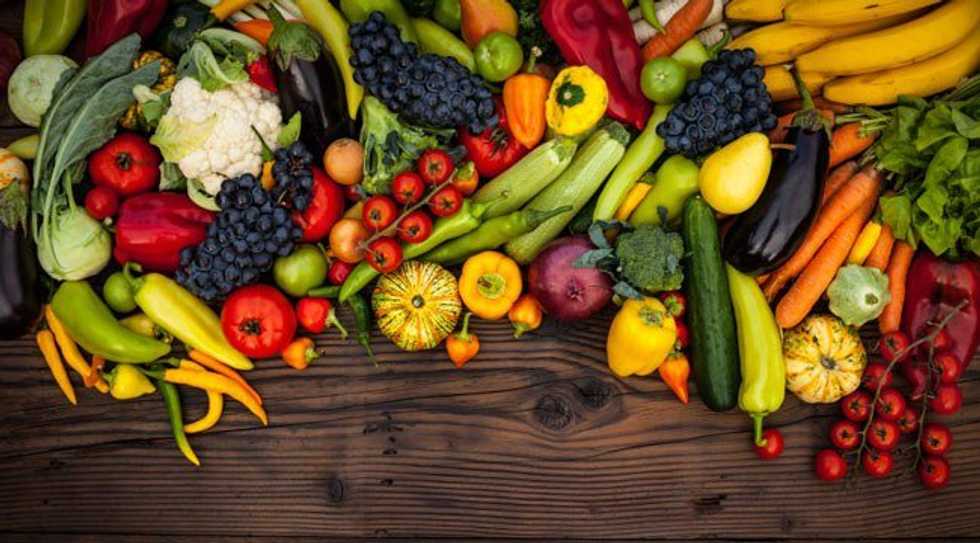
Every time I sit down to eat with a friend, family member, or stranger I’ve just met, I find myself always anticipating the same question, “You’re a vegetarian?” The question is usually said with a look of dismay at my plate full of veggies and followed with one of the most aggravating questions of all time, “Why would you ever be a vegetarian?”
Sure, my diet is a major life decision and I love to talk about it, but after a while of explaining it you begin to wonder why it’s not common knowledge. It’s not only about my sentiments towards animals, but the larger problem of animal agriculture and its huge affect on so much of our world. While this isn’t the type of topic that usually suits a casual lunch in between classes, it's something that everyone should be aware of.
Yes, many argue that eating meat is a part of our anatomy. We are omnivorous creatures whose bodies are built to break down and ingest both meat and plants. If someone had asked me about my vegetarianism in the Middle Ages, I would’ve gladly accepted this as a valid argument. However in this day and age, the problem lies with how we acquire our meat, not with how we digest it.
Animal Agriculture, which is the name commonly given to the industry of producing meat as well as meat products, such as dairy and eggs, is easily one of the largest contributors to global environmental issues today, and can be linked to global warming as the main cause. Livestock that are raised for our food are known to emit greenhouse gas, which accounts for 14.5 percent of our global total.
This number represents solely the amount of emissions caused by the product of animal agriculture itself, and not everything that goes into it. Emissions of nitrous oxide can also be found in massive amounts from the genetically altered food that is grown to feed the animals being produced. What does this mean for us? It means that if meat consumption increases, so will the amount of animal agriculture. This increase in emissions contributing to global warming will continue to change our climate and eventually make our planet inhabitual. Is it worth it to destroy our planet just because we crave chicken tenders?
These products of animal agriculture only represent half of the problems it causes. What goes into “producing” these animals for our benefit is an entirely different story. Approximately ⅓ of our country’s raw materials as well as fossil fuels are consumed in animal production. Two of our planet’s most valuable resources in today’s world are fossil fuels and water. Just one calorie of animal protein requires about ten times the amount of fossil fuel that one calorie of plant protein requires, while one ton of meat produced requires a hefty four million gallons of water. This contrasts greatly with the amount of water required to produce a ton of vegetables, which is only 85,000 gallons.
Alfalfa is a plant that tends to only be produced solely for the use of cattle, yet, in the state of California, it consumes the most amount of water out of any other plant. Not only is so much water clearly being overused in the production of meat, but our natural water sources are also being polluted as a result.
Animals in factory farming settings produce 130 times the amount of waste of the entire human population, the run-off from which will pollute our planet’s water. As if that pollution wasn’t enough, hormones, antibiotics, fertilizers and genetically altered food given to the animals will run off with the waste.
The reality of animal production is that is looks to accomplish a short term goal. Right now, the way that factory farming operates allows for a cost effective way to make money in our country, which is one of the highest producers of meat in the world, joined by countries such as China and Brazil. Presently, the industry creates 1,851,000 jobs while producing $346 billion in total economic output, in our country alone. In the United States, animal agriculture also out turns $60 billion in household income, $15 billion in income taxes paid, and $6 billion in property taxes paid.
Whether you are good with numbers or not, anyone can see that this business is very influential in our struggling economy. In an honest, economic-minded sense, cutting down the production of meat would do nothing but hurt our country's economy as well as the global economy. This is important to consider, however it is once again a short term goal. While this industry will benefit the global economy right now, the continuation of the industry will damage and harm our planet in the future.
With climate change caused from the amount of greenhouse gases emitted, growing crops will become impossible, therefore feeding animals for production impossible, causing an inevitable crash. We are setting ourselves up for an irreversibly damaged environment which will inevitably become detrimental to our economy that is arguably sustained by the booming meat production industry. The concerns of our economy are definitely important, however they can in no way trump the importance of preservation of our environment to preserve our way of life.
Yes, a part of the reason that I chose to not consume meat is because I love animals and don’t feel comfortable eating another, once living creature, especially one “manufactured” from the very beginning to be nothing more than another product to us. However, to me, a turkey sandwich is just not worth supporting this destructive industry.While it is not us as individuals directly letting off dangerous emissions, using up valuable resources, and carelessly torturing and murdering animals with the disguise of producing food, we are what is fueling these things. It is our continual, increasing consumption of meat that allows animal agriculture to continue to be so successful and make so much money. Even just cutting out meat from one meal a day makes a huge difference. So next time you see someone eating a salad or a veggie burger because of their choice to not eat meat, refrain from giving them a nasty look or telling them about how much you love and could never part from meat, because they’re making a step in trying to save and preserve our world as we know it, and from my standpoint, your beloved burger doesn’t seem to do much at all.