
It is my junior year of college, and I am taking a class on Nazi Germany. No, I am not a history major. No, I am not a World War II buff, and no, I am not Jewish. I am taking this course because everyone should. As en engaged American citizen I choose to honor those who died under the Third Reich and those who fought against Nazi Germany by learning everything I can about it.
As a class we have gone back in time, studying the history of the Weimar Republic, the transfer of power from a monarchy to a democracy, hyperinflation in 1923, the stock market crash in 1929, the rise of Hitler's power, and the social, economic, and political policies of the Third Reich. Interestingly, we are just approaching World War II and the Holocaust, what I expected the entire class to be about. Yet, I am grateful for the time spent on a more holistic view of German history. I now have a greater understanding of how depression that follows defeat in war, a shattered economy, overbearing war reparations and other other factors may lead individuals to adopt extremist political views. Many Americans look at Trump supporters and ask why. I now understand the power of disillusionment as cause for extreme action.
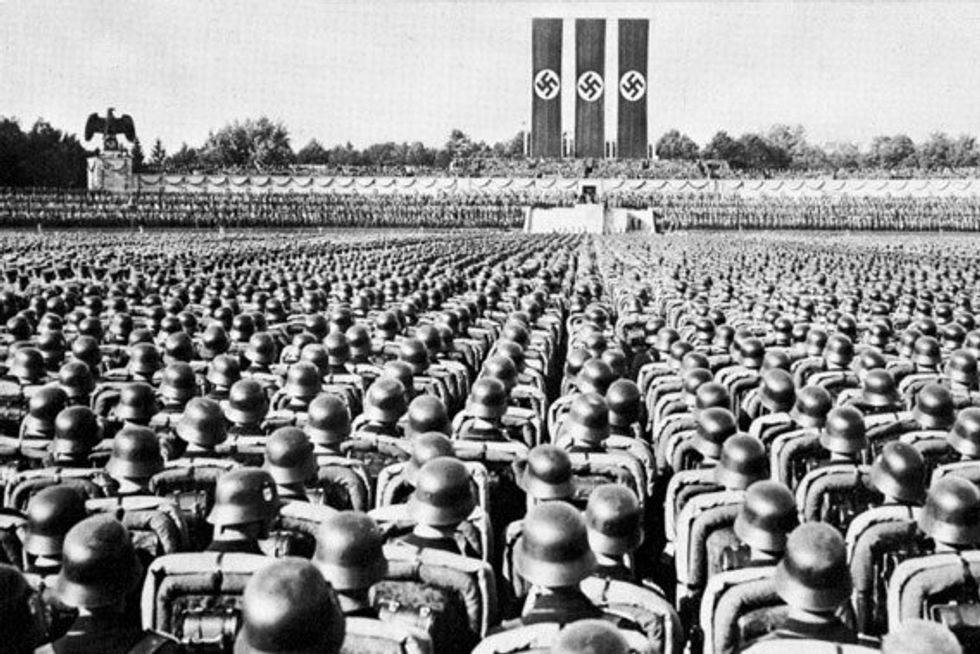
Nazi Germany has been made into a symbol. It is a metaphor of genocide, of the horrors of what human beings are capable of creating. Yet, when displayed as a dark shadow that cannot be penetrated, we fail to acknowledge that individual people were abused, persecuted, and slaughtered. By this we also fail to recognize that individual people abused, persecuted, and slaughtered other people. We read personal accounts from women, Marxists, SS officers, Hitler, Hindenburg, Goebbels, Poles, and concentration camp survivors in order to immerse ourselves in a world that was very much real.
Due to a plethora of primary source documents, academic journals, and an incredibly gifted history professor, our class of 20 or so is engaged, questioning, and vocal. We are committed to gaining as much knowledge as possible, and using that knowledge to ask questions, critique one another, and make connections to the past and present.
Genocide is is no way unique to the Holocaust. An estimated six to eight million people in the Ukraine were killed under Joseph Stalin's famine from 1932-1933. The Japanese Imperial Army killed 300,000 Chinese from December 1937-January 1938. From 1975 to 1979 Khmer Rouge leader Pol Pot killed up to two million people from starvation, forced labor and executions. Saddam Hussein's regime killed 100,000 Iraqi Kurds. 100,000 Bosnians were killed under Yugoslavian President Slobodan Milosevic's regime from 1992 to 1995. In Rwanda, 800,000 mostly Tutsi civilians were murdered in 1994. From 2003 to the present between 200,000 and 500,000 people were killed in the Darfur region of Sudan. In a 2016 UN report, ISIS was believed to be holding 3,500 people as slaves. These are only a few recent examples of genocide.
I am taking a class on Nazi Germany because I will not ignore one of the most significant events in the world's history of violence. It is painful, uncomfortable, and distressing to read and talk about. Yet knowing that acts of genocide have continued after the Holocaust has demonstrated that we have not learned enough to stop this utter disregard for human life.