Writer's Note: A couple weeks back, I wrote an article on how a seemingly uneventful day taught me an important lesson that has stayed with me for life. I find it very enjoyable to reflect on how people's circumstances and experiences affect their behaviors and outlook on life — it's why I enjoy listening to people so much. Each of us has a unique story to tell about the events that have made us who we are, though not too many people seem to give it a great deal of thought, and even fewer discuss it openly. (If you haven't noticed, our generation isn't big on openness and vulnerability.) It's in this spirit that I hope to kick off a miniature series of sorts. The point, which I hope to explore further in coming weeks, is this: our experiences, either instantaneous or prolonged, as well as our reactions to them shape the people we come to be, and a healthy amount of introspection is necessary to gaining an understanding of how one's self operates. Likewise, and perhaps more importantly, one should always keep this same idea in mind in dealings with other people — people all have different stories, so in considering someone's character, it's important to withhold judgment and try to imagine where that person could be coming from. My hope for this series of mini-memoirs is to inspire people to understand and take interest in others for who they are. Also, if nothing else, there is value in shared experience, and I figure it'd be worthwhile to share some of the central lessons that I've learned in hopes that others might be able to learn from them as well.
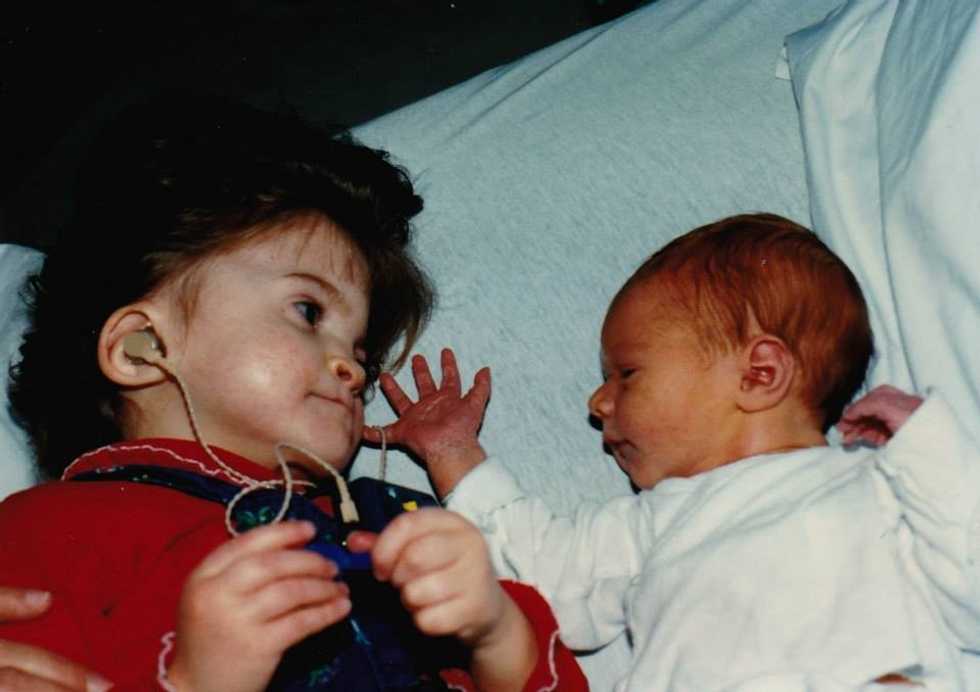
One of the ways in which my experience growing up was unique was that it involved learning to live with a severely disabled older sister. My sister Rachel, who is three years my elder, was born with an exceedingly rare and severe set of defects collectively referred to as CHARGE syndrome. As a result, she is deaf, mentally handicapped, small in stature, very OCD and has had other problems such as allergies, a cleft palate, a faulty stomach valve and so on and so forth. Perhaps the most taxing issue, however, was her obsessive-compulsive behavior. She's extremely creative and has always spent a large part of her time creating collages from materials she finds around the house. Mainly, they are composed of circles (her favorite shape) cut from paper as well as circular objects like hula hoops, metal rings, bowls and so on. She's also very curious and enjoys searching for new materials to use as well as taking apart anything she can get her hands on. Naturally, anything that wasn't bolted down (as well as most things that were) was liable to be broken and incorporated into her sprawling creations. This we could deal with.
The real problem, however, is that Rachel always required hand-over-hand assistance (and usually that of my mother) in her endeavors. It's not that she needed the help, but rather that she absolutely refused to do things herself. She would become very frustrated if she didn't get exactly what she wanted, and her almost total lack of communicative skills made it hard to tell exactly what she wanted. Like many other disabled children, when she became frustrated, she would launch into self-injurious behavior, slamming her arms and head down on furniture or biting herself. It's a terribly sad behavioral pattern, and there's not much to do about it once it has taken hold — giving in to it only encourages it, and not giving in to it can lead to serious damage. To make matters worse, she would wake up most nights and refuse to go to sleep until her creations were exactly the way she wanted them.
Needless to say, there were times where tensions ran rather high in my house. Half the house would become entangled in a spider web of yarn and tape and scraps of paper. I, who shared a room with my sister, would be terribly sleep deprived, and my parents would be faring even worse on that front. An expensive gadget or important document would likely be lying on the ground in pieces. My sister, meanwhile, would be mere seconds from cutting through a power cord. Understandably, in these times, emotions in our little house ran high — I certainly wouldn't care to relive those days. Accordingly, at some point during my early school years, I was faced with a semiconscious decision that would decide the course of my life. Given the chaos I had to navigate, I could either allow anger and frustration to get the best of me, or I could accept my difficulties and do my best to keep a level head. Thankfully, I think I made the right choice. I ended up becoming a stoic in the face of such troubles, which got me through a great deal of heartache over the years that were to come. This attitude spilled over into other areas of my life, and I'm now of the opinion that my stoicism was somewhat of an overcompensatory tack to take (though I'm still not sure to what degree), but that's a larger story for another time.
Rachel is doing well now — around the time I entered high school, she began attending Perkins School for the Blind, an academy in Massachusetts that educated Helen Keller as well as her teacher Anne Sullivan. Though Rachel isn't blind, Perkins had the highest number of CHARGE syndrome students anywhere in the country (which was only a bit over a dozen), so she was allowed to attend. She left Perkins two years ago and is now residing in a home where she has round-the-clock staff and is within driving distance of my parents, who are able to see her frequently. Ultimately, everything worked together for good — though all too often it seemed like she drove us apart, my sister drew my family closer together and taught us all to remain patient through hardships, and for that, I'm very thankful.
A final note — I'd very much be open to talking to other people about the important events in their lives that have altered their outlooks. Chronicling people's stories and telling them here sounds to me like a very enjoyable undertaking; though I do personally have more to tell, I'd feel dirty and incredibly vain writing about myself all the time. If you want to chat, just drop me a line. (At the time being, my audience hasn't much expanded outside my real-life friends, so I'll withhold contact info for the time being.)
Edit: A classmate and dear friend of mine is publishing an article in a similar vein this week, if you're interested.