


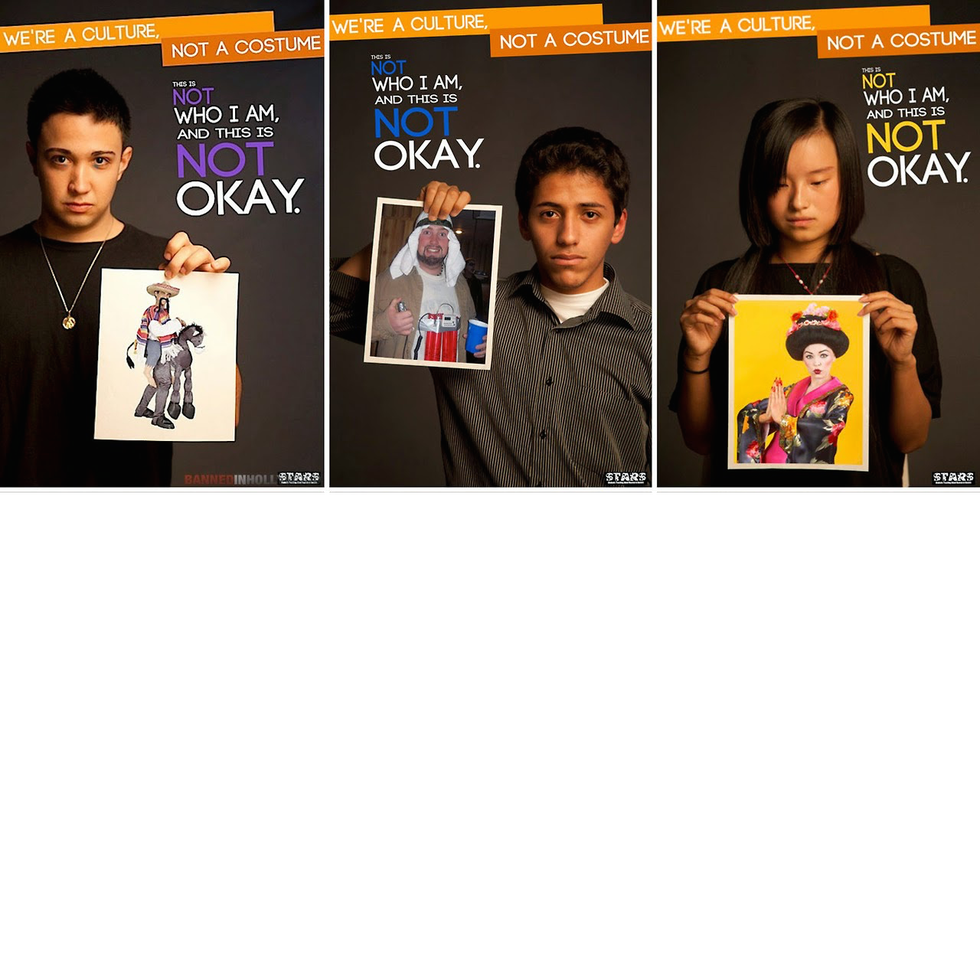
While browsing for a last minute Halloween costume online, I stumbled upon a "Zoot Suit Riots” costume.
For those of you who don’t know, the Zoot Suit Riots were riots resulting from racial tension between Mexican-Americans and white servicemen in Los Angeles during World War II. The news coverage surrounding these riots led many Americans to believe that young, Mexican-American men were criminals and gangsters. Zoot suits that were strongly associated with jazz and worn mostly by young Mexican and Black Americans, became an indicator for criminals and gangsters. During the riots, one Los Angeles newspaper recommended its readers "Grab a zooter. Take off his pants and frock coat and tear them up or burn them.” By the end of the Zoot Suit riots, upwards of 600 Mexican-Americans, many of whom were victims of attacks by the servicemen, were arrested. Both the LAPD and news outlets were criticized for fueling racist perspectives about Mexican-American people afterwards.
Now, it is a Halloween costume.
The consumer might not know about the Zoot Suit Riots and exactly what piece of American History they are representing while wearing the costume. Moreover, the costume does not seek to defend the Mexican-Americans, instead it capitalizes on the stereotypes perpetuated by racist media by including a dollar-sign tie. This costume does not acknowledge the senseless violence or extreme racism Mexican-Americans experienced during these riots nor does it appropriately represent the culture associated with the Zoot Suit and with Mexican Americans.
This was not the only problematic costume I found.
I found Geisha, Native-American, Caitlyn Jenner, and Gypsy costumes.
These choices are unacceptable.
Geisha costumes depict a racial and sexualized stereotype of Asian women -- more specifically, these costumes imply that they are sexually submissive and exist for the sexual gratification of others. These costumes do not acknowledge the Japanese culture surrounding Geishas and only recognize them as sexual objects.
Native-American costumes are often marketed as “Indian” rather than Native-America, and in some cases, are even being marketed as “Princess” costumes when in fact, no Native-American nation actually has any princesses (to add insult to injury). The costumes also do not recognize Native-American culture behind them or what these clothes mean. Most costumes do not even specify which of the hundreds of diverse Native-American nations they seek to represent.
According to this online petition imploring Spirit Halloween to stop selling Caitlyn Jenner Halloween costumes, “To make a costume out of a marginalized identity reduces that person and community to a stereotype for privileged people to abuse.” Spirit Halloween PR head Trisha Lombardo says that this particular costume is a “celebration” of a modern-day superhero, but when you evaluate the fact that they are also selling a “Decathlon Track Star” costume that bears an eerie resemblance to pre-transition Caitlyn Jenner, it only encourages Before and After costumes that will ultimately perpetuate transphobia. Transphobia in the real world translates to higher sexual assault, suicide and poverty rates as well as workplace and healthcare discrimination.
Gypsies, more appropriately called Roma, are consistently stereotyped as beggars and con men and women. In fact, the origin of the word “gypped” is in reference to being conned by a gypsy. Romani women are stereotyped sexually and racially as seductresses - just another way in which Romani people are viewed as social deviants and inherently immoral. This exoticism is reinforced by their costumes including crystal balls and the costume names including adjectives such as “mystic”, “magical” or “seductive”. They face incredible discrimination throughout Europe and are often rejected housing, employment, healthcare and education due to theses stereotypes.
Wearing these costumes has real world consequences and will injure the members of these groups. The 2012 “My Culture is Not a Costume “ campaign depicts members of marginalized groups and costumes based upon their identity with the tagline “You wear the costume for one night. I wear the stigma for life.” It may seem like fun to dress up as some of these things but, the reality is in doing so you are feeding into ugly stereotypes which will ultimately disenfranchise these populations.
Pop Culture makes these things seem okay because celebrities continue to make mistakes. Colton Haynes is being lauded for his Ursula costume at the moment but, in the past he has both dressed in blackface as Kanye West and brownface as Ghandi. In 2013, Julianne Hough dressed in blackface as Suzanne “Crazy Eyes” Warren. Both have since apologized.
College campuses also contribute to this problem.
Just over two weeks ago, the UCLA Sigma Phi Epsilon fraternity and the Alpha Phi sorority chapters hosted a party themed “Kanye Western” which encouraged the attendees, who were mostly white according to first hand accounts, to come to the party dressed as rappers and/or in blackface.
Fraternities and sororities have come under criticism recently for perpetuating racism -- i.e.; Oklahoma University chapter of Sigma Alpha Epsilon singing “There will never be a n*gger in SAE” and a whole slew of other racially discriminatory or hateful incidents listed here.
We can not just pin off these issues as an exclusively greek problem, though. This is a campus problem.
There will undoubtedly be someone wandering through South O wearing a Zoot Suit Riot costume this Halloweekend or wearing a sombrero, moustache, and poncho to a Cinco de Mayo celebration.
As students, we need to condemn this behavior. Don’t attend these parties. Educate yourself and others about why these parties and costumes are inappropriate.

















