
Your heart is beating. It's beating a lot faster than you want it to. That's probably why you've started to hyperventilate, why you can't control the hot rivers making their way down your face. Now you're shaking. Now all the stress, all the repressed anxiety that's been building up is about to boil it's way to the top and cause an explosion like the world has never seen nor felt. Or you just lie there, facing the ceiling. You take deep breaths and cry silent silver streams that gently float into the void. Maybe you close your eyes and let the plume of emotions rise over you. You wonder how you got to this point of losing emotional control, how you let so much pressure build up inside you that the alarms start ringing. The sirens sing their warning songs. It is Volcano Day and you cannot go back.
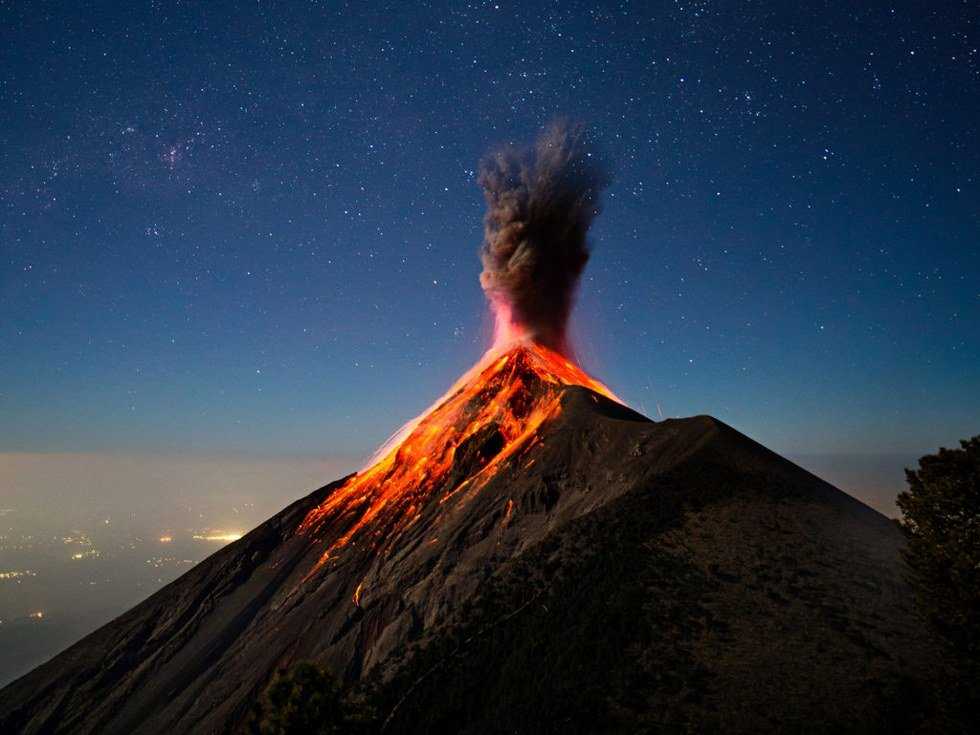
Mt. Toba, the low-quality animation of it, exploded over my group as we watched the animated scene fold over my group's heads at the planetarium. The plume of smoke, carrying volcanic lightning, rose over the fiery mountain. Rocks shot from it and landed on the ground below. Magma blew from the ground like Old Faithful. The island that Mt. Toba sat on cracked and broke apart, most of it collapsing into rivers of lava. The smoke and ash that rose into the sky covered the sun's rays for thousands of year. The seas were filled with toxins and life dwindled to almost nothing. It was the largest supervolcano eruption in the past 2.4 million years.
There are two ways of forming a supervolcano on Earth. One is to jam some of the Earth's crust together on top of a magma shaft and watch it build up for thousands of years. The second in purely chance; have a piece of land that sits on top of a wayward magma shaft until it build up, and up, and up. It's a bit like how a person with bad anxiety has a panic attack. You put enough pressure on them and they blow up. Though panic attacks come in all shapes and sizes, like volcanic eruptions, the best ones are the rare ones, the ones you always here about. They involve hyperventilating, uncontrollable crying, the shakies, and the black out. Those are the Toba panic attacks, the ones you always hear about but hardly ever see.
The scene in the movie changed from the chaos of Earth to darkness of space. Specifically Titan, a moon of Neptune's. On Titan, peppered across the landscape, are volcanoes. Now they're a little different from the ones you might be thinking about. These volcanoes erupt liquid nitrogen into space. As I was watching with my neck craned back in that awkward planetarium seat, I took notice how beautiful it was to see shimmering streams of liquid nitrogen flow into space and turn into silver mists. They're much like the calm, quiet, sad let go of pent up emotions. When tears fall gently down and it's just you in your room, wrapped in a blanket burrito. These are the panic attacks you don't hear about, the only kind of volcanoes you see in obscure planetariums with a group of friends.
Sometimes though, there is no release. No beautiful, sad expression of inner feelings. Sometimes the anxiety gets what it wants and continues to build with only a few pretend releases. That's when you become Yellowstone, a supervolcano with enough force to rival Mt. Toba. The magma chamber underneath it is 18 miles deep with a magma shaft under it about 55 miles down. While some pressure is relieved by geysers like Old Faithful, it's not enough. Yellowstone is overdue for an eruption and nobody knows when the breaking point will be.
How a supervolcano ends depends on the release of magma. If the magma chamber underneath it is emptied, the ground that once held up the volcano collapses. After Toba erupted, most of the island collapsed, forming a serene lake, a motionless caldera. Those who experience anxiety have more work to do than let nature take its course. You have to learn techniques to combat the impending explosion. Unlike a volcano, your explosion cannot be predicted. Like Yellowstone, you'll just have to wait and see.