
I have a younger sibling with autism. It takes patience and a lot of effort to communicate properly and help people with this developmental disorder. Types of people with autism are wide ranging. Some are unable to grasp the importance in understanding consequences of their actions and have social anxiety, or the inability to "understand social norms." Some may even lack motor skills and communication skills. But undoubtedly, like all other humans, people with autism want friends — people who will speak to them kindly.
The Autism Spectrum Is Wide Ranging
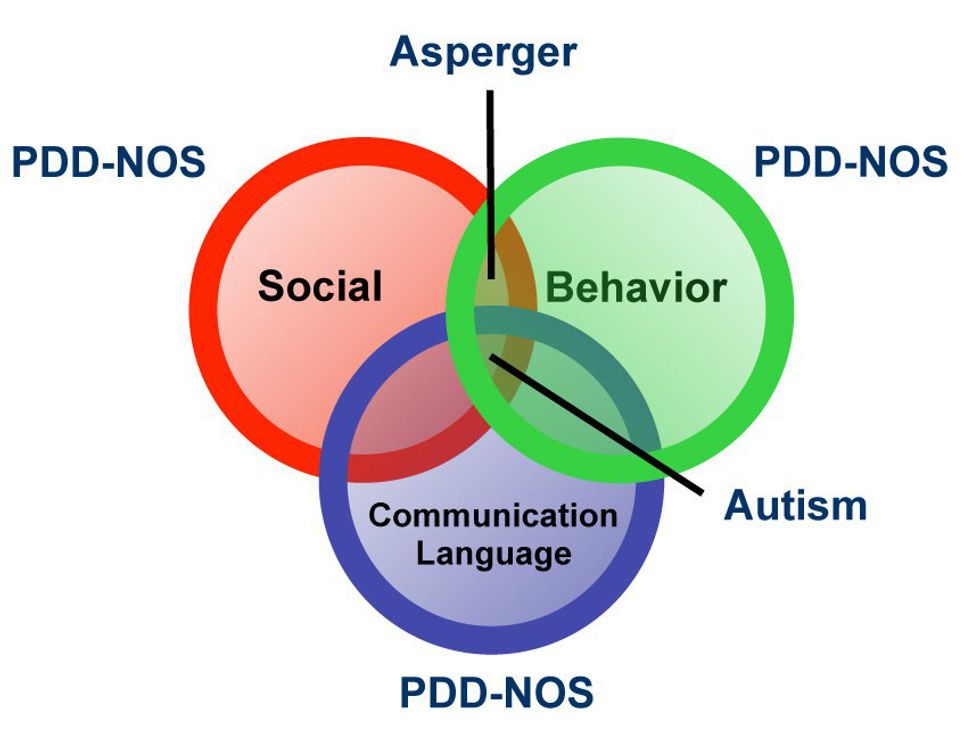
With autism, there is Common Autism, Rett's Syndrome, Childhood Disintegrative Disorder (CDD), Asperger's, and Pervasive Developmental Disorder. With Common Autism Disorder, there may be speech and language difficulties, intellectual disabilities, attention deficit issues, anxiety, depression, and epilepsy. Rett's syndrome is a genetically x-inked disorder that causes the loss of motor skills and mobility in females. CDD is the late development of social, intellectual, and motor skills. Asperger's is characterized by repetitive behavior patterns, and difficulties in social and nonverbal communication. People with Asperger's have both neurotypical and autistic minds. Lastly, with Pervasive Developmental Disorder, there are interval related delays in communication skills.
parentinghealthybabies.com
People With Autism May Have Emotional Breakdowns and Be Misunderstood
Growing up with a sibling who has Asperger's Syndrome can be complicated. My sibling was categorized as anxious, hyperactive and hot-tempered. He was the kid who always had to sit in the "time out chair" in school for his misbehavior, and he was constantly bullied by his peers and older children for having emotional breakdowns, for rioting, or even for protesting against what he felt were "unfair rules."
For example, he has told me about how he wants to be successful in life, yet he does not believe in the foundation of homework. Despite being highly intelligent (especially when it comes to solving math problems or understanding politics) he simply does not wish to "waste his time." Although my brother has great technical skills and memory, he lacks common sense skills and does not understand social cues.
For example, he believes that strangers should not be treated as strangers, and people should be free to speak their minds. It is also common for him to give advice to others, but not follow it himself — which some people may think of as hypocritical. He may demand certain behavior from others, but exhibit the opposite for himself.
It is difficult for him to understand the emotions of other, when he feels the way they are exerted is unjustified. He prefers to go against the teachings of society. For many, people with Asperger's may seem "overly sensitive" and "immature." But children with Asperger's are not dumb or stupid, they simply have brains that function differently than the average neurotypical person.
People with Autism May Think Differently Than Those Without
"I am calming myself. My senses are so disconnected I lose my body, so I flap [my hands]. If I don't do this, I feel scattered and anxious ... I hardly realized that I had a body ... I needed constant movement, which made me get the feeling of my body" -Tito Mukhopadhyay
People with autism have brains that are filled with several thoughts and even new inventions. Great math skills or art skills can come with autism. Thus, they make great technical problem solvers and multi-taskers. Such people may also have sensory sensitivity overload. Many people with autism wish to have their own space to reflect on ideas.
There May Be A Link Between Autism and "Abnormal" Behavioral Patterns
For people with autism, it is common to have repetitive patterns of behavior and routine. There may be addictions associated with the disorder as well. For example, an individual with autism who loves computers may takes hours to get off of a computer and will prioritize that hobby over other obligations.
It Is Hard For People with Autism To Find The Right Friends or to fit in.
People with autism just want others to understand them. They are not devious or ill-behaved, they are just neurologically diverse. They just want to be loved and accepted into the framework of society. They need people with the same hobbies as them and they need care.
In order to solve problems related to autism such as communication skills and behavior, there needs to be more training and understanding for their own safety rather than pressuring people with autism to fit inside a box and be disciplined. Education systems should also emphasize the importance of understanding autism, and have more effective anti bullying campaigns, and buddy systems for those who volunteer to partake in such programs.
 http://specialeducation.departments.pwcs.edu/